Malvern EastProject Repton , 2025
“The key thing we were looking for was the consistency in the pricing that we received, having the right team to be able to problem solve when an issue arose, they did it in a very calm and measured manner. They're a great team and we worked so well together, had we done the design with Envy it would have saved us 6 months minimum”
Builders in Victoria Melbourne: Your Guide to Finding Top Local Builders

When you decide to build a luxury home in Melbourne, you’re not just hiring a contractor; you’re entrusting your vision to a professional who needs to know this city’s unique building landscape inside and out. The very best builders in victoria melbourne have more than just a portfolio of beautiful homes—they have a proven track record of navigating a demanding and ever-changing market.
Decoding the Melbourne Building Market
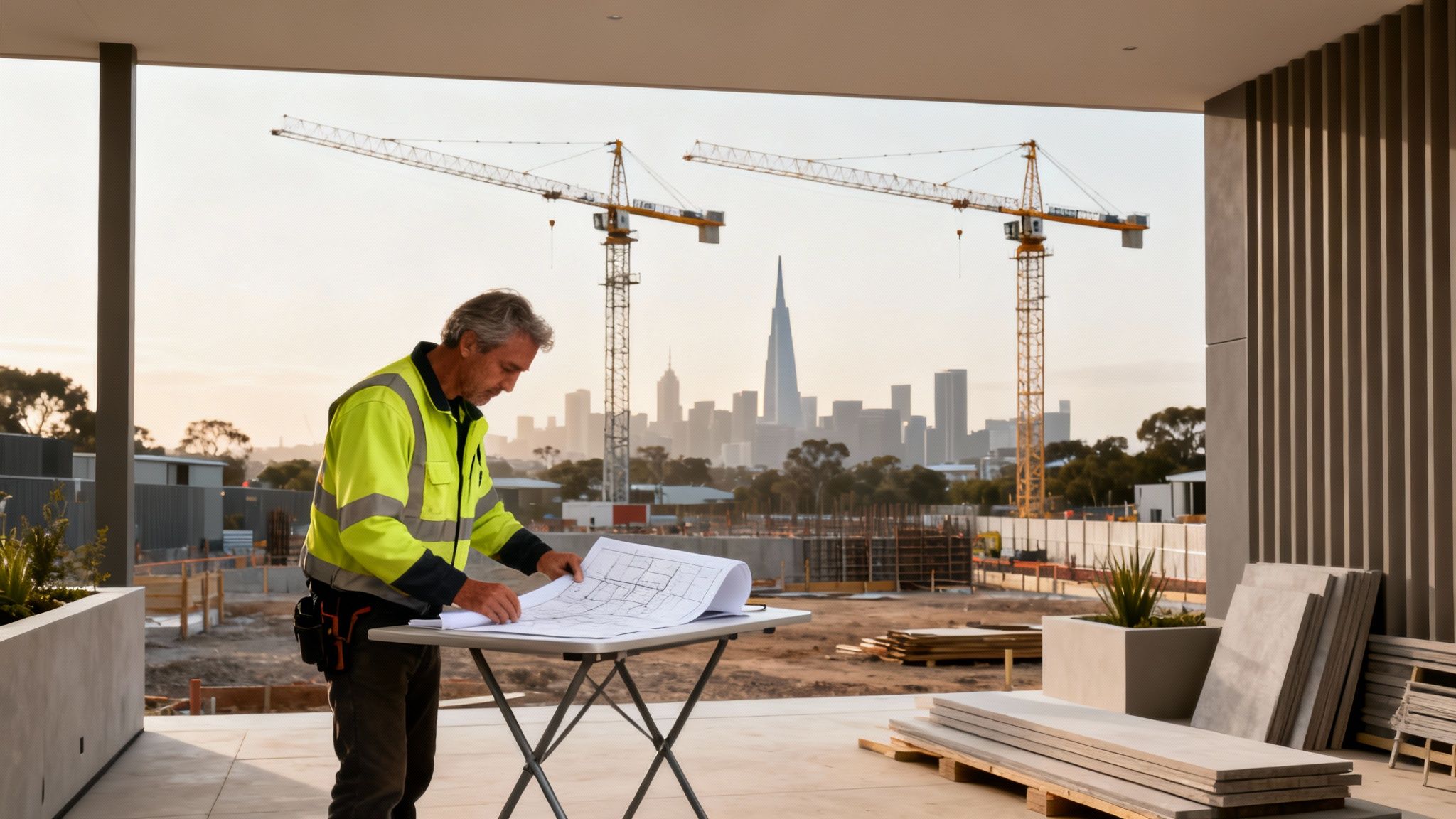
Embarking on a custom build in Melbourne throws you into a pretty unique environment. The market is caught in a constant tug-of-war: soaring demand for high-quality homes clashing with very real-world shortages of materials, skilled trades, and even land itself. This dynamic makes your choice of builder more critical than ever.
The Squeeze on Supply and Demand
The last few years have been a wild ride for Victoria’s construction industry. While there were around 63,700 dwellings under construction statewide, that figure actually dropped by 11% from the previous year, mostly because high-density apartment projects hit the brakes.
At the same time, Victoria’s population is booming, growing by over 183,000 people in just twelve months thanks to migration from overseas and interstate. This massive influx puts incredible pressure on our housing supply, creating a real crunch.
In this climate, efficiency and reliability aren’t just nice-to-haves; they’re essential. An experienced luxury builder is already geared up to handle these pressures. They know how to secure resources and schedule trades to keep your project moving forward without cutting corners on quality.
Your builder isn’t just constructing a house. They’re your project manager, supply chain expert, and chief problem-solver in a high-stakes environment. Their ability to navigate market pressures directly impacts your timeline, budget, and the final quality of your home.
Navigating the Local Landscape
Understanding this market context is the first crucial step. It’s why timelines can shift and why locking in a highly competent team is completely non-negotiable.
Here’s what this means for you:
- Government Initiatives: Ambitious government housing targets are designed to ease the supply shortage, but this can also put a strain on the industry, causing a rush on materials and labour that can sideswipe less organised projects.
- Quality Over Speed: The pressure to build fast can tempt some contractors to cut corners. A reputable custom builder will always put craftsmanship first, ensuring your investment is built to last.
- The Power of Experience: Seasoned builders in Victoria have spent years building relationships with the best subcontractors and suppliers. In a competitive market, that network is a massive advantage.
Being armed with this knowledge helps you ask the right questions and set realistic expectations from the get-go. If you're looking for a curated list of professionals who are masters of this environment, our guide on the top 20 builders in Melbourne is a great place to start.
Ultimately, choosing a partner who truly gets the intricacies of the local scene is your best strategy for bringing a sophisticated vision to life.
Turning Your Vision Into a Clear Builder's Brief
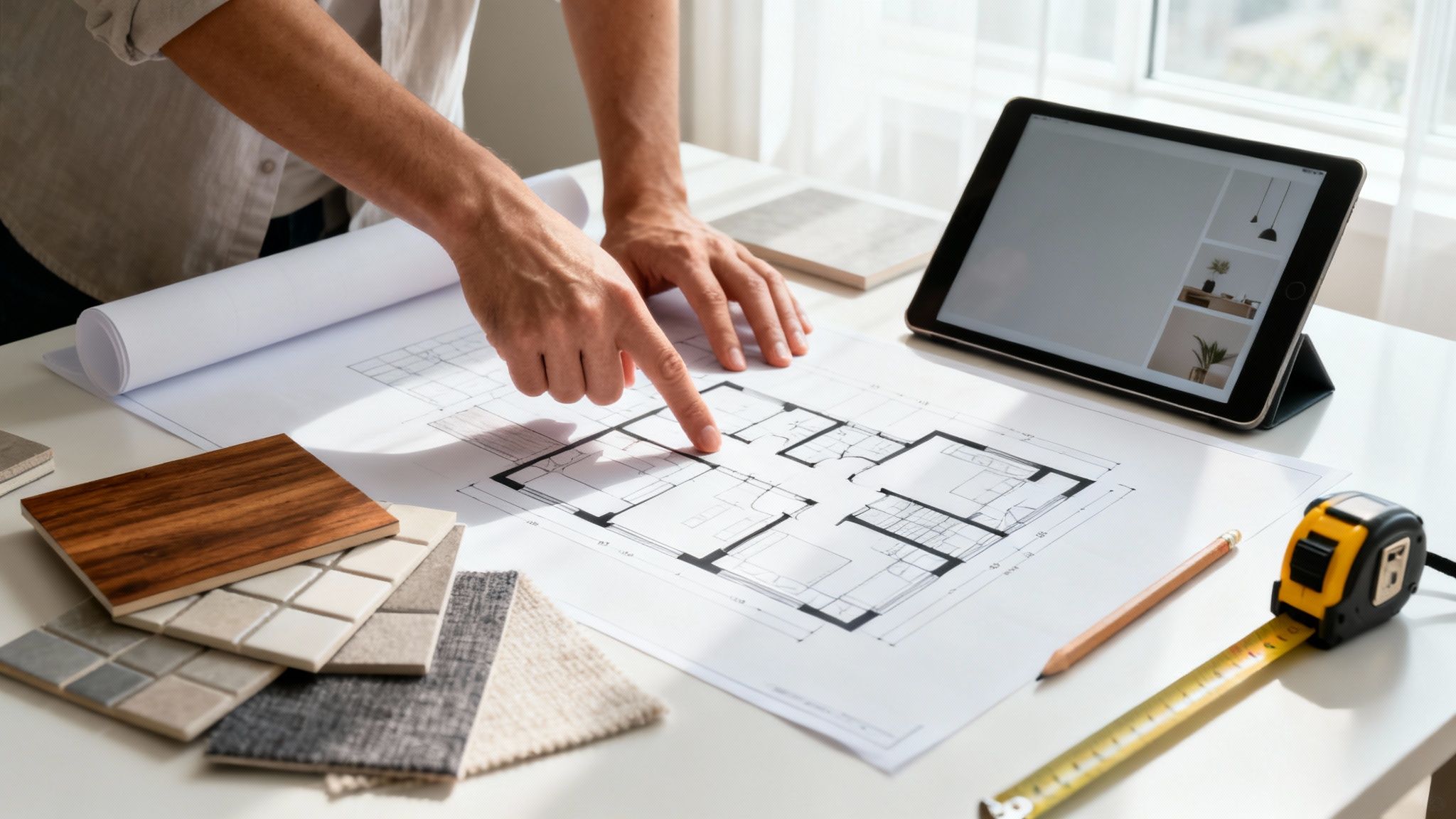
Before you even think about shortlisting the best builders in victoria melbourne, the most important work starts right at your own kitchen table. A detailed, well-considered project brief is the absolute foundation of your entire build. It’s the compass that guides every single decision, from the first architectural sketch to the final coat of paint, ensuring you and your builder are always on the same page.
Skip this step, and you're opening the door to miscommunication, budget blowouts, and a finished home that doesn't quite live up to the dream in your head. A great brief is all about translating your lifestyle and aspirations into a practical, actionable plan a professional can understand and bring to life.
Defining Your Project Scope
First things first, what kind of project are we talking about? Each path has its own set of challenges and opportunities, influencing your budget, timeline, and the specific expertise you'll need from a builder.
- Custom New Build: This is the ultimate blank slate. You have total creative freedom, from how the home sits on the block to the exact finish on the tapware. This journey requires a builder with serious experience managing complex, ground-up projects.
- Major Extension: You love where you live but have simply outgrown the space. A successful extension feels like it was always there, seamlessly blending with the original home's character while adding all the modern functionality you need. This is a job for a builder who is a master at harmonising old and new.
- High-End Renovation: This is about completely reimagining your home's interior. You might be reconfiguring the entire floor plan, upgrading every finish, and meticulously restoring beautiful period features. Here, you need a builder with an obsessive eye for detail and a deep respect for the home's existing style.
Nailing down which category you fall into is a critical first step. If you’re leaning towards creating something brand new from scratch, spending some time exploring a gallery of custom new home design projects can be a fantastic source of inspiration to help flesh out your brief.
Crafting a Detailed Wish List
Once the big picture is clear, it's time to dive into the details. Go beyond the simple "3 bedrooms, 2 bathrooms" and think about how you actually want to live in your new space day-to-day.
A few prompts to get you started:
- Your Lifestyle: Do you work from home? Love to entertain big crowds? Need a dedicated zone for a home gym or a messy hobby? Your daily habits should be the driving force behind the floor plan.
- Architectural Style: Are you drawn to the sharp, clean lines of modern design, the relaxed elegance of a Hamptons-style home, or the intricate charm of a restored Victorian terrace? Start a mood board with images that capture the feeling you're after.
- Must-Haves vs. Nice-to-Haves: This is a classic for a reason. Make two lists. 'Must-haves' are your non-negotiables—things like a butler's pantry or a covered alfresco area. 'Nice-to-haves' are the dream features you'd love if the budget stretches, like a wine cellar or a dedicated home cinema.
A strong brief is less a rigid set of instructions and more a detailed story about your family's future. It communicates the feeling you want to create, not just the features you want to include. This emotional context helps a great builder make intuitive design and construction suggestions.
Future-Proofing Your Vision
A home is one of the biggest investments you'll ever make, so your brief needs to look beyond just the here and now. Building for the future means creating a home that’s adaptable, efficient, and holds its value for decades.
Try to weave these forward-thinking ideas into your plan:
- Sustainability: Think about passive solar design to harness natural light and warmth, high-performance insulation, double-glazed windows, and maybe even a rainwater harvesting system. These aren't just good for the planet; they significantly cut down your running costs over time.
- Smart Technology: Plan ahead for integrated systems like automated lighting, climate control, and security. Even if you don't install a full system right away, getting the pre-wiring done during the build makes future upgrades a breeze.
- Accessibility: Consider incorporating elements of universal design. Things like wider doorways, a ground-floor main bedroom suite, and a step-free entry make a home comfortable and functional for every stage of life, for everyone.
By putting in this time and effort upfront, you empower yourself completely. You'll walk into your first meeting with a builder not with a vague idea, but with a clear, confident vision for the incredible home you're about to create.
Mastering Your Budget and Melbourne's Regulations
Any successful luxury build stands on two unshakeable pillars: a realistic budget and a solid grasp of local building rules. Getting these right before a single shovel hits the dirt is absolutely non-negotiable. It’s what separates a smooth, predictable project from one that gets bogged down in surprise costs and frustrating delays.
The financial side of things is about so much more than just the build cost. A truly comprehensive budget for a Melbourne project has to account for every single line item, from the first architectural sketches right through to the final landscaping touches.
Establishing a Realistic Financial Plan
Your total project cost is a sum of several key parts. The construction itself is the biggest piece of the puzzle, but it's far from the only one.
Here’s a quick breakdown of what your budget needs to cover:
- Construction Costs: This is the core expense for labour and materials paid to your builder.
- Professional Fees: Think architect, draftsperson, structural engineer, and soil testing fees.
- Permits and Council Fees: These are the mandatory costs for securing building permits and other local approvals.
- Contingency Fund: You absolutely must set aside 10-15% of your total construction cost. This is your safety net for the unknowns, like hitting rock during excavation or deciding on a design change mid-build.
Melbourne's Luxury Build Cost Benchmarks
So, what does a luxury build actually cost in Melbourne? The answer varies significantly depending on where you are. Factors like land accessibility, specific council requirements, and the sheer complexity of your design all play a part. Of course, luxury builds demand high-end materials and superior craftsmanship, and that’s reflected in the price per square metre.
To give you a realistic starting point, we've put together a table with some general estimates for high-end residential projects across key Melbourne areas.
Estimated Luxury Build Costs Per Square Metre in Melbourne
A comparative guide to average high-end residential construction costs across different Melbourne regions, helping you establish a preliminary budget. Note: These are estimates and can vary based on finishes and site complexity.
Melbourne Region | Average Cost (per m²) | Influencing Factors |
Inner Bayside (e.g., Brighton) | $4,500 - $7,000+ | Coastal building regulations, high-end finishes, and basement construction. |
Stonnington (e.g., Toorak) | $5,000 - $8,500+ | Large-scale luxury homes, complex architectural designs, heritage overlays. |
Inner East (e.g., Hawthorn) | $4,000 - $6,500+ | Site access challenges on smaller blocks, heritage considerations, and premium materials. |
Boroondara (e.g., Kew) | $4,200 - $7,000+ | Varied block sizes, significant earthworks, and demand for bespoke features. |
Remember, these figures are a guide. The final cost will always come down to your specific choices for finishes, fittings, and fixtures. An experienced builder can provide a detailed, itemised quote based on your final plans.
Navigating Victoria's Building Regulations
Melbourne’s regulatory landscape can feel like a maze, with rules set by both local councils and the statewide Victorian Building Authority (VBA). This is where an expert builder becomes your guide, making sure every part of your project is fully compliant.
The industry is constantly pushing to meet housing needs. In the year leading up to the March quarter, over 59,800 new homes were completed in Victoria—a 5.9% increase. Yet, this still falls short of government targets, putting pressure on builders to deliver while navigating an increasingly complex rulebook.
Navigating local regulations isn't just about ticking boxes; it's about strategic planning. A builder who anticipates permit challenges, understands heritage overlays, and has strong relationships with council planners can save you months of delays and thousands of dollars in holding costs.
One of the most common hurdles, particularly in established suburbs, is the heritage overlay. If your property is covered by one, any new build or renovation must respect the area's historical character. This calls for a builder with specific experience in blending modern construction with heritage-sensitive design—someone who can manage the process seamlessly, from the initial design submissions to the final council sign-off.
For a more detailed look, you can check out our guide on understanding home building regulations. Ultimately, partnering with knowledgeable builders in victoria melbourne ensures your project is not only beautifully designed but also financially sound and legally compliant from day one.
A Practical Guide to Vetting Melbourne Builders
Choosing your builder is, without a doubt, the single most important decision you'll make for your entire project. It's the moment your vision, budget, and timeline all hinge on one crucial partnership. A thorough, methodical vetting process is your best insurance policy against costly mistakes and ensures you team up with one of the truly professional builders in Victoria Melbourne who can actually deliver on their promises.
This isn’t about a quick gut check. Think of it as a deep dive into a company’s credentials, their real-world craftsmanship, and how they run their business day-to-day. Getting this right sets the foundation for a smooth, successful build.
First Things First: Verifying Credentials and Insurance
This is the non-negotiable first step. In Victoria, any builder taking on domestic work valued over $10,000 must be registered with the Building & Plumbing Commission (BPC). You can—and absolutely should—check this in seconds on the BPC's public register.
Beyond registration, insurance is your critical safety net. Your builder must have two key policies in place:
- Public Liability Insurance: This covers injury or property damage to others. Always ask for a current certificate and make sure it’s valid for the entire planned duration of your project.
- Domestic Building Insurance (DBI): This is mandatory for any project over $16,000. It’s your protection if your builder dies, disappears, or goes insolvent. A builder is legally required to give you a policy specific to your project before you pay a cent of the deposit.
If a builder is cagey or hesitant about providing these documents, walk away. It’s a massive red flag.
Assessing Build Quality and Craftsmanship
A glossy brochure and a slick website are one thing, but seeing the work up close tells the real story. Any good builder will be proud to show you their finished projects and might even connect you with past clients.
When you get the chance to tour a home, look past the beautiful furniture and styling. Focus on the little details that scream quality craftsmanship:
- Joinery and Finishes: Are the cabinet doors and drawers perfectly aligned? Is the paint finish smooth and even, especially around tricky spots like skirting boards and cornices?
- Tiling and Grouting: Look for crisp, uniform grout lines and precisely cut tiles. Messy, uneven lines often point to a rushed job.
- Structural Details: Check for straight lines in walls and ceilings. Look closely at how different materials meet—like where timber flooring transitions to tiles. The connection should be seamless.
Here's a pro tip: Ask to see a project that’s currently under construction. A clean, organised, and safe building site says a lot about a builder's project management style and their respect for the job, the site, and their team.
How Do They Manage and Communicate?
The way a builder manages their projects and communicates with clients is just as vital as the quality of their brick-and-mortar work. In your first few meetings, you're not just chatting—you're interviewing them for the most important role on your project team.
You need to get a feel for their entire process. Ask them directly about their communication rhythm, how they handle unexpected issues, and what software or tools they use to keep clients in the loop on progress and financials. A transparent builder will have a clear, documented system for everything, from progress payments to handling variations. For a more detailed list of questions, you might find our guide on how to select a builder really helpful.
Builder Evaluation Checklist
To keep things organised, use this checklist as a framework when you start comparing builders in Melbourne. It’ll make sure you don’t miss any critical details.
Evaluation Criteria | What to Check | Why It Matters |
Licensing & Insurance | BPC Registration, Public Liability, Domestic Building Insurance (DBI). | Ensures they're legally compliant and your investment is protected from the unexpected. |
Experience & Portfolio | Years in business, similar projects completed, client testimonials. | Demonstrates they have the specific skills to handle the scale and style of your project. |
On-Site Inspection | Quality of finishes, structural integrity, organisation of a current site. | Gives you tangible proof of their craftsmanship beyond what you see in marketing photos. |
Communication Style | Responsiveness, clarity, use of project management tools, reference checks. | A solid communication process is the key to a transparent, low-stress building experience. |
Warranties & Support | Details of structural and non-structural warranties, post-handover process. | Clarifies their long-term commitment to quality and how they handle any post-build issues. |
Ultimately, this process isn’t just about choosing a builder; it’s about selecting a partner. You’re looking for a professional who not only has the technical skills but also the integrity and communication style that makes you feel confident and comfortable, setting the stage for a truly collaborative and successful project.
Getting Down to Brass Tacks: Interviewing Builders and Comparing Quotes
You’ve done the hard yards—the background checks, the portfolio reviews, the drive-bys. Now, you have a shortlist of a few top-tier builders, and it's time to move from paper to person. This is where you find out if there's real chemistry and if their approach truly aligns with your vision.
Think of this stage as peeling back the final layer. You’re looking beyond the polished website and glossy brochures to understand how they work. How do they manage their teams and trades? What’s their communication style like when things get tricky? Most importantly, how do they handle the inevitable curveballs that every custom build throws? The answers will tell you everything you need to know about their professionalism and character.
This diagram breaks down the essential steps to take before you even sit down for that first meeting.
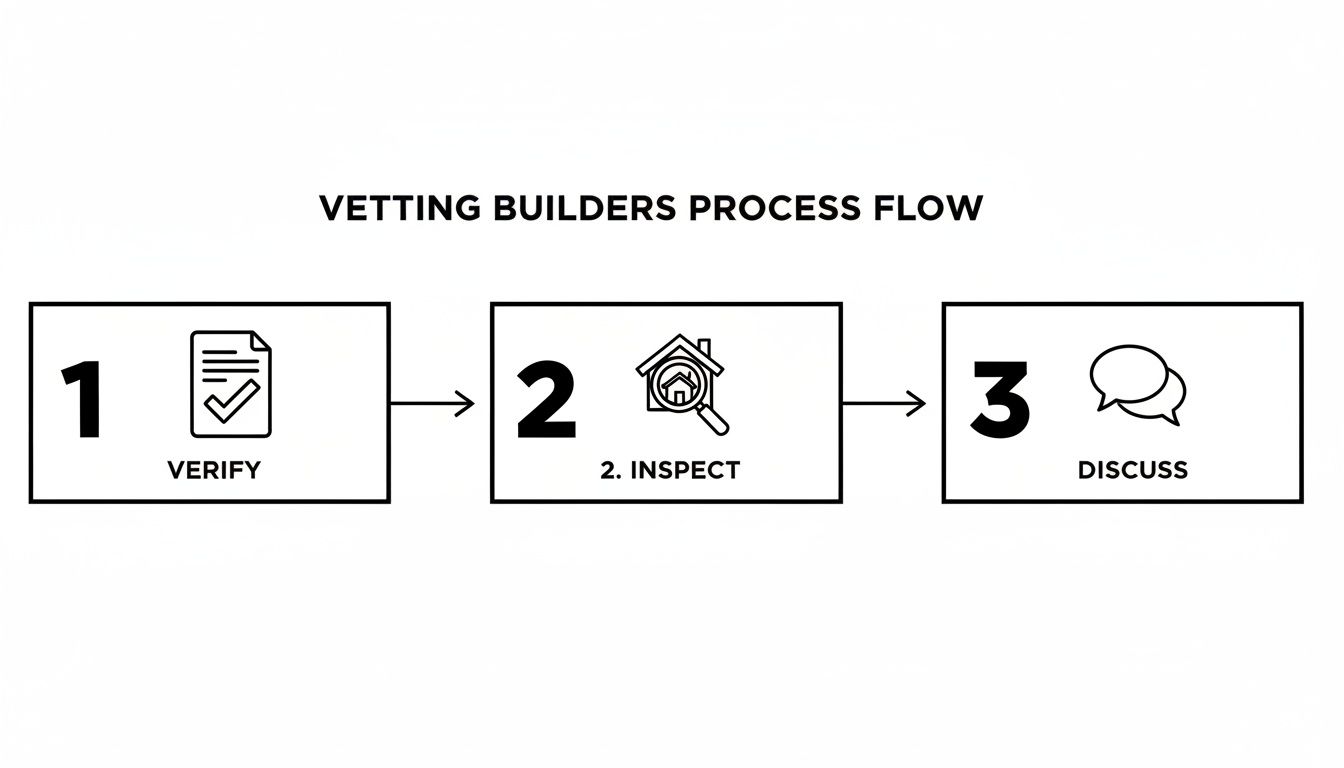
Following this process ensures you’re only dedicating your valuable time to builders who have already proven they meet your non-negotiables on credentials and quality.
Must-Ask Questions for Your Builder Interview
Remember, this meeting is a two-way street. Just as you’re sizing them up, a truly great builder will be doing the same with you, making sure your project is the right fit for their team and process.
Here are a few essential questions to get the conversation rolling:
- Team and Trades: "Who will be my day-to-day contact, and who’s the site supervisor I'll be seeing? How long have you been working with your main plumbers, electricians, and joiners?" A builder with long-term, loyal subcontractors is a huge green flag—it points to stability and consistent quality.
- Project Management: "What software or systems do you use to keep me in the loop on progress, financials, and decisions? How often will I hear from you?" Look for a structured, organised process. Chaos on the communication front often leads to chaos on-site.
- Handling Variations: "Walk me through your process when a change is needed. How do you price variations, and what’s the approval process look like?" Their answer here is a direct reflection of their commitment to transparency and cost control.
- Timeline and Scheduling: "What’s your current workload like, and where would our project realistically fit in? What are the biggest potential risks you see to our timeline right now?" This is a great test of their honesty and ability to plan ahead.
On the topic of timelines, it’s worth noting that builders in Victoria are currently delivering some of the fastest build times for new detached homes in a decade. The local average is now 39.12 weeks—a fair bit quicker than the national average of 45.96 weeks. This efficiency is largely driven by refined building methods and high market demand. You can always explore the latest building activity data from the ABS to get a clearer picture of the current industry climate.
How to Properly Read and Compare Quotes
Once the quotes arrive, the real detective work begins. It’s so tempting to just skip to the final number at the bottom, but I can tell you from experience that the cheapest quote is almost never the best value. To do this right, you need to forensically analyse what’s included—and, just as crucially, what’s been left out.
A quote isn't just a price; it’s a story about how well the builder has understood your project. A highly detailed, transparent quote shows they’ve listened and thought through every element. A vague, one-page summary is a massive red flag.
Pay very close attention to these two areas:
- Provisional Sums (PS): These are essentially educated guesses for costs that can’t be locked in yet, like extensive site works or specialised joinery. Some builders will intentionally use a low PS to make their total look more attractive, knowing you’ll have to cover the true cost later. If a provisional sum looks too good to be true, it probably is.
- Prime Cost (PC) Items: This is an allowance for specific fixtures and fittings you’ll select down the track, like your taps, tiles, or kitchen appliances. Make sure the PC allowances are realistic for the high-end finish you’re after. A $50 allowance for a tap in a luxury home tells you the builder’s budget isn't aligned with your actual vision.
Your job is to get all quotes speaking the same language. I always recommend creating a simple spreadsheet to compare them line by line. If one builder has included demolition and landscaping but another hasn’t, you need to account for those costs to get an accurate, apples-to-apples comparison. This meticulous approach is your best defence against budget blowouts and ensures you’re choosing a partner based on true value, not just a seductive price tag.
Common Questions When Choosing a Melbourne Builder
Going through the process of choosing a builder brings up a lot of questions. It’s totally normal. In a competitive market like Melbourne's, you need to feel confident in every single decision you make. Let's tackle some of the most common queries we hear from our clients.
What's the Real Difference Between a Custom and a Volume Builder?
This is a big one. A volume builder essentially works from a catalogue of pre-designed plans. They offer some customisation, but their model is all about scale and efficiency—building many homes quickly and at a lower price point.
A custom home builder is in a completely different league. They are the partner you need for a truly bespoke or luxury project. We work hand-in-glove with you and your architect to create a one-of-a-kind home from the ground up. This approach gives you total freedom over the design, the materials, and every last finish, making sure the home you walk into is a true reflection of your vision.
How Important Is Domestic Building Insurance in Victoria?
It’s not just important; it's legally mandatory and completely non-negotiable for any domestic building work valued over $16,000 in Victoria. Think of Domestic Building Insurance (DBI) as your ultimate financial safety net.
This insurance is crucial. It protects you if your builder dies, disappears, or becomes insolvent before finishing your home or fixing any defects. You must get a certificate of currency for DBI that is specific to your project before you hand over a deposit. Never, ever proceed with a builder who can't provide this.
If a builder hesitates to provide proof of DBI, it's not a small administrative issue. It’s a massive red flag signalling that your project and your financial investment are at risk. Professional builders in Victoria Melbourne will have this sorted as a standard part of their onboarding process.
What Are the Biggest Red Flags to Watch for When Hiring a Builder?
Always trust your gut, but also keep an eye out for specific warning signs that can predict a world of headaches down the track.
Be on the lookout for these red flags:
- High-Pressure Tactics: A builder pushing you to sign a contract on the spot, without giving you proper time to review it.
- Suspiciously Low Quotes: A price that's miles cheaper than others often means something critical has been left out, or they plan to cut corners.
- Demanding a Huge Deposit: The legal limit for a deposit in Victoria is 5% for contracts over $20,000. Anyone asking for more is breaking the law.
- Vague Communication: They can't give you clear answers, won't provide recent client references, or are evasive about showing their VBA registration and insurance.
These early indicators are often a preview of how the entire project will be managed. Pay attention to them.
I've Chosen My Builder. What's Next?
Fantastic. Once you've made your decision, the next vital step is to get a solicitor who specialises in construction law to review the contract. Make sure every single detail you've discussed—from the working drawings and specifications to the inclusions list and payment schedule—is clearly documented.
After signing and receiving your project-specific DBI certificate, the project can move into the final approvals stage before construction finally begins. From this point on, a clear and consistent communication plan is the absolute key to a smooth and successful build.
Ready to partner with a builder who combines innovative design with transparent, expert project management? Envy Abode specialises in crafting bespoke luxury homes, seamless extensions, and transformative renovations across Melbourne. Let's start the conversation about bringing your vision to life.
Explore our services and see how we can help at https://envyabode.com.au.