Malvern EastProject Repton , 2025
“The key thing we were looking for was the consistency in the pricing that we received, having the right team to be able to problem solve when an issue arose, they did it in a very calm and measured manner. They're a great team and we worked so well together, had we done the design with Envy it would have saved us 6 months minimum”
Cost Plus Contracts A Builder's Guide

When you're embarking on a high-end custom build, the contract you sign with your builder is one of the most critical documents in the entire process. It sets the tone for your relationship, defines how costs are handled, and ultimately shapes the final outcome. One model that’s perfectly suited for bespoke projects is the cost plus contract.
So, what exactly is it? Put simply, a cost plus contract is an agreement where you pay the builder for the actual cost of the project—every piece of timber, every hour of labour—plus an agreed-upon fee that covers their overhead and profit. It’s an open-book approach, a world away from the traditional fixed-price model where everything is bundled into one single, upfront number.
What Are Cost Plus Contracts in Home Building?
Think of it like commissioning a piece of bespoke art. You’d expect to cover the artist’s canvas, paints, and studio time. On top of that, you’d pay a fee for their unique skill and creative vision. A cost plus contract works on the very same principle, but for your home.
This model changes the whole game. Instead of a client-versus-builder dynamic, it fosters a genuine partnership built on trust. You get to see every invoice and timesheet, which means the builder isn't incentivised to find cheaper materials or cut corners to protect their profit margin. The focus shifts entirely to achieving the highest quality result for your home.
The Rise of Cost Plus in Australia
While fixed-price contracts have long been the default choice, the ground has shifted significantly in recent years. In Australia, cost plus agreements saw a massive surge in popularity following the economic rollercoaster of the pandemic and the resulting chaos in global supply chains.
Historically, over 90-95% of residential builds were locked into fixed-price models. But as material costs skyrocketed and labour became scarce, trying to accurately price a project 12 or 18 months in advance became a huge gamble for builders. The flexibility of cost plus became the solution.
Key Differences From Fixed Price Contracts
The biggest difference comes down to one thing: risk. With a fixed-price contract, the builder absorbs all the risk of unexpected cost increases. To manage this, they build a hefty contingency—a financial buffer—into your quote to protect themselves from the unknown.
With a cost plus contract, more of that financial risk sits with you, the client. But in return, you gain some powerful advantages:
- Total Transparency: You see every receipt and invoice. You know you’re only paying for what’s actually being used on your project.
- Greater Flexibility: Want to upgrade those kitchen benchtops or change the bathroom tiles halfway through? No problem. Changes can be made easily without the drama of renegotiating the entire contract.
- A Focus on Quality: The builder is free to source the absolute best materials and tradespeople without being handcuffed by a rigid, pre-set budget.
For a quick overview of how these two models stack up, here’s a simple comparison.
Cost Plus vs Fixed Price Contracts at a Glance
This table breaks down the fundamental differences to help you see which approach might be the right fit for your project.
Feature | Cost Plus Contract | Fixed Price Contract |
Pricing Model | Actual costs + builder's fee | A single, all-inclusive price |
Transparency | High (open-book invoicing) | Low (costs are bundled) |
Flexibility | High (easy to make changes) | Low (changes require variations) |
Risk Allocation | Primarily with the client | Primarily with the builder |
Best For | Complex, custom, high-end projects | Simpler, well-defined projects |
Ultimately, the choice depends on your project's complexity and your comfort level with the financial structure.
A well-managed cost plus contract transforms the building process into a collaborative journey. It requires a high degree of trust and open communication, often facilitated by an experienced project manager who ensures costs are tracked meticulously and the project stays aligned with your vision.
This approach is tailor-made for high-end custom homes, complex renovations, or extensions where the full scope might not be crystal clear from day one. When everyone understands their roles, the partnership can thrive. To get a better handle on this, check out our guide on what a project manager in construction does to make it all work. The open-book nature of cost plus ensures every decision is a shared one, leading to a home that is a true reflection of your vision.
Exploring the Different Types of Cost Plus Agreements
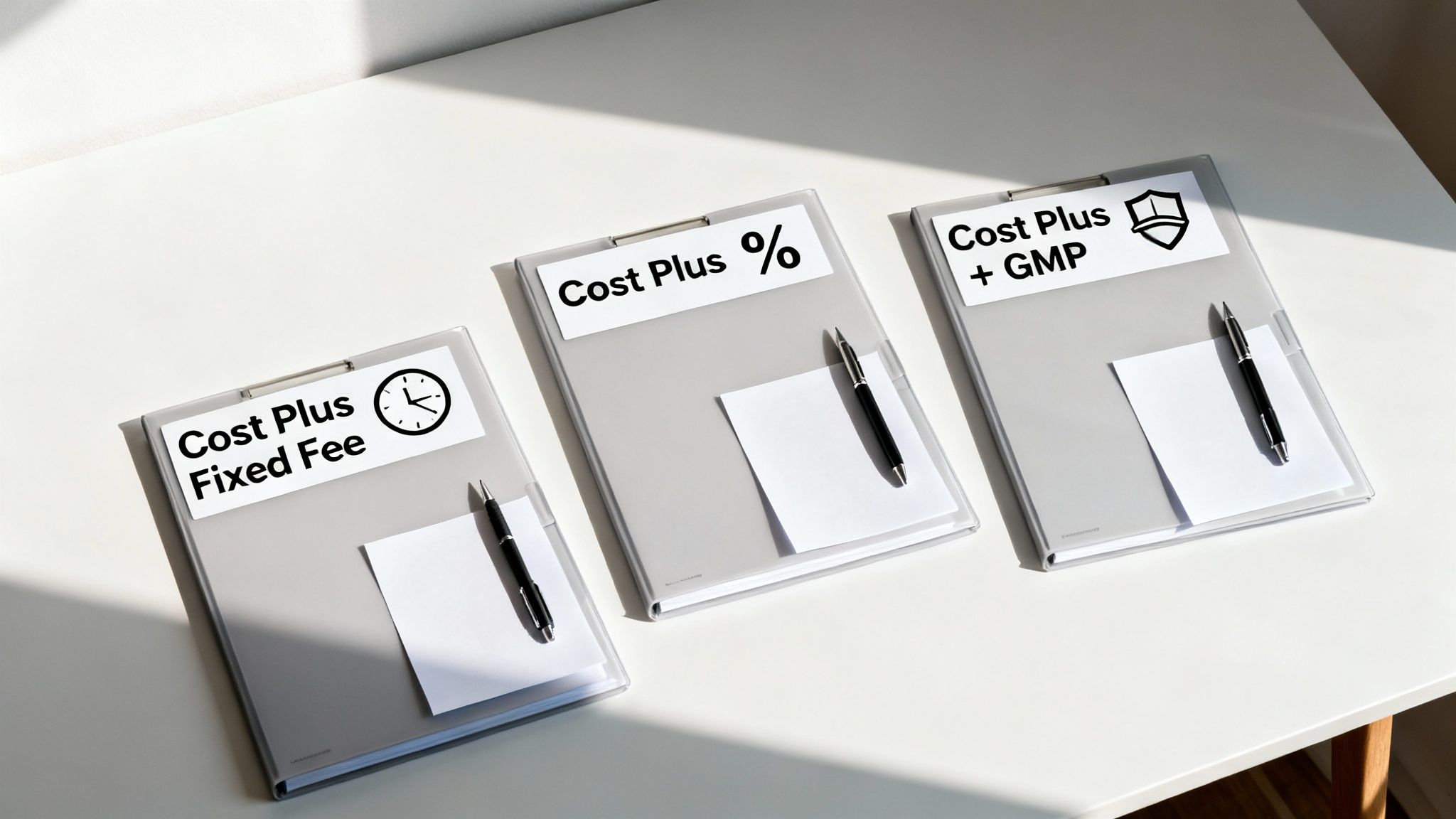
While the core idea of transparency is the same, not all cost plus agreements are cut from the same cloth. Think of it like choosing a mobile phone plan: they all let you make calls, but the way you pay for data and services can be vastly different. Each type of cost plus contract strikes a unique balance between risk, builder incentive, and your control over the budget.
Getting your head around these variations is key to picking the right one for your luxury build. The three main flavours you'll come across are Cost Plus Fixed Fee, Cost Plus Percentage, and Cost Plus with a Guaranteed Maximum Price (GMP). Let’s break down how each one works.
Cost Plus Fixed Fee (CPFF)
This is often seen as the gold standard for a client-friendly cost plus contract. With a Cost Plus Fixed Fee (CPFF) agreement, the builder’s profit is a single, pre-determined lump sum that you both agree on before a single sod is turned. You still cover the actual costs of materials and labour as they come, but the builder's fee is set in stone—it won’t budge, even if the project costs fluctuate.
This creates a powerful, positive dynamic. Because the builder's fee is locked in, their main driver is to finish the project efficiently and to an impeccable standard. There's simply no financial upside for them if project costs get out of hand, which aligns their goals perfectly with yours: to create a stunning home without wasteful spending.
Example Scenario: Imagine you're renovating a heritage home in Melbourne and the builder's fixed fee is agreed at $250,000. If your team uncovers unexpected structural issues that add $100,000 to the construction costs, the builder’s fee remains $250,000. Their focus is squarely on solving the problem, not profiting from it.
Cost Plus Percentage of Cost (CPPC)
The Cost Plus Percentage of Cost (CPPC) model is the most straightforward, but it also puts the most risk on your shoulders as the client. In this setup, the builder’s fee is simply a set percentage of the total project costs. So, if the fee is 25% and the total project cost comes to $2 million, their fee is $500,000.
The major drawback here is pretty obvious: the more the project costs, the more the builder earns. This creates a potential conflict of interest, as there's a built-in financial incentive for costs to creep up. This model really only works in situations of extremely high trust or for smaller, highly unpredictable projects where the final scope is a total unknown.
Cost Plus with a Guaranteed Maximum Price (GMP)
For clients who love the transparency of cost plus but need the budget certainty of a fixed-price contract, the hybrid Guaranteed Maximum Price (GMP) model is a brilliant solution. This agreement puts a firm ceiling on the total project cost. You pay the actual costs plus the builder's fee, but only up to the pre-agreed maximum price.
Any costs that blow past this cap are generally the builder's responsibility to cover. This structure gives you a clear budget limit, protecting you from major financial surprises.
What’s more, these contracts often include a "shared savings" clause. If the project comes in under the GMP, the savings are split between you and the builder based on a pre-agreed ratio (like 50/50 or 60/40). This gives the builder a real incentive to find smart, cost-effective solutions without ever compromising on quality. To get a better feel for how these pieces fit together, check out our insights on design and construction project management. This hybrid approach offers both a safety net and a powerful push for efficiency, making it a popular choice for large-scale luxury projects.
Weighing the Pros and Cons for Your Project
Deciding between a cost-plus contract and a fixed-price model is one of the most significant choices you’ll make for your luxury build. Each path comes with its own set of benefits and potential hurdles, and the right fit really comes down to your project’s complexity, how involved you want to be, and your comfort level with financial flexibility.
Let's break down the real-world advantages and potential drawbacks you need to have on your radar. By looking at both sides of the coin, you can make a truly informed decision that sets your project up for success from day one.
The Clear Advantages of Cost-Plus Contracts
For discerning clients building a one-of-a-kind home, the benefits of a cost-plus contract are genuinely compelling. The entire model is built on a foundation of collaboration, transparency, and a shared goal of achieving the absolute highest quality.
- Complete Financial Transparency: This is the heart and soul of the cost-plus model. You see every single invoice, receipt, and timesheet, so you know exactly where every dollar is going. There are no hidden markups or bundled costs, which builds an incredible amount of trust between you and your builder.
- Unmatched Flexibility: Let's be honest, luxury builds often evolve. A cost-plus agreement gives you the freedom to make changes or upgrade selections mid-stream without the headache of formal contract variations. If you fall in love with that imported Italian marble instead of the tiles you originally planned, the process is seamless.
- A Focus on Superior Quality: Because the builder’s fee is separate from the project costs, they have zero incentive to cut corners or swap in cheaper materials to protect their profit margin. Their main goal becomes delivering exceptional craftsmanship, allowing them to source the best trades and materials without being handcuffed by a rigid, pre-set budget.
- Potential for Cost Savings: A fixed-price contract always has a hefty contingency buffer built in to protect the builder from unknowns. In a cost-plus scenario, you only pay for what’s actually spent. If the project runs smoothly and there are no major surprises, the final cost could very well be lower than a comparable fixed-price quote. You can explore this dynamic further in our guide to the pros and cons of the design-build model.
Potential Drawbacks and How to Manage Them
While the benefits are huge, it’s just as important to be aware of the potential downsides. For most homeowners, the biggest worry is the lack of a guaranteed final price, which can feel a bit like flying without a map.
The ongoing financial pressures in the Australian construction industry really highlight why these contracts are becoming more common. Over the last year, construction material prices in Australia jumped by more than 10%, while a labour shortage of roughly 20% in key trades pushed wages up. This kind of volatility puts immense strain on builders locked into fixed-price models. Cost-plus contracts offer a practical way to protect builders from these market swings, though it does shift some of that risk over to you.
The success of a cost-plus contract hinges on trust and active participation. It is not a "set and forget" arrangement; it requires you to be an engaged partner in the financial oversight of your project.
Here are the main challenges to think about:
- Budget Uncertainty: The final project cost isn’t locked in from the start, which can be unsettling if you need absolute certainty. The best way to manage this is with detailed preliminary estimates, regular budget reviews, and even considering a structure with a Guaranteed Maximum Price (GMP).
- Requires More Client Involvement: The open-book approach means you or your representative needs to be actively involved in reviewing invoices and tracking where the money is going. This hands-on approach keeps everyone accountable but definitely demands more of your time and attention than a fixed-price project would.
When is a Cost Plus Contract the Right Choice?
A cost plus contract isn't the right fit for every project, but when the conditions are right, it’s an incredibly powerful and flexible tool. Think of it less as a rigid agreement and more as a collaborative partnership. It truly comes into its own on projects where creative freedom, exceptional quality, and adaptability are more important than a locked-in price from day one.
Choosing this open-book approach means weighing up your priorities. For some, the absolute budget certainty of a fixed-price contract is the bottom line. For others, the transparency and freedom to refine their vision along the way is priceless. Let’s look at the specific scenarios where a cost plus model really shines.
For a Vision That’s Still Taking Shape
If you see your architectural plans as a beautiful starting point rather than a strict set of instructions, then a cost plus contract is perfect for you. High-end custom homes are rarely static; they grow and evolve during the build as inspiration strikes or new possibilities reveal themselves. You might decide halfway through that you want to add a wine cellar, reorient the living room to capture the afternoon sun, or integrate a more advanced smart home system.
With a cost plus model, making these kinds of changes is straightforward. There’s no need to grind the project to a halt for complex and costly contract renegotiations. You and your builder can simply pivot, document the new costs transparently, and keep the momentum going. This agility ensures your finished home is a perfect reflection of your final vision, not just the one you had on paper months ago.
A cost plus contract gives you the creative control to make decisions as the build unfolds. It turns the process from a rigid checklist into an organic journey where the best ideas can be brought to life.
For Complex Renovations and Heritage Restorations
Some projects are just full of surprises—and nowhere is this truer than in large-scale renovations or delicate heritage restorations. The moment you start opening up walls in an older home, you’re stepping into the unknown. You might uncover hidden structural problems, ancient wiring that needs a complete overhaul, or beautiful period details you’ll want to painstakingly restore.
Trying to account for every single one of these "what ifs" in a fixed-price contract is a fool's errand. A builder would have to load the quote with huge financial buffers to cover their risk, and you'd end up paying for them whether the problems arise or not.
This is where a cost plus contract makes perfect sense. It creates a framework for you and your builder to tackle challenges together, transparently, as they appear. You only pay for the work that actually needs to be done, which is a much fairer and more practical way to handle projects where the unexpected is almost a certainty.
Is a Cost Plus Contract Right for You?
Still on the fence? This simple checklist should help you see if this model fits your project and your personality.
- Quality is Your Top Priority: You want the very best materials and finishes, and you don’t want your builder feeling pressured to cut corners to protect their profit margin.
- You Want to Be Involved: The idea of seeing every invoice and being a true partner in the financial decisions of your build appeals to you.
- Your Project is Complex or Unpredictable: You’re building a large custom home, a technically ambitious extension, or renovating a property with lots of unknowns.
- You Trust Your Builder Implicitly: This is the absolute cornerstone. A successful cost plus project hinges on open communication and a shared goal of creating something exceptional.
If you found yourself nodding along to these points, a cost plus contract might just be the perfect foundation for building your dream home.
Essential Clauses and Contract Red Flags
When it comes to a cost plus contract, the real devil is in the details. It’s less about the big numbers and more about the clarity of the agreement itself. Think of your contract as the blueprint for your partnership with your builder—it defines every rule of engagement. A well-written one fosters trust and protects everyone involved, paving the way for a smooth project from start to finish.
It’s like setting house rules before a guest moves in for a long stay. By agreeing on everything upfront, you sidestep those awkward misunderstandings and potential disputes down the track. This section is your field guide to the non-negotiable clauses your contract needs and the subtle red flags that should make you pause.
Must-Have Clauses for Your Protection
A solid cost plus contract leaves no room for guesswork. It should be a detailed, transparent document that clearly spells out every part of the financial relationship. Vague language is the enemy here, so make sure these critical clauses are front and centre.
- A Crystal-Clear Definition of ‘Cost’: This is the absolute cornerstone of the whole agreement. The contract must explicitly state what counts as a reimbursable project cost—think materials, subcontractor labour, permits, and equipment hire. Just as importantly, it needs to specify what’s excluded, like the builder's own head office overheads.
- Detailed Fee Structure: Whether it’s a fixed fee or a percentage, the contract has to break down exactly how your builder’s fee is calculated and when it gets billed. There should be zero grey areas about what that fee covers.
- Expense Approval Process: Your contract should map out the process for submitting and approving every expense. This means stipulating the required paperwork (invoices, receipts, timesheets) and the timeline for you to review and sign off before any payment is made.
A "right to audit" clause isn't just a nice-to-have; it's non-negotiable in a cost plus contract. This gives you or your representative the legal right to inspect the builder's financial records for your project, providing the ultimate layer of transparency and accountability.
Spotting Potential Red Flags
Knowing what should be in your contract is one thing; knowing what to watch out for is just as crucial. A few seemingly minor omissions or vaguely worded clauses can easily lead to budget blowouts and serious disputes. Having your solicitor review the contract is essential, but you are always the first line of defence.
This decision tree infographic can help you visualise if a cost plus contract is the right path for your project.
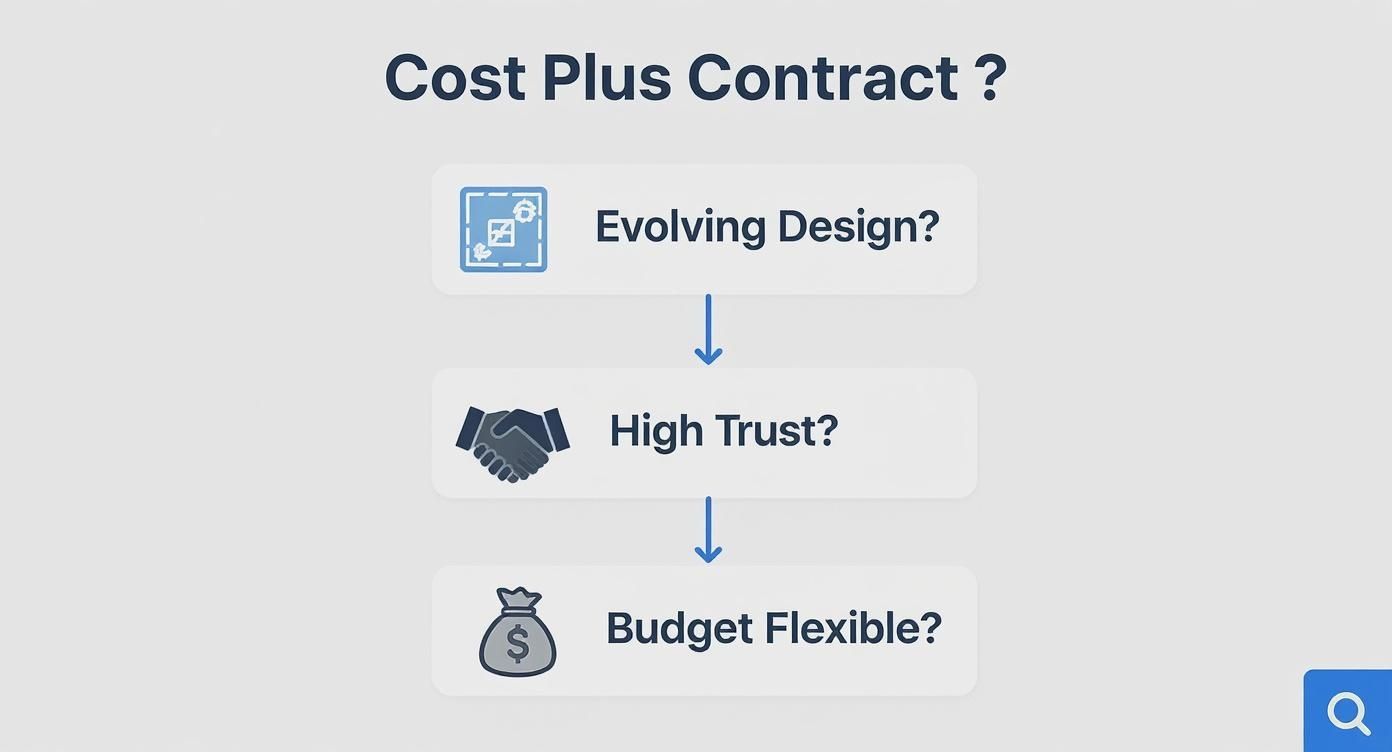
As the visual shows, this contract type really shines when your design is still evolving, the trust between you and your builder is high, and your budget has a bit of breathing room.
Essential Clauses Checklist for Your Cost Plus Contract
To help you feel confident before you sign, we've put together a checklist of the most important clauses. Use this table as a quick reference to ensure your contract is comprehensive and genuinely protects your interests.
Clause | Purpose | What to Look For |
Definition of 'Cost' | To prevent ambiguity about what you're paying for. | An exhaustive list of what is included (materials, labour, permits) and explicitly excluded (builder’s office overheads, marketing). |
Fee Calculation | To clearly outline the builder's profit. | The exact percentage or fixed fee amount and a clear explanation of how it's calculated (e.g., on actual costs, before or after GST). |
Payment Schedule | To manage cash flow and link payments to progress. | A clear schedule for progress payments, invoicing procedures, and required documentation (receipts, timesheets). |
Right to Audit | To ensure total financial transparency. | A clause giving you or a designated professional the right to inspect all project-related financial records. |
Change Order Process | To formally manage scope changes and their cost impact. | A defined procedure for documenting, pricing, and approving any changes to the original plan. |
Dispute Resolution | To provide a roadmap for resolving disagreements. | A multi-step process, starting with mediation, to avoid costly legal action if issues arise. |
Subcontractor Management | To clarify who is responsible for hiring and paying trades. | Language that confirms the builder manages and pays all subcontractors, with costs passed on to you transparently. |
This checklist isn't exhaustive, but it covers the core elements that create a fair and balanced agreement, setting your project up for success.
Common Contractual Pitfalls
Keep an eye out for these warning signs. They often point to a contract that’s skewed in the builder’s favour or simply lacks the detail needed for a true open-book partnership.
- Vague Definitions of Reimbursable Costs: If the contract doesn’t clearly define "cost," it opens the door for the builder to bill you for things that should be covered by their own fee, such as general office admin or marketing.
- Lack of a Change Order Process: Even in a flexible contract like this, any significant change to the scope of work needs to be formally documented. No clear change order process can lead to chaos and arguments over what was actually approved.
- No Mention of Dispute Resolution: A well-drafted agreement always prepares for the worst-case scenario. It should outline the steps for resolving disagreements, like mediation, before things escalate into a costly legal fight.
Keeping all this paperwork in order is vital. You can learn more about the best practices in our guide to construction documentation management. By making sure your contract is clear and comprehensive, you empower yourself to sign on the dotted line with confidence, knowing your investment is protected.
Got Questions About Cost Plus Contracts?
It's completely normal to have a few questions when you're looking at a cost-plus contract. Getting these things cleared up from the very beginning is the key to building the trust we need for a brilliant partnership. Let's walk through some of the most common queries we hear from our clients.
How Do I Keep Control of the Budget?
Keeping the budget in check with a cost-plus contract is all about teamwork. It’s an active, collaborative process, not a "set and forget" one.
The best way to start is by working closely with us to create a detailed preliminary budget. This gives everyone a realistic baseline to work from. From there, we’ll schedule regular budget meetings—usually weekly or fortnightly—so you can see exactly how spending is tracking against our projections.
A smart move is to also require your approval for any single expense that goes over a certain amount. And for ultimate peace of mind? A Guaranteed Maximum Price (GMP) clause can be added, putting a firm cap on the total cost of the project.
Are Cost-Plus Contracts Just More Expensive?
Not always. It’s a common misconception. While a fixed-price contract feels safe, that price always includes a hefty contingency buffer built in by the builder to cover their risk of the unknown. You end up paying for that buffer whether things go wrong or not.
With a cost-plus contract, you only pay for the actual costs. If the project runs smoothly without any major curveballs, it can often come in for less than a comparable fixed-price quote. The trade-off, of course, is that the risk of cost overruns is higher if the scope isn't managed carefully.
What Kind of Paperwork Should I Expect to See?
You should expect—and demand—complete transparency. This means you’ll get copies of every single invoice from subcontractors, every receipt for materials from suppliers, and detailed timesheets for all labour. Your contract needs to spell out exactly how and when you'll receive all this financial reporting.
These days, great builders use project management software to give you a live, real-time window into all the project financials. It’s an open-book approach that makes the entire process clear and honest from day one.
This level of detail ensures you can see precisely where every dollar is going, which is the very heart of a well-managed cost-plus agreement.
At Envy Abode, we don't just build beautiful homes; we build relationships founded on transparency and trust. If you're dreaming of a luxury build, extension, or renovation, let's have a chat about how our collaborative approach can bring your vision to life. Explore our extensive design and build services to learn more.