Malvern EastProject Repton , 2025
“The key thing we were looking for was the consistency in the pricing that we received, having the right team to be able to problem solve when an issue arose, they did it in a very calm and measured manner. They're a great team and we worked so well together, had we done the design with Envy it would have saved us 6 months minimum”
Finding Home Builders in Melbourne VIC A Practical Guide

Building your dream home is a massive undertaking, but the real work starts long before anyone even thinks about picking up a shovel. This is the planning stage, and getting it right sets the foundation for the entire project, making sure the home you end up with is the one you actually envisioned.
Before You Even Speak to a Builder, Get Your Vision Clear
The single most valuable thing you can do before approaching any home builders in Melbourne VIC is to create a detailed project brief. This isn't just a rough floor plan. It’s the blueprint of your life—how you live, what you need, and what you can afford.
Nailing this down from the get-go saves you from expensive changes and headaches later on. It also means every conversation you have with a potential builder is sharp, focused, and productive.
Think Lifestyle, Not Just Layouts
A home should be a perfect fit for the people living in it. So, start by mapping out your daily routines, your weekend habits, and what you see for yourself in the future.
Do you work from home and need a genuinely quiet office, tucked away from the chaos of the main living areas? Is a massive, open-plan kitchen with a butler's pantry an absolute must-have for your love of entertaining?
Get specific and think about:
- Your Family's Rhythm: Do you need a separate zone for teenagers to escape to? A dedicated playroom for the little ones? Or perhaps accessible, single-level living for ageing parents?
- Passions and Hobbies: What about a home gym, a workshop for weekend projects, or proper storage for bikes and surfboards? Maybe even a soundproofed room for music?
- How You Entertain: Are you the type to host big, casual get-togethers that spill out into the garden, or do you prefer more intimate, formal dinner parties?
Let's Talk Real Numbers: Your Budget
A realistic budget is so much more than the construction quote. This is where so many first-time builders get tripped up, completely forgetting all the extra costs that are an unavoidable part of any build. To avoid nasty surprises, your financial plan needs to be comprehensive.
Your total project cost isn't just the build price. It needs to include council fees, service connections, landscaping, and window coverings, plus a contingency fund of at least 10-15% for the things that will inevitably pop up.
This all-in approach gives you a true picture of what you're committing to financially. It's also crucial to have a grasp on the current market. Right now, home builders in Melbourne, Victoria, are navigating a serious gap between housing demand and supply.
In the 12 months to March 2025, Victoria only completed 59,878 new dwellings, which falls short of what’s needed to keep up with population growth. You can read more about Victoria's recent dwelling completion trends to get a feel for the market pressures. Having a clear, all-inclusive budget doesn't just protect you—it positions you as a serious, prepared client that the best builders will want to work with.
How To Find and Shortlist Top Melbourne Builders
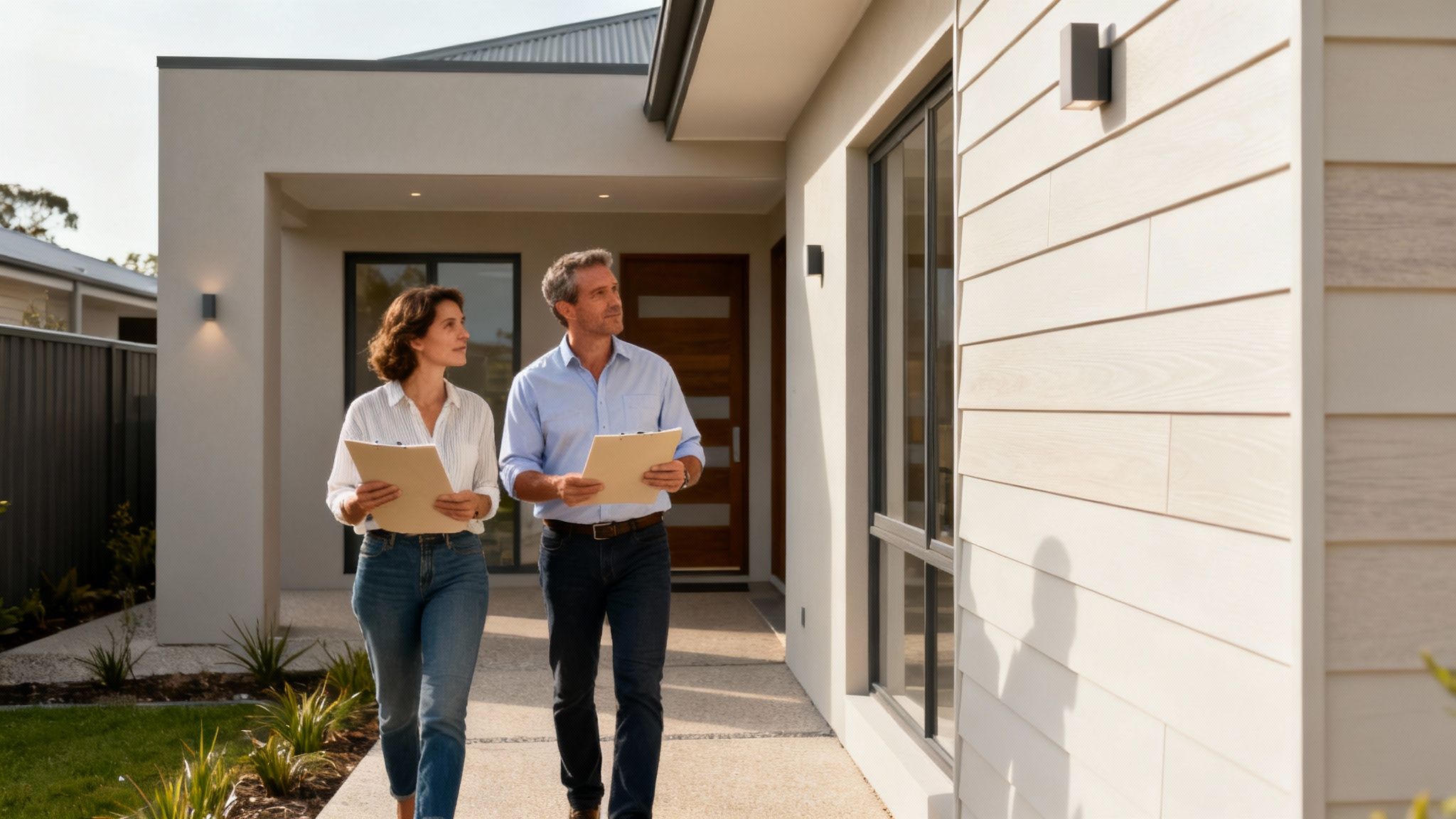
With a detailed brief in hand and your budget locked in, you’re ready to find the right team to bring your vision to life. The first step is to move beyond a simple Google search and tap into credible, industry-backed sources to create a long list of potential builders.
From there, the real work begins: learning to critically assess their work. You need to develop an eye for true craftsmanship and quality, looking past the professionally staged photos in a glossy portfolio.
Start Your Search with Credible Sources
Before you get lost in an endless scroll of search results, start with trusted industry bodies and genuine recommendations. This simple step helps weed out questionable operators from the get-go, so you know you’re only considering established professionals.
A great starting point is the Master Builders Victoria (MBAV). Their member directory is an excellent resource for finding registered and reputable home builders in Melbourne VIC. Don't underestimate the power of a good referral, either. Chat with friends, family, or colleagues who have recently built a home and ask about their experiences—the good, the bad, and the ugly.
Move Beyond the Portfolio to Assess Real Work
A builder’s online portfolio is a marketing tool, meticulously curated to show their best work in the best possible light. To get a true feel for their quality, you need to dig a little deeper.
Ask potential builders for addresses of recently completed projects you can drive by. This lets you see how their homes actually look in a real streetscape, free from professional photography and editing tricks. Even better, ask if they have any current projects you could safely visit. Seeing a build in progress is incredibly revealing.
Seeing a site in action speaks volumes. A clean, organised construction site is often a strong indicator of a builder's professionalism, attention to detail, and respect for both the project and the client.
Melbourne’s residential construction industry is a cornerstone of the state's economy, employing over 291,000 people and contributing 7.6% to Victoria’s Gross State Product. With a staggering 65,310 homes built across the state in 2021 alone, there's a huge pool of talent out there. You can get more context on the industry's economic impact in the 2022 Victorian election imperatives report from HIA. This activity means you have plenty of builders to choose from, which makes doing your homework even more critical.
Your Practical Checklist for Display Homes
Visiting a display home is your chance to physically inspect a builder's work up close. Go in with a plan and a critical eye, paying attention to the small details that reveal the real quality of their construction.
Use this checklist as your guide:
- Look at the Paint Job: Check for clean, crisp lines where walls meet ceilings and architraves. Are there any visible drips, uneven patches, or sloppy finishes?
- Inspect the Joinery: Open and close every drawer and cupboard. Do they run smoothly and align perfectly? Pay close attention to the gaps between cabinet doors—they should be consistent.
- Check Tiling and Grout Lines: Are the tiles laid perfectly flat? Are the grout lines consistent in width and colour, especially in tight corners and around fixtures?
- Test Doors and Windows: Open and close them all. Do they stick or feel stiff? Check that locks and handles feel solid and secure, not flimsy.
This hands-on inspection gives you tangible proof of a builder's standards. For a more detailed walkthrough, our guide offers more advice on how to select a builder you can trust and what to look for. Taking this thorough approach ensures the builder you ultimately choose can deliver the level of quality your vision demands.
Doing Your Due Diligence on Builder Credentials
It’s one thing to fall in love with a builder’s stunning portfolio, but it’s the behind-the-scenes homework that truly protects your investment. Verifying a builder's credentials isn't just a formality; it's a non-negotiable step to make sure they're legally compliant, properly insured, and actually qualified to bring your vision to life.
Before you even think about signing a contract, you absolutely must confirm your builder holds a current registration with the Victorian Building Authority (VBA). Think of this as your first line of defence against unqualified operators. A registered builder has already proven they have the right qualifications and experience to meet Victoria's strict standards.
You can—and should—check any builder's status yourself on the VBA website. It's a quick, simple search that gives you immediate peace of mind and confirms you’re dealing with a legitimate professional among the many home builders in Melbourne VIC.
Verifying Essential Insurances
Beyond their registration, any builder worth their salt must carry specific, non-negotiable insurance policies. These aren't just pieces of paper; they are your financial safety net, protecting you from worst-case scenarios that could otherwise derail your budget and your entire build.
There are two policies you need to see with your own eyes:
- Domestic Building Insurance (DBI): You might hear this called builder’s warranty insurance. It’s mandatory in Victoria for any domestic building project over $16,000. Its main job is to protect you if your builder dies, disappears, or becomes insolvent, covering the costs to finish the job or fix defective work.
- Public Liability Insurance: This is what covers claims for property damage or personal injury to a third party—think a neighbour, a visitor, or the council's footpath—that might happen because of the building work.
Our advice: Always ask for a copy of the builder’s Certificate of Currency for both their DBI and public liability policies. If a builder hesitates or refuses to provide them, that’s a massive red flag. Walk away. No exceptions.
Victoria’s building regulations have a long and complex history, with major reforms constantly being introduced to better protect homeowners. The system is designed to look after you, but it only works if you do your part and verify that your builder is fully compliant. After you've shortlisted a few contenders, you might find it helpful to look through our list of the top 20 builders in Melbourne to see how established firms operate.
Essential Builder Credential Checklist
To make this crucial step a little less daunting, we’ve put together a simple checklist. It’s a straightforward way to make sure you've covered all the bases before you make your final choice.
This table summarises the non-negotiable credentials you must verify for any potential home builder in Melbourne and tells you exactly where to look.
Credential to Verify | What It Means for You | Where to Check |
Builder Registration | Confirms the builder is legally qualified to perform domestic building work in Victoria. | Victorian Building Authority (VBA) website's public register. |
Domestic Building Insurance (DBI) | Provides a safety net if the builder cannot complete the job or fix defects due to insolvency, death, or disappearance. | Ask for the policy certificate; verify with the insurer. |
Public Liability Insurance | Protects you from financial liability if an accident on-site causes injury to a third party or damages neighbouring property. | Request the Certificate of Currency from the builder. |
Using this systematic approach helps you compare builders on a level playing field, empowering you to confidently weed out anyone who doesn't meet the standards required for building in Victoria.
Making Sense of Your Building Contract and Timeline
The building contract is more than just a piece of paper; it’s the legal backbone of your entire project. This document lays out everyone's rights and responsibilities and the precise scope of work. Before you put pen to paper with any home builders in Melbourne VIC, it's absolutely vital to know exactly what you're agreeing to.
Most reputable builders use standard Victorian contracts, like those from Master Builders Victoria (MBAV). While they’re designed to be fair, they can be full of dense legal jargon. Taking the time to read every single clause—or even better, having a solicitor look it over—is a smart move. Pay special attention to the progress payment schedule, as this dictates when and how much you’ll pay your builder as they hit specific construction milestones.
This timeline gives you a bird's-eye view of the key phases, from signing the dotted line to finally getting the keys to your new home.
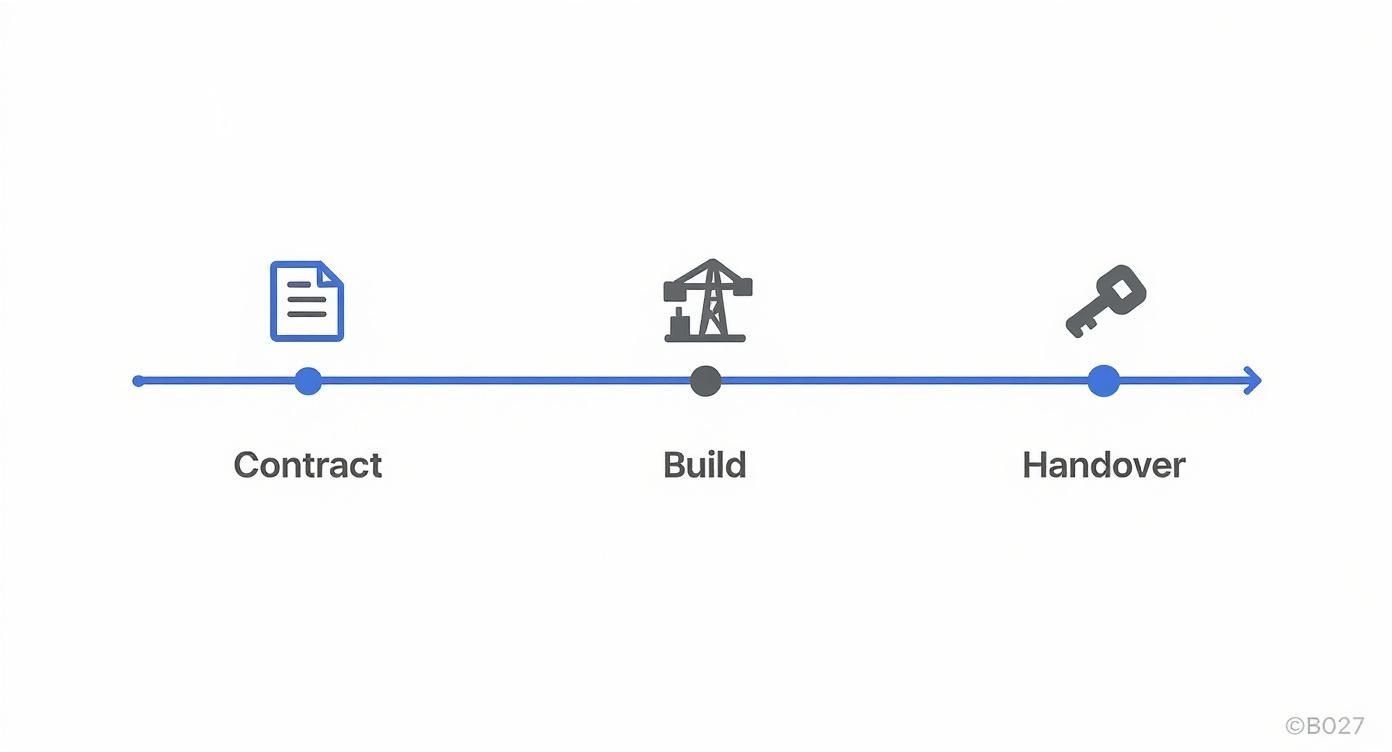
Understanding this flow helps you anticipate what’s coming next, manage your own expectations, and keep the lines of communication with your builder wide open.
Key Clauses to Keep an Eye On
Two terms that often trip people up are provisional sums and prime cost items. A provisional sum is basically an allowance for work where the final cost isn't set in stone yet, like excavation. A prime cost item is an allowance for a specific fixture you'll choose later, such as taps or kitchen appliances. You must clarify what these allowances cover and have a clear plan for what happens if the actual cost ends up being higher.
A well-defined contract is your best defence against disputes down the track. It needs to clearly outline the process for variations (changes to the plan), extensions of time, and how you’ll handle any disagreements that might crop up.
This level of detail is non-negotiable for a smooth build. Once the contract is signed and you have all your approvals in hand, the real fun can begin. Our guide on how to get a building permit can walk you through the crucial steps you need to take before any dirt is turned on site.
Navigating the Construction Timeline
Every builder will give you a projected timeline, but the reality is that construction is a dynamic process. Delays can and do happen. Some of the most common culprits include:
- Wild Weather: In Melbourne, you know the drill. Heavy rain or scorching heat can stop work in its tracks, especially during early stages like pouring the slab or putting up the frame.
- Material Hold-Ups: Supply chain issues can delay key components, from timber frames to the specific tiles you fell in love with.
- Trade Shortages: Sometimes, the schedule depends on the availability of a specific tiler or electrician, and if they're in high demand, it can create a bottleneck.
- Council Inspections: The build has to be inspected and signed off at several mandatory stages, and just scheduling these can sometimes cause minor delays.
Luckily, there’s some good news on the horizon for Victorian homeowners. In the 2024-25 period, the average build time for a detached house in Victoria dropped to 39.12 weeks—a noticeable improvement and much faster than the national average. It’s the first time in a decade that build times have actually decreased, which points to the local industry getting more efficient.
It’s always a good idea to chat with your builder about potential delays upfront. A good one will have a plan for managing their schedule and will be transparent about communicating any changes with you.
Keeping the Lines of Communication Open
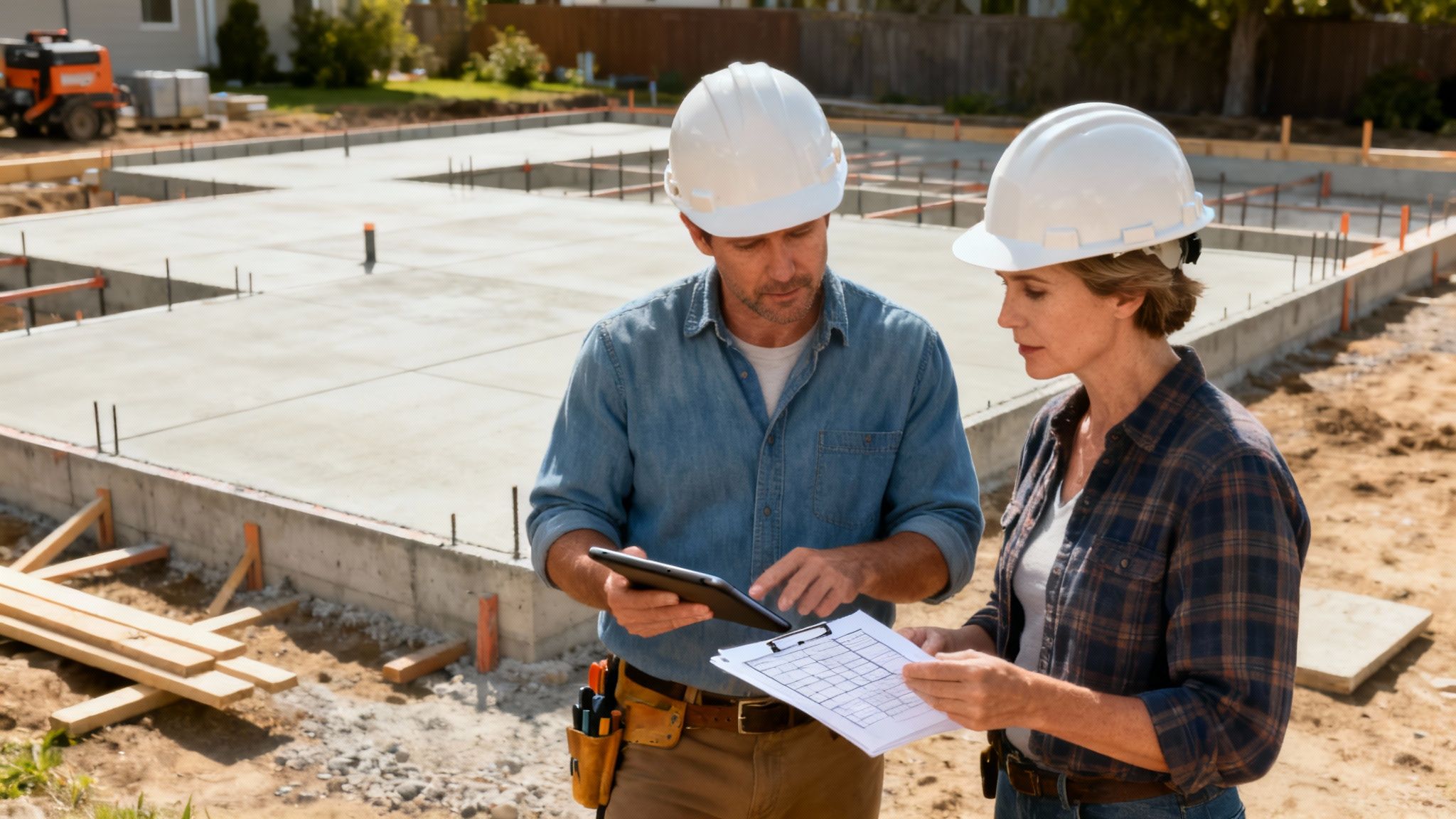
Once the tools are on-site and construction kicks off, the whole project lives and breathes on clear communication. A solid rhythm with your builder from day one is what stops small misunderstandings from becoming big problems, helps manage expectations, and keeps everything moving forward.
This isn't about looking over their shoulder; it's about building a partnership. Before the first bit of concrete is even poured, you need to agree on a communication plan that works for everyone. This way, you’re always kept in the loop without distracting the team on the ground.
Getting Your Communication Channels Sorted
Any of the top home builders in Melbourne VIC will get this conversation started, but you have to be comfortable with the final plan. A good, structured approach usually has a few key things in place to make sure you’re never left guessing.
Most of the time, you'll be dealing with a site manager or a dedicated project manager. It's really important to understand what they do, as they're the ones wrangling trades and watching over the day-to-day progress. You can get a better feel for what a project manager does in construction to see just how vital their role is.
Here are a few touchpoints you should lock in:
- Weekly Updates: A quick email on a Friday afternoon can do wonders. It should sum up what got done, what decisions they need from you, and what’s on the cards for next week.
- Regular Site Meetings: Pencil in a walk-through every fortnight or month. It’s the best way to see the progress with your own eyes and ask questions while you’re standing in the space.
- A Single Point of Truth: Whether it's a shared app or just a simple email thread, keeping all non-urgent chats in one spot creates a clear record.
A quick tip: try to avoid making big decisions over a casual chat or a text message. Always follow up with an email. It creates a paper trail that protects both you and the builder if anything is ever questioned.
Getting this right from the start turns the standard client-builder relationship into a real partnership. It builds trust, so when the inevitable hiccup occurs, you can work through it together as a team.
From Practical Completion to Getting the Keys
As your home starts to look less like a construction site and more like, well, a home, the communication gets laser-focused on the details. These final stages are arguably the most important, and it all leads up to that big moment: the handover.
The first major milestone here is the practical completion inspection. This is your first official walk-through of the almost-finished home. Your job is to be picky—meticulously check every wall, tap, and tile to create a defect list. This is just a list of minor fixes, like paint touch-ups, a drawer that doesn't quite close right, or a chipped tile.
Once you and the builder have signed off on the defect list and the final payment is sorted, it’s time for the official handover. You'll get your keys, all the warranties for your new appliances, and the necessary compliance certificates. It’s the perfect end to a long journey, made so much smoother because you laid a foundation of great communication from the very beginning.
Of course, here is the rewritten section with a more human, expert-driven tone.
Your Top Questions About Melbourne Home Builders, Answered
If you’re thinking about building, you’ve probably got a million questions swirling around. It’s a huge undertaking, and it’s only natural to want clarity before you dive in. We get it. Over the years, we’ve heard just about every question in the book, so we’ve put together some straight-talking answers to the most common ones.
So, How Much Does It Really Cost to Build a House in Melbourne?
This is always the first question, and for good reason. The honest-to-goodness answer? It depends. The final price tag is a mix of so many things: the home’s size, how complex the design is, whether you’re building on a tricky sloping block, and the level of finishes you’ve got your heart set on.
As a rough guide, a standard project home might start from around $2,200 per square metre. But for a high-end, completely custom architectural home, you could be looking at $5,000 per square metre or even more.
Just remember, that figure is usually just for the build itself. You'll need to account for other big-ticket items like demolition of an old house, landscaping, council fees, and even things like blinds and curtains. Always insist on a detailed, itemised quote so you know exactly what’s included and what isn’t. No surprises.
What's the Difference Between a Custom Builder and a Volume Builder?
Getting your head around this is probably the most important first step you can take. Your choice here sets the tone for the entire project, influencing your budget, design freedom, and the whole experience.
- Volume Builders: Think of the big names you see advertising house-and-land packages. They’re geared up to build a lot of homes based on a catalogue of pre-set floor plans. This model is often more affordable because of their scale, but the trade-off is much less flexibility to make the design your own.
- Custom Builders: This is where we fit in. A custom builder specialises in one-of-a-kind homes. We work hand-in-glove with you and your designer to bring a completely unique vision to life. You get total freedom to create something that’s 100% you, but this bespoke approach naturally comes with a higher price point and a longer timeline.
How Long Will the Building Process Actually Take?
Patience is a virtue in building! For the on-site construction part—from the day the concrete slab is poured to the moment we hand over the keys—you’re typically looking at somewhere between 9 and 15 months for a new home in Melbourne.
But that’s only half the story. The pre-construction phase is a massive part of the journey. This is where all the designing, engineering, and back-and-forth with the council happens. This stage alone can easily take another 6 to 12 months before a single shovel hits the dirt.
It’s so important to go in with realistic expectations. Things like Melbourne's unpredictable weather, supply chain hiccups, or a shortage of specific trades can all push timelines out. A great builder won't just cross their fingers; they'll communicate openly and keep you in the loop every step of the way.
Choosing the right partner from the dozens of home builders in Melbourne VIC is a decision that will shape your experience for years to come. By getting clear on these key questions from the outset, you’ll be in a much better position to find a team that truly aligns with your budget, your vision, and how you want to feel during the journey.
Ready to bring your home vision to life with a team dedicated to craftsmanship and clear communication? Contact Envy Abode to discuss your luxury new build, extension, or renovation project. Learn more about our design and build process.