Malvern EastProject Repton , 2025
“The key thing we were looking for was the consistency in the pricing that we received, having the right team to be able to problem solve when an issue arose, they did it in a very calm and measured manner. They're a great team and we worked so well together, had we done the design with Envy it would have saved us 6 months minimum”
Finding Home Builders Melbourne for Your Dream Build

Embarking on the journey to build your own custom home in Melbourne is one of life’s most exciting ventures. But let’s be honest, its success all comes down to partnering with the right team. This guide is your roadmap to finding the absolute best home builders Melbourne has to offer, starting with the crucial first steps of defining your vision and understanding the local landscape to protect your investment.
Starting Your Melbourne Custom Home Journey

A custom build is more than just a project; it's a chance to shape a space that is a true reflection of your lifestyle, taste, and aspirations. The path from a dream scribbled on a napkin to a beautifully finished home is a complex one, though, especially in a market as dynamic as Melbourne’s.
This is why your first decision—choosing a builder—is by far the most important.
This isn’t just about finding someone who can pour a slab and put up a frame. You're looking for a long-term partner for what is a deeply personal and significant financial undertaking. The right builder is your guide, your advocate, and your expert, navigating the intricate web of design, council permits, and construction on your behalf.
Defining Your Vision and Brief
Before you even start Googling builders, the real work begins with you. You need to translate all those brilliant ideas into a clear, practical brief. Think of this document as the foundation for your entire project. It's so much more than a list of rooms; it’s a detailed story of how you and your family want to live.
A strong brief should touch on these key elements:
- Lifestyle Needs: How does your family really live? Do you love to entertain, or do you need a quiet home office? Are dedicated hobby spaces a must?
- Aesthetic Preferences: What style makes you feel at home? Are you drawn to the clean lines of modernism, the charm of classic heritage, or something else entirely? Start collecting images from magazines, Pinterest, and even just homes you admire around town.
- Must-Have Features: This is your non-negotiable list. It could be anything from a true chef's kitchen and a seamless indoor-outdoor flow to specific smart home technology.
- Budget and Timeline: Be upfront and realistic about your financial comfort zone and when you'd ideally like to be moving in. This honesty helps builders assess feasibility from the very first conversation.
With a well-developed brief in hand, those initial meetings become far more productive. It allows potential home builders in Melbourne to give you genuine feedback and more accurate preliminary costings, which saves everyone time and avoids frustration down the track. To help you get started, our comprehensive building a custom home checklist is the perfect resource.
Understanding the Local Building Climate
The Melbourne construction scene is in constant motion, shaped by everything from fluctuating material costs and the availability of skilled trades to the specific regulations of each local council. A careful builder selection process is your best defence against the budget blowouts and delays that can spring from these challenges.
An informed client is an empowered client. Understanding the current market conditions and knowing what to look for in a builder gives you control over the process and protects your investment.
By taking the time to do this upfront preparation and meticulously vet your options, you're setting the stage for a collaborative and genuinely successful building experience. This initial effort is what ensures the home you build is precisely the home you've always imagined.
How to Find and Vet Melbourne's Best Builders
Choosing the right builder is the most critical decision you’ll make. It’s the one that will fundamentally shape the outcome of your entire project, for better or worse. This isn’t about a quick Google search; it’s about carefully identifying and thoroughly vetting Melbourne’s top-tier professionals to find a true partner for your vision.
The Melbourne market is a hive of activity and has consistently led the charge in single-unit house construction in Australia. In fact, Victoria saw 2,892 private sector house approvals in September alone in a recent year—a 7.3% jump from the previous month. You can dig into the numbers yourself by reviewing the latest building approvals statistics from the ABS.
All this activity means you have plenty of choices, but it also means doing your homework is absolutely essential.
Building Your Initial Shortlist
A solid shortlist is built on trusted recommendations, not flashy ads. While an online search is a decent starting point, the most reliable referrals come from other professionals in the building industry—people who have seen a builder's quality and conduct firsthand.
Start by tapping into these networks:
- Home Designer Recommendations: If you're already working with an building designer, ask them who they trust to execute their plans flawlessly. They know which home builders in Melbourne respect the design integrity and are great collaborators.
- Industry Awards: Take a look at recent winners from respected organisations like the Master Builders Association of Victoria (MBAV) or the Housing Industry Association (HIA). These awards are a strong sign of peer-recognised excellence.
- Local Council Planners: They won't give you a direct recommendation, but they see it all. Noticing which builders consistently submit well-prepared, compliant applications is a subtle nod towards their professionalism and local expertise.
From here, your goal is to narrow it down to a focused list of three to five builders whose portfolio genuinely aligns with the style and scale of what you want to achieve.
The Essential Vetting Process
Once you have your shortlist, the real investigation begins. This is where you move from names on a page to a deep understanding of each firm’s credentials, capabilities, and reputation. Your goal is complete confidence before a contract is even on the table.
The vetting stage isn't just a box-ticking exercise. It's about verifying that a builder has the technical skill, financial stability, and professional integrity required for a high-value custom home project.
First things first: verify their licence and insurance. This is non-negotiable. Every legitimate builder in Victoria must be registered with the Victorian Building Authority (VBA). You’re looking for a Domestic Builder – Unlimited (DB-U) registration, which is what they need to carry out all domestic building work. You should also ask for current copies of their Public Liability Insurance and Domestic Building Insurance (DBI) certificates.
Diving Deep into Their Work
A builder’s portfolio is their resume in pictures. Don't just get swept away by the glossy photos on their website. Ask to see projects that are similar to yours, both in scope and architectural style. Look closely at the quality of the finishes, the complexity of the work, and whether that quality is consistent across different projects.
A confident builder will also be happy to provide references from past clients. When you speak to them, get into the nitty-gritty. Ask about their real experience with communication, budget management, and how any unexpected issues were handled. This is your chance for an unfiltered look at what it's really like to work with them day-to-day. For more tips on this, check out our detailed article on how to select the right builder for your project.
Key Questions for Your First Meeting
Think of the initial meeting as a two-way interview. You're sizing them up, and they're figuring out if your project is a good fit for their team. Come prepared with questions that go beyond the surface and reveal their process and philosophy.
Crucial Questions to Ask Potential Builders
- Who will be my main point of contact, and who will be managing the site daily? This tells you a lot about communication and team structure.
- How do you handle project variations and changes once construction has started? A good builder has a clear, documented process to prevent budget blowouts.
- Can you walk me through your typical project timeline and key milestones? This reveals their organisational skills and approach to scheduling.
- What challenges do you foresee with my site or design, and how would you address them? This tests their problem-solving skills and shows they’re thinking critically about your specific project.
Listen carefully to their answers. You’re looking for transparency, genuine expertise, and a communication style you feel comfortable with. At the end of the day, finding the right Melbourne builder is about finding a partner you can trust to bring your dream home to life with precision and care.
Understanding Costs and Contracts in Melbourne
Getting a firm grip on the money and the paperwork is one of the most empowering things you can do as a homeowner. Let’s be honest, it’s not the most glamorous part of the process, but a crystal-clear understanding of costs and a rock-solid contract are the twin pillars supporting a successful build with any high-end home builders Melbourne has to offer.
This is where your vision starts to become a tangible investment. It’s all about demystifying the numbers and knowing exactly what you're signing on the dotted line.
Key Drivers of Melbourne Building Costs
The final number on a quote for a custom home, extension, or major renovation is never pulled out of thin air. It’s the result of a complex interplay of factors, and while every project has its own unique character, some elements consistently move the needle on the budget more than others.
Knowing these from the get-go helps you plan realistically and decide where to allocate your funds for the biggest impact.
These are the big ones we see time and time again:
- Site Conditions: A sloping block in a suburb like Toorak or tricky access in Brighton can add a surprising amount to the bottom line. Costs for extra excavation, specialised foundation engineering, and retaining walls can mount quickly.
- Architectural Complexity: Those beautiful, intricate rooflines, dramatic voids, cantilevered balconies, and huge walls of glass are hallmarks of luxury design. They also demand more labour, more complex engineering, and more specialised trades, which all directly influence the price.
- Quality of Finishes: This is a huge variable. The selections you make for flooring, cabinetry, benchtops, tapware, and lighting can swing the budget dramatically. There's a world of difference between high-quality standard options and, say, imported European oak flooring and slabs of Calacatta marble.
Of course, the wider Melbourne construction market plays its part, too. Recently, the average cost for a new home build in Melbourne hovered between $400,000 and $550,000, with high-end custom projects often soaring past $1,200,000. These figures reflect our city’s demand for top-tier trades and the need to meet stringent building codes. You can get a broader perspective on material pricing and national trends from this detailed construction outlook from Altus Group.
For a closer look at how these factors play out locally, our guide on the cost of building a house in Melbourne breaks it down even further.
To give you a clearer picture, here's a look at what you can generally expect.
Estimated Cost Drivers for Melbourne Building Projects
The table below outlines the typical cost ranges and the key factors that influence the final price for different high-end residential projects across Melbourne.
Project Type | Average Cost Per Square Metre | Key Cost Influencers |
New Custom Build | $5,500 - $9,000+ | Design complexity, site conditions (slope, soil), level of luxury finishes (e.g., stone, imported fixtures), smart home automation. |
Ground-Floor Extension | $4,000 - $6,500+ | Extent of structural changes to existing home, integration of new and old sections, complexity of roofing, high-end kitchen/bathroom additions. |
Second-Storey Addition | $5,000 - $7,000+ | Need for structural reinforcement of the ground floor, engineering for stairs, complexity of tying into the existing roofline, extensive glazing. |
Major Renovation | $4,500 - $7,000+ | Scale of demolition, moving structural walls or plumbing, quality of fixtures and fittings, rectifying existing issues (e.g., wiring, asbestos). |
Remember, these are guideposts. The true cost always comes down to the specifics of your unique project and vision.
Fixed-Price vs Cost-Plus Contracts
When it comes to the contract itself, you'll generally come across two main structures. Neither is right or wrong, but one will almost certainly be a better fit for your project and your personal comfort level with financial risk.
Fixed-Price Contract
This is the most common path for new custom homes. The builder provides a set, all-inclusive price to complete the entire project as specified.
- The upside? You get budget certainty. It’s a huge relief to know what the final bill will be, assuming the scope doesn’t change.
- The downside? A builder has to factor in a contingency for unforeseen risks, which can sometimes mean the initial price is a touch higher. It can also be a bit rigid if you decide you want to make changes once work is underway.
Cost-Plus Contract (or Cost-Plus-Margin)
With this model, you pay the actual, itemised cost of all labour and materials, plus an agreed-upon percentage on top for the builder's margin.
- The upside? It’s incredibly transparent—you see every invoice. This flexibility is perfect for complex renovations where it's nearly impossible to know the full scope from day one.
- The downside? There’s less certainty around the final budget. The total cost isn't locked in until the very end, which requires an immense amount of trust in your builder's integrity and management.
For most of our clients building a bespoke new home from detailed plans, a fixed-price contract offers the greatest peace of mind. It places the onus on the builder to manage costs and deliver your home for the agreed price.
Dissecting Your Victorian Building Contract
No matter which type you choose, your building contract is a serious legal document. It needs to be read, understood, and scrutinised. A reputable Melbourne builder will always use a standard contract from an industry body like the Master Builders Association of Victoria (MBAV) or the Housing Industry Association (HIA).
Before a single pen hits paper, zoom in on these critical clauses:
- Scope of Works: This section must be your bible. It needs to meticulously detail everything included in the price, referencing the architectural drawings, engineering plans, and a comprehensive specifications document that lists every single finish and fixture. Any ambiguity here is a major red flag.
- Payment Schedule: This lays out the progress payments you’ll make at key construction milestones—think slab down, frame complete, lock-up stage. Crucially, the payment amounts should directly reflect the value of the work completed on-site. Never, ever agree to pay a huge upfront deposit beyond the legal limit in Victoria.
- Variation Procedure: This clause is your best friend if you change your mind. It defines the formal process for making any alterations to the plan or specifications. A proper procedure demands that any change is documented in writing, costed, and approved by you before the work proceeds. This is what prevents nasty surprise costs at the end.
- Completion Date and Delays: Your contract will set a target completion date. It will also list the specific conditions under which the builder can claim an extension of time, like freak weather events or industry-wide material shortages. Make sure these conditions are reasonable and clearly defined.
Taking the time to get comfortable with these financial and legal details isn’t just about ticking boxes. It’s about building a foundation of trust and absolute clarity with your builder, so you can focus on the truly exciting part: watching your vision come to life.
Untangling the Web of Design and Approvals
Before a single shovel hits the dirt, your project with a top-tier Melbourne builder begins in what we call the pre-construction phase. This is where the real magic happens—it’s a meticulous process of planning and design that sets the entire project up for success. This is where your vision is translated from ideas into a concrete, buildable blueprint that can navigate the maze of local council requirements.
Getting this stage right is everything. It's about turning creative architectural concepts into something real, practical, and fully compliant. Think of it as the strategic groundwork that prevents those soul-crushing delays and budget blowouts down the track.
From a Blank Page to Construction-Ready Plans
The journey always starts with a deep dive into your property. Any builder worth their salt will kick things off with a thorough site analysis. They're looking at everything: the block's orientation, the slope of the land, soil conditions, and any existing trees or structures. This isn’t just ticking a box; this information directly shapes the design, influencing everything from the type of foundation needed to how you can harness natural light and winter sun.
With that knowledge in hand, the first concept designs start to emerge. This is a genuinely collaborative and creative back-and-forth between you and the design team. You'll explore different layouts, play with the home's overall shape, and dial in the aesthetic until it just feels right. It’s a delicate dance, balancing your dream home with the practicalities of your land and budget.
I can't stress this enough: don't rush the concept stage. A well-considered design, refined with your builder's practical input on what's actually buildable, is the single best investment you can make in the entire project.
Once the big picture is locked in, the focus sharpens to the finer details. Now we're talking about selecting the specific materials, fixtures, and finishes that bring the design to life. A good design-build firm makes this feel easy, guiding you through selections that not only match your style but also align perfectly with the project’s budget.
Demystifying Melbourne's Approval Maze
With a brilliant design finalised, the next big step is getting all the necessary permits. In Melbourne, this usually means tackling two different types of approvals, each with its own purpose and authority.
1. The Town Planning Permit
This permit comes directly from your local council, and it's all about how your new home will impact the street and your neighbours. The council is looking at things like:
- Neighbourhood Character: Does the style and scale of your home fit in with the existing feel of the street?
- Overlooking and Overshadowing: Will your new home compromise your neighbours' privacy or block their sunlight?
- Site Coverage and Setbacks: Are you building too much on your block, and is the house positioned correctly according to local rules?
Your builder and their team will pull together a comprehensive application, complete with detailed drawings and reports, to present the best possible case to the council.
2. The Building Permit
After you have planning approval (if you needed it), the next step is securing a building permit. This is handled by a Building Surveyor—either from the council or a private firm—and its focus is purely on safety and compliance. It's the official check that ensures your architectural and engineering plans meet the National Construction Code (NCC) and other relevant Australian Standards. The surveyor signs off on structural integrity, fire safety, energy efficiency, and accessibility.
Assembling Your A-Team of Experts
Getting through all this red tape is definitely not a one-person job. Your builder will be the one to coordinate a whole team of specialists needed to get the paperwork in order.
- Building Surveyor: This independent expert is crucial. They certify that your plans comply with regulations and will pop in at key stages during the build to conduct mandatory inspections.
- Structural Engineer: The engineer designs the home's skeleton—the concrete slab, the frame, and the roof structure—making sure it’s all safe, sound, and built to last.
- Geotechnical Engineer: They're the ones who get their hands dirty, analysing the soil on your block to give the structural engineer the vital data they need to design the right foundations.
- Energy Rater: This consultant assesses your plans to ensure the home meets Victoria's minimum 6-Star energy efficiency standard. Their report is a non-negotiable part of the building permit application.
Having an experienced builder managing this whole consultant team is a massive advantage. They make sure all the reports and drawings are coordinated, accurate, and submitted on time. It’s this proactive management that transforms a confusing, bureaucratic headache into a streamlined, predictable part of your journey.
Managing the Build from Foundation to Handover
This is it—the moment your vision starts taking shape on-site. For Melbourne's luxury home builders, this is where meticulous oversight and clear communication make all the difference, preventing small hiccups from becoming major headaches down the track.
As soon as the slab is poured, the real work begins, and you need a solid game plan.
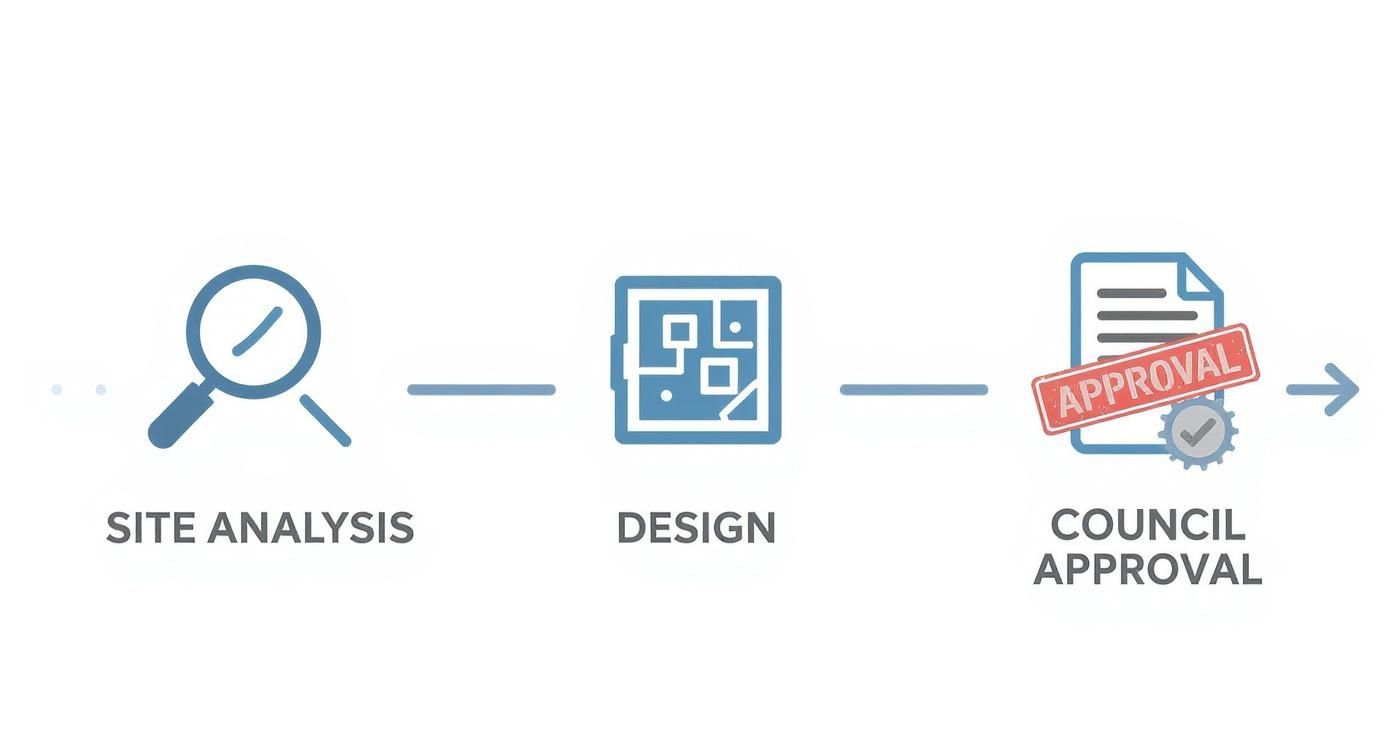
The infographic above gives you a bird's-eye view of how the project flows, from the initial site analysis and design development right through to getting that final council stamp of approval. It’s a complex dance, but a good builder makes it look effortless.
Key Milestones in Construction
The first big step is the foundation stage. This is where excavation and footing work set the literal groundwork for everything to come. It's not just about digging a hole; we're paying close attention to soil compaction and drainage to avoid issues later. Site engineers will be testing moisture levels to prevent future cracks—it's a critical, often unseen, part of the process.
Next, the project really comes to life during the framing phase. You'll see remarkable visual progress as the timber or steel frame goes up. Because it happens so quickly, it’s crucial to ensure every joint is perfectly level and plumb. We always recommend weekly site visits at this point just to watch your home take its form.
- Foundation Milestone: Double-check that all footings and the slab precisely match the engineer's specifications.
- Framing Milestone: Verify stud alignment and all structural bracing. It’s the skeleton of your home.
- Lock-Up Milestone: Confirm the external walls and roof are fully sealed and weatherproof.
- Fixing Milestone: Inspect the plaster, joinery, and the first coats of paint and finishes.
A weekly site meeting is non-negotiable. It keeps everyone on the same page and helps us catch potential issues before they can escalate.
Effective Communication with Your Site Manager
Think of your site manager as the central hub for all daily progress. Establishing a consistent reporting rhythm from day one is key—a mix of photos, quick walk-throughs, and a brief call can work wonders. These check-ins build trust and make it easy to spot any deviation from the plan immediately.
If a problem does pop up, documenting it in writing is the best practice. A quick email with the date, time, and a photo means no one forgets about a misaligned window or a late finish.
- Talk Through Daily Priorities: A quick chat to confirm the tasks for the next 24 hours.
- Review Safety Protocols: Ensure everything is compliant with OH&S standards.
- Note Material Deliveries: Track that the right materials are arriving on schedule.
Handling Variations Without Delays
Let’s be realistic: changes are almost inevitable. But if they aren’t managed properly, variations can kill your budget and timeline. The key is to treat every request formally. Issue a variation notice, get a detailed quote, and sign off before any work starts.
Always ask your builder for a clear analysis of the impact on both cost and schedule. Then, you can decide whether that stunning marble sink is worth the potential delay.
A formal variation process isn't red tape; it's a safety net that protects your timeline and budget by creating a clear, agreed-upon record of every change.
- Finalise Major Decisions Upfront: Lock in all your finishes before a single nail is hammered.
- Set a Contingency Budget: We always recommend allocating 5-10% of the total cost for surprises.
- Require Written Approvals: No changes should ever proceed without your written consent.
Final Inspection and Handover
As the build wraps up, the final inspection is easily the most gratifying stage. This is your chance to walk through every room with your builder and create a defect list for the liability period. It's a meticulous process, but an essential one.
By law, builders must fix structural faults for six years and non-structural issues for two years under Domestic Building Insurance. Some firms, like ours, also offer an extra defect liability period of up to 12 months to handle minor tweaks as the house settles.
Once every item is ticked off, you’ll receive the keys and your full warranty documentation. Congratulations—you’re ready to move into your beautiful new luxury home.
Real World Example on Managing Delays
On a recent Brighton project, we were hit with unexpected heavy rains that flooded the foundation trench. It could have been a disaster.
Our site manager immediately notified the homeowner and safely paused all work. Within 24 hours, a provisional drainage pump was installed, which minimised the schedule slippage significantly. By acting fast and communicating clearly, we kept the project on track.
- An immediate variation request and cost estimate was issued.
- The homeowner approved temporary works to protect the site's integrity.
- We adjusted the crane schedule and contractor bookings on the fly.
- All actions were documented with time stamped photos for complete transparency.
Pro Tips for a Smooth Handover
Just before handover, consider walking the site with an independent building surveyor. They have a trained eye for spotting minor defects you might miss and can verify full compliance.
It’s also a great idea to schedule a post-handover check about three months later to catch any settling cracks or other minor issues that can appear as a new home settles in.
That small investment in a pre-handover survey can genuinely save you thousands in potential fixes down the line.
- Confirm and test all appliance installations.
- Verify that every tap, drain, and plumbing fixture is fully operational.
- Check that all access panels and service points are clearly labelled.
- Collect all operation manuals and warranty documents in a single, organised folder.
Following these steps ensures the builder's warranty is crystal clear and leaves absolutely no loose ends.
For a more detailed look at the entire timeline, check out our guide on house construction stages.
Common Questions About Building in Melbourne
Embarking on a custom build journey always brings up a lot of questions. As builders who have guided countless Melbourne families through this process, we’ve heard just about everything. Here are a few of the most common queries we get, with some straight answers to give you clarity and confidence.
These insights come from years of hands-on experience navigating the unique challenges and opportunities of building high-end homes right here in Melbourne.
How Long Does a Custom Home Build Take in Melbourne?
This is usually the first question on everyone's mind, and for good reason. For a truly bespoke luxury home in Melbourne, the total time frame really hinges on the project's scale, the complexity of the design, and how quickly the local council processes applications.
As a general rule of thumb, you should plan for around four to six months just for the pre-construction phase. This is the crucial period for design development, detailed documentation, and securing all the necessary approvals. It’s where we get every single detail right on paper before a shovel ever hits the ground.
Once construction begins, the build itself typically takes between 12 and 18 months. Several things can stretch this out, including:
- Tricky site conditions: A sloping block or difficult soil can add time, especially during the initial earthworks and foundation stages.
- Classic Melbourne weather: We all know it. Long stretches of rain can unfortunately cause delays, particularly in the early phases.
- Lead times for custom materials: If you’ve got your heart set on specialised or imported finishes, sourcing them can sometimes extend the schedule.
A professional builder will always give you a detailed project schedule with clear milestones, so you’re never left wondering what’s happening next.
What Is the Main Difference Between a Custom and Volume Builder?
Getting this distinction right is key to finding a building partner who is truly aligned with your vision. The two types of builders serve completely different needs and parts of the market.
A volume builder works on a model of scale and repetition. They build from a catalogue of pre-set plans and offer a fairly limited menu of customisation options. Their entire process is geared towards delivering a product quickly and at a competitive price, which they achieve by building the same designs over and over.
A custom home builder is something else entirely—we’re your creative partner. We work with you and your architect from the very beginning to design and construct a one-of-a-kind home that’s a perfect fit for your land, your lifestyle, and your unique vision.
While a custom build is a more significant investment, it gives you complete design freedom, a far superior standard of craftsmanship, and a deeply personal level of service that’s essential for creating a genuine luxury home.
What Warranties Do Melbourne Builders Provide?
Thankfully, consumer protections here in Victoria are quite robust, giving you significant peace of mind. For any domestic building project valued over $16,000, your builder is legally required to take out Domestic Building Insurance (DBI) on your behalf. This has to be done before you pay a cent of your deposit.
This insurance is your safety net. It covers structural defects for ten years and non-structural defects for two years if the worst happens and your builder dies, disappears, or becomes insolvent.
On top of this mandatory cover, any reputable builder will also offer their own 'defect liability period'. This is usually a 3 to 12-month period after handover where they’ll come back to fix any minor things that pop up as the house settles—think small paint touch-ups or a sticking door. Make sure this is clearly spelled out in your contract.
How Should I Manage Changes During Construction?
Even with the most detailed planning, you might see something on-site and decide to make a change. In the building world, we call these 'variations', and having a clear process for managing them is crucial to avoiding budget blowouts and arguments.
Your contract must lay out a formal process for any variations. It should look something like this:
- You request the change in writing.
- The builder provides a 'variation notice' that details the exact cost and any impact it will have on the timeline.
- You must sign off on this notice in writing before any of the new work can begin.
This formal paper trail ensures total transparency—no nasty surprises on the final invoice. Of course, the best strategy is always to lock in as many decisions as you can during the design phase. It’s the simplest way to keep your project running smoothly, on time, and on budget.
Ready to turn your vision into a stunning reality? The team at Envy Abode specialises in creating bespoke luxury homes, extensions, and renovations across Melbourne. Let's start the conversation about your project today. https://envyabode.com.au