Malvern EastProject Repton , 2025
“The key thing we were looking for was the consistency in the pricing that we received, having the right team to be able to problem solve when an issue arose, they did it in a very calm and measured manner. They're a great team and we worked so well together, had we done the design with Envy it would have saved us 6 months minimum”
Home builders Melbourne Australia: Your Guide to New Homes

Building a new home in Melbourne is one of life’s biggest milestones. But turning that complex, often daunting, process into an exciting and rewarding journey comes down to one thing: finding the right partner.
The best home builders in Melbourne, Australia are the ones who truly get your vision, respect your budget, and match your communication style. They’re more than just contractors; they become your trusted guide from that first sketch on a napkin to the moment you get the keys. Honestly, this is the single most important decision you'll make for the entire project.
Starting Your Melbourne Home Building Journey
Embarking on a new build is a massive investment, both financially and emotionally. It’s not just about putting up walls and a roof; it’s about creating a space that genuinely reflects your lifestyle and will serve your family for years to come. The journey starts long before the first shovel hits the dirt—it begins with a clear vision and finding a capable team to bring it to life.
This guide is designed to give you a clear roadmap. We’ll walk through the essentials every future homeowner needs to understand, including:
- Breaking down construction costs and realistic timelines.
- Navigating the maze of local council approvals and permits.
- Understanding the difference between various types of building firms.
- Weaving modern, energy-efficient design principles into your home.
Melbourne, a National Construction Leader
Melbourne’s residential construction industry is a real powerhouse and a cornerstone of Australia's building sector. In fact, Victoria consistently leads the nation in building new single-unit houses, thanks to strong local demand and a growing population.
The national market for house construction is valued at roughly AUD 90.1 billion, and this specific sector pulls in about 60% of the industry's total revenue. That really underscores Melbourne's vital role in it all.
Your choice of builder is the foundation upon which your entire project rests. It influences everything from the architectural integrity and craftsmanship to your overall experience, budget adherence, and the final quality of your home.
This foundational knowledge is crucial, and it all begins with your block of land. Getting to know the unique characteristics of your site is the very first step. You can learn more about this in our guide on buying a block of land before you build. Our goal is to arm you with the clarity and confidence you need to move forward.
Navigating the Melbourne Home Building Process
Building a new home can feel a bit like setting out on a long voyage without a map. It’s a huge undertaking! But knowing what’s coming next is the key to staying in control and actually enjoying the journey.
Professional home builders in Melbourne don’t just wing it; they follow a structured, step-by-step process. Think of it as a well-oiled production line where each stage has to be nailed before the next one can kick off. This methodical approach is designed to catch issues early, keep things moving smoothly, and turn your big ideas into a beautifully finished home.
This simple timeline gives you a bird's-eye view of the journey, from that first spark of an idea to the moment you get the keys.
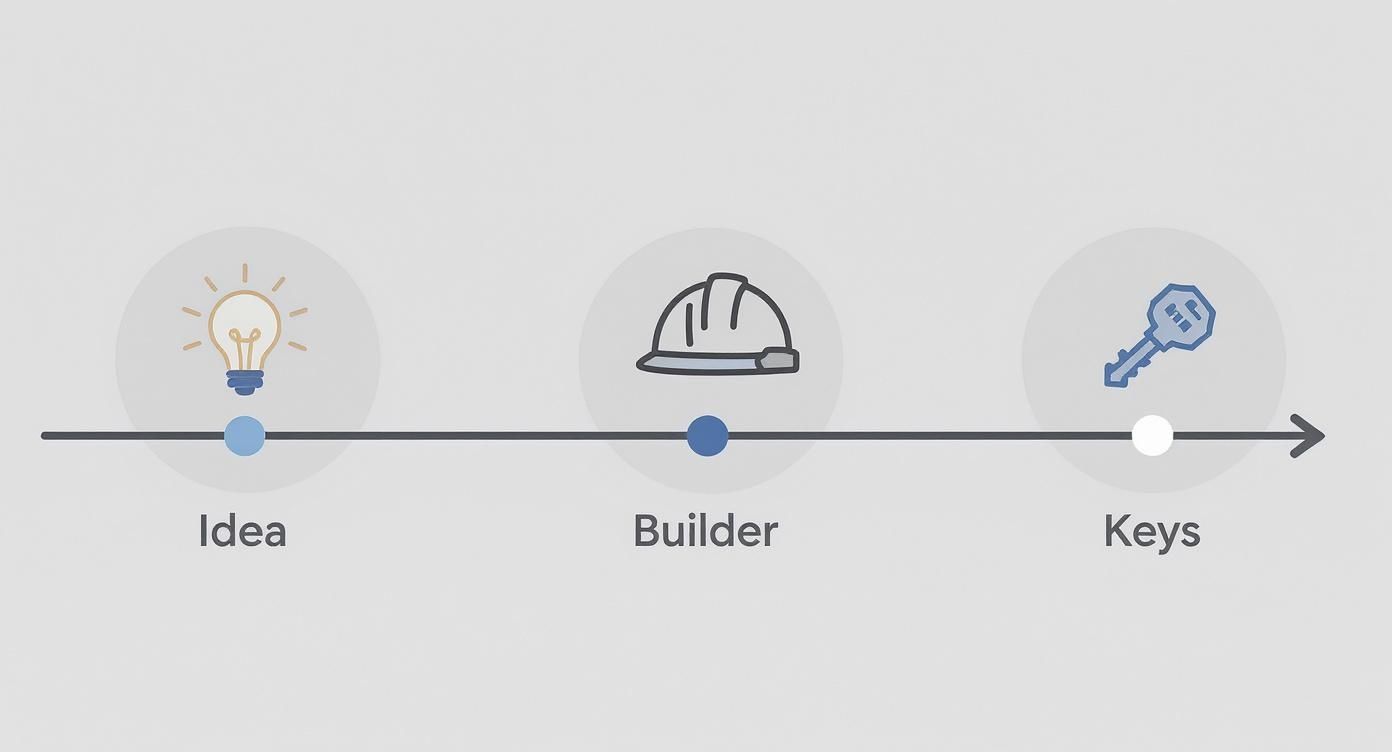
It really is a partnership. It starts with your vision and ends with a home delivered by your building expert.
To give you a clearer picture, we've broken down the typical journey into its core phases.
Typical Home Building Phases in Melbourne
Here’s a summary of the key stages you can expect when building a home in Melbourne, from the initial planning sessions right through to the final handover.
Phase | Key Activities | Typical Duration |
Pre-Construction | Design, finance approval, soil tests, engineering, council and building permits. | 3-6 months |
Construction | Site preparation, slab, framing, lock-up (external cladding, roof, windows), fixing (internal linings, joinery). | 6-12 months |
Completion & Handover | Finishing touches (painting, tiling, flooring), final inspections, defects rectification, handover. | 1-2 months |
This table shows how the process is much more than just the physical build; the planning and finishing stages are just as crucial to getting the final result right.
The Pre-Construction Phase
Long before a single shovel hits the dirt, a mountain of critical work gets done. This is the pre-construction phase, where all the meticulous planning lays the foundation for a seamless build.
- Design and Consultation: This is where the magic begins. You'll sit down with building home designers to turn your lifestyle needs, design tastes, and the unique aspects of your block of land into a detailed set of working drawings.
- Securing Finance: Armed with a design and a preliminary cost estimate, you'll head to your lender to get formal finance approval. Your builder can usually provide all the documents needed to support your application.
- Council Approvals and Permits: This is a big one. Your builder will handle submitting plans to the local council for a planning permit (if needed) and to a private building surveyor for a building permit. Delays can be common here, so having an experienced builder who knows the ins and outs of local Melbourne councils is an absolute game-changer.
The Construction Phase In Action
Once all the permits are signed off, the real excitement starts. The construction phase is broken down into several key stages, and you’ll typically make a progress payment as each one is completed.
- Site Preparation and Slab Pour: The team clears the land, handles the earthworks, and sets up all the underground plumbing and electrical conduits. Then, the foundation—usually a concrete slab—is poured.
- Framing: Suddenly, your home’s skeleton appears! You’ll see the wall frames and roof trusses go up, giving you the first real sense of the rooms, scale, and layout.
- Lock-Up Stage: This is a massive milestone. The house becomes a secure, weatherproof shell once the external doors, windows, and roof are installed. This means all the internal work can now begin safely, rain or shine.
- Fit-Out or 'Fixing' Stage: Now the inside starts to come to life. Plasterboard goes on the walls, internal doors are hung, and all the joinery like cabinets, skirting boards, and architraves are fitted. This stage gets everything ready for the final finishes.
A well-managed construction process is all about momentum. Each completed stage builds upon the last, turning a collection of raw materials into a structured, functional, and beautiful living space.
This journey involves countless steps, from the first sketch to the final walkthrough. To get into the nitty-gritty, you can explore our detailed guide on the full process of building a new home.
Finalising Your New Home
The home stretch is all about the details and making sure everything is perfect before you move in.
The completion stage is where all the finishing touches come together. This means painting, tiling, electrical and plumbing fit-offs (installing lights, taps, and appliances), and laying the floors. Landscaping and driveway construction usually happen around this time, too.
Finally, you’ve reached handover. You’ll do a final inspection with your builder to point out any minor issues, which get added to a defects list. Once those are fixed up and the final payment is made, the keys to your brand-new Melbourne home are yours! Your builder will also provide a defects liability period (typically three months) to sort out any non-urgent issues that might pop up after you've settled in.
Understanding Your Budget and Project Timeline
Let’s get straight to it. Every new home build boils down to two huge questions: "How much is this going to cost?" and "How long will it take?" Getting honest, realistic answers to these for the Melbourne market is the absolute first step. Without a firm grip on your budget and timeline, even the most exciting dream home can turn into a source of stress.
Think of it like buying a car. You can walk into a dealership and drive away in a standard model with a clear price tag and immediate delivery. Or, you could commission a custom-built vehicle, where you choose everything from the engine performance to the colour of the stitching on the leather seats. That bespoke car will be one-of-a-kind, but it naturally comes with a higher price and a much longer, more involved production schedule. Building a home works on exactly the same principle.
A project home from a volume builder is your off-the-lot car—it’s built for efficiency and cost-effectiveness. A custom architectural home is that bespoke vehicle, a unique creation where every bit of complexity and personalisation adds to the final cost and timeline. Knowing which path you're heading down is crucial for setting expectations you can actually meet.
Decoding Building Costs in Melbourne
The cost of building a house in Melbourne isn't one single number. It’s a spectrum, and where you land on it depends on your block of land, your design choices, and the level of finish you’re after. The industry often talks about a cost per square metre, but even that figure can swing wildly.
Here are the big factors that move the needle:
- Your Block of Land: A perfectly flat, stable block is a builder's dream. But if your site is sloped, has difficult soil, or needs major rock removal, you could be looking at tens of thousands in extra site prep costs before a single drop of concrete is poured.
- Design Complexity: A simple, rectangular home is the most cost-effective shape to build. The moment you introduce multiple angles, curved walls, split levels, or intricate rooflines, the labour and material costs start to climb.
- Quality of Finishes: This is where a budget can truly blow out. You can stick to budget-friendly options like laminate benchtops and standard tiles, or you can elevate the home with premium selections like natural stone, imported hardwood floors, and high-end European appliances. The difference in cost is massive.
If you want to get into the nitty-gritty, we’ve put together a full guide on the cost of building a house in Melbourne.
Mapping Out Your Project Timeline
Just like the costs, building timelines are anything but fixed. The actual construction is the part everyone sees, but the whole process from start to finish is much, much longer. It's also worth noting that the Melbourne building industry is constantly playing catch-up with housing demand, which can put pressure on schedules.
While Victorian builders are putting up a steady number of new homes, research shows it’s taking longer to complete them than it did a few decades ago, thanks to supply chain headaches and labour shortages. For example, the national average cost to build a new house recently sat between $1,800 and $4,500 per square metre—a figure directly impacted by these longer build times and rising material costs.
A smart timeline doesn't just cover the days the tradies are on site. It has to include buffer time for design changes, council approvals, and the things no one can control, like a week of torrential rain or a delayed shipment of materials. Patience and planning are your best friends here.
For a custom home build in Melbourne, a typical timeline looks something like this:
- Pre-Construction (3-6 months): This is the "paperwork" phase. It covers developing the design, getting all the engineering done, and—most importantly—navigating the council and building permit approvals, which can be unpredictable.
- Construction (8-14 months): This is the exciting part, from the slab pour right through to handover. How long it takes really depends on the home's size, complexity, and any challenges your specific site throws up.
- Post-Construction (1-3 months): Once you have the keys, there’s usually a defects liability period. This is when your builder will come back and sort out any minor issues that pop up as you settle into your new home.
At the end of the day, truly experienced home builders in Melbourne, Australia, will give you transparent costings and realistic schedules from the outset, helping you move forward with clarity and confidence.
Choosing Your Ideal Building Partner
The builder you choose is easily the most important partner in your home-building journey. It's a decision that will shape everything—your budget, your timeline, the final quality, and frankly, your overall stress levels.
In Melbourne, your choice generally boils down to two main camps: volume builders and custom design-build firms.
Getting this right isn't about picking which one is "better" in a general sense. It’s about finding the perfect fit for your specific project, your vision, and even your personality.
Think of it this way. A volume builder is like choosing from a set menu at a fantastic restaurant. The options are proven hits, the kitchen is a well-oiled machine, and your meal arrives quickly at a predictable price. A custom design-build firm, on the other hand, is like hiring a personal chef. They sit down with you to create a completely unique menu from scratch, sourcing special ingredients to craft a one-of-a-kind experience.
Volume Builders: The Path of Efficiency
Volume builders are the big names you see across Melbourne's growth corridors, building entire estates of new homes. Their whole game is about constructing a high number of homes from a curated portfolio of pre-designed floor plans.
Their business model is laser-focused on efficiency and repeatability. By using standardised designs and buying materials in bulk, they can offer seriously competitive pricing and much faster build times. This makes them a hugely popular choice, especially for first-home builders or anyone with a straightforward vision and a firm budget.
What to expect from a volume builder:
- Proven Designs: They offer a catalogue of floor plans that have been built time and time again, so you know the layout is tested and functional.
- Predictable Pricing: You begin with a clear base price, which makes managing your finances feel much more straightforward from the get-go.
- Streamlined Process: From the moment you walk into a display home to the final handover, they have a system for everything.
The trade-off for all this efficiency? Customisation is limited. While you can definitely make minor tweaks and choose from a set range of finishes (often during a 'colour selection' appointment), you won't be able to make significant structural changes.
Custom Design-Build Firms: The Bespoke Approach
If you have a unique vision, a tricky block of land, or you’re dreaming of a truly custom luxury home, a custom design-build firm is your perfect partner. These firms provide a complete, end-to-end service, seamlessly integrating the architectural design process with the construction itself.
Instead of flicking through a catalogue, you start with a blank page. The entire home is designed from the ground up around your lifestyle, your taste, and the specific quirks of your site. This is the path you take to get a home that is genuinely one-of-a-kind.
A custom design-build process ensures a seamless flow from concept to completion. Having the designer and builder under one roof fosters collaboration, enhances accountability, and often leads to more innovative and site-responsive solutions.
This integrated approach means the team designing your home is in constant conversation with the team building it. It’s a holistic way of working that ensures the architectural vision is actually practical to build within your budget, with quality control baked in from day one.
Comparing Your Options Side-By-Side
To help you figure out which path is the right one for you, let's put these two types of home builders in Melbourne, Australia, head-to-head on the factors that matter most.
Choosing the right building partner is a crucial first step. The table below breaks down the key differences to help you decide whether a volume builder or a custom design-build firm like Envy Abode is the better fit for your project.
Volume Builder vs Custom Design-Build Firm Comparison
Feature | Volume Builder | Custom Design-Build Firm |
Design Flexibility | Limited customisation, works from a set portfolio of plans. | Complete design freedom, a bespoke home created from scratch. |
Cost Structure | Lower base price with costs for upgrades. Generally more budget-friendly. | Higher cost per square metre, reflecting unique design and materials. |
Communication | Often involves multiple contacts (sales, design, site supervisor). | Typically a single, primary point of contact throughout the entire project. |
Project Timeline | Faster due to standardised processes and repeatable designs. | Longer, as it includes a full bespoke design and approvals phase. |
Best Suited For | First-home builders, standard blocks, and those on a strict budget. | Unique architectural homes, sloping or difficult sites, luxury builds. |
Ultimately, the best choice comes down to what you prioritise. Do you value speed and cost-effectiveness above all else? Or is complete creative control and a bespoke result your ultimate goal? Answering that question is the first and most important step toward a successful build.
Future-Proofing Your New Melbourne Home
Building a new house is about so much more than the materials and the floor plan. It’s a long-term investment in your lifestyle and your family's future. A genuinely modern home isn't just designed for today; it's built to thrive for decades to come. That means thinking beyond the initial 'wow' factor and focusing on sustainability, intelligence, and adaptability right from the very first conversation.
Future-proofing isn't about chasing the latest gadget or fleeting design trend. It’s about making smart, deliberate choices during the build that will pay you back with comfort, lower running costs, and real, tangible value for years. By embedding these forward-thinking features into your home's DNA, you create a living space that’s not just beautiful, but also resilient and wonderfully efficient.
Building for a Sustainable Melbourne Lifestyle
Sustainable design is often mistaken for a niche luxury, but its benefits are incredibly down-to-earth. An energy-efficient home means lower power bills and a more comfortable place to live, no matter what Melbourne's famously four-seasons-in-one-day weather throws at you. The trick is to weave these features into the fabric of the home from day one.
When you work with experienced home builders in Melbourne, Australia, you can lean on their expertise to design a home that works with our local climate, not against it. This might include:
- Passive Solar Design: This is all about orientation. We position your home to soak up the free warmth of the northern sun in winter and shield it from the harsh western sun in summer, keeping it naturally comfortable.
- High-Performance Insulation: Think of it as a quality thermos for your house. Superior insulation in the walls, ceilings, and under the floor keeps the internal temperature stable all year round.
- Advanced Glazing: Installing double or even triple-glazed windows is a game-changer. It dramatically cuts heat loss in winter and stops your home from overheating in summer.
- Rainwater Harvesting: Integrating tanks to capture rainwater for your garden or toilets is a simple way to reduce your reliance on mains water and trim your utility bills.
All these elements work together, creating a home that needs far less energy to heat and cool, delivering serious savings over its lifetime.
Integrating Smart Home Technology Seamlessly
Smart home technology has well and truly moved past being a gimmick. These days, it offers genuine convenience, better security, and real efficiency gains. The crucial difference, though, is planning for it during construction versus trying to tack it on later.
Integrating smart systems during the build is like wiring your home's central nervous system. It ensures every component talks to each other flawlessly, creating a seamless experience that retrofitted solutions can rarely ever match.
Imagine a home where your lights, blinds, security, and heating are all managed from one simple interface—or even better, automated to fit your daily routines without you lifting a finger.
Key Smart Home Integrations
- Structured Cabling: We run data cables to key spots throughout the house, giving you a rock-solid, high-speed network for all your devices—no more Wi-Fi dead zones.
- Automated Lighting and Blinds: Systems that can adjust based on the time of day or how much sun is coming in, boosting comfort and saving energy effortlessly.
- Integrated Security: Think smart locks, cameras, and alarm systems you can check in on and control from anywhere in the world, right from your phone.
- Smart Climate Control: Zoned heating and cooling systems that learn your family's preferences and can be adjusted remotely. You'll always come home to the perfect temperature.
By planning for this tech from the very beginning, you avoid the mess, disruption, and ugly compromises of running new wires through a finished home. It’s simply the smartest way to build a home that’s ready for whatever the future holds.
How to Vet and Select the Right Melbourne Builder
Choosing the right building partner is without a doubt the single most important decision you’ll make for your entire project. It’s about looking past a polished sales pitch and really getting to know how a builder works. A thorough, methodical vetting process is the only way to find a team with the right mix of skill, transparency, and integrity to bring your home to life.
Think of it as conducting a series of in-depth interviews where you’re the one in charge. Your mission is to find real, tangible proof of their skills and reliability, not just take their word for it. A builder’s track record, communication style, and past projects will tell you everything you need to know.
Your Essential Due Diligence Checklist
Before you even think about signing a contract, you need to verify the basics. This is a non-negotiable step that protects you and your investment from the very start.
- Verify Licenses and Insurance: First things first, always check that your builder holds a current Domestic Builder registration with the Victorian Building Authority (VBA). You should also ask for a copy of their public liability insurance and make sure they will take out Domestic Building Insurance (DBI) for your project, which is required for any build over $16,000.
- Review Their Work Firsthand: Don’t just scroll through glossy photos on a website. Ask to speak with recent clients and, if possible, visit one or two of their completed homes. This gives you an honest, unfiltered look at their craftsmanship and the real-world quality of their finishes.
- Understand Their Financial Stability: It might feel like a delicate topic, but it’s completely fair to ask about their business history and financial health. A builder who has been operating successfully for many years is almost always a safer bet.
Asking the Right Questions
Once you’ve narrowed it down to a few potential builders, it’s time to dig a little deeper. The answers they give to these questions will reveal exactly how they manage their projects and, crucially, how they communicate with their clients.
A great builder won't just answer your questions; they'll anticipate them. Their willingness to talk openly about their processes is one of the strongest signs you've found a transparent and collaborative partner.
Make sure you ask every potential builder about their:
- Communication Protocol: Who will be your main point of contact throughout the build? How often can you expect updates, and what’s the format (e.g., weekly site meetings, calls, project management software)?
- Project Management Systems: What software or tools do they use to keep track of schedules, budgets, and your selections? A structured, organised system is a sign of a professional operation that won’t let details slip through the cracks.
- Handling of Variations: Things change, and unforeseen issues can pop up. How do they manage it? Ask for their specific process on contract variations, including how costs are calculated and approved by you.
Taking this kind of rigorous approach is essential, especially in today’s market. In fact, a recent report from the Australian Bureau of Statistics showed that while Victoria is leading the country in new housing starts, builders are also dealing with increased average build times of around 39.12 weeks. A well-organised builder is simply better equipped to manage these pressures. You can read more about the latest building activity statistics on the ABS website.
By following this framework, you can move forward with confidence, knowing you’ve chosen the right partner. For more tips, check out our in-depth article on how to select a builder for your project.
Got Questions About Building in Melbourne? We’ve Got Answers.
Stepping into the world of home building for the first time? It’s completely normal to have a long list of questions. Getting clear, honest answers is the first step toward feeling confident and in control of your project. We've put together this quick-fire Q&A to tackle some of the most common queries we hear from clients across Melbourne.
Think of it as your cheat sheet for the journey ahead. We’re here to cut through the jargon and make the whole process feel a lot less intimidating from day one.
How Much Does It Really Cost to Build?
This is the million-dollar question—sometimes literally. The final cost swings wildly depending on your home’s size, the architectural complexity, and the quality of finishes you can’t live without.
As a very rough starting point, a standard four-bedroom project home often lands in the $450,000–$700,000 bracket. For a truly bespoke, custom designed home, it’s not uncommon to see that figure climb well past $1.2 million.
It's crucial to know that these numbers almost never include big-ticket items like the land itself, major earthworks for a sloping block, a pool, high-end landscaping, or certain council fees. Always insist on a detailed, itemised quote so you know exactly what your contract covers—and what it doesn’t.
Planning Permit vs. Building Permit: What's the Difference?
So many people get these two mixed up, but they play very different roles in getting your build off the ground. Getting your head around the distinction will save you a lot of confusion during the approvals stage.
The simplest way to think about it is this: a planning permit is about what you can build and where it goes on the land, while a building permit is about how you build it so it’s safe and meets all the codes.
- Planning Permit: This comes from your local council and is all about making sure your project fits in with local zoning rules and neighbourhood character. You don’t always need one, but if you’re planning something unique or building in a heritage overlay area, you probably will.
- Building Permit: This one is non-negotiable. Issued by a registered building surveyor, it’s the official tick of approval confirming your architectural and engineering plans are up to scratch and meet the National Construction Code for safety, structural integrity, and energy efficiency.
What Are Prime Costs and Provisional Sums?
You’ll spot these terms in your building contract, and they’re essentially budget placeholders for items that haven’t been locked in just yet. If you don't keep a close eye on them, they can be a common source of budget blowouts.
A Prime Cost (PC) is a specific dollar allowance for an item you’ll choose later, like your kitchen appliances, tapware, or floor tiles. Your contract will have an estimated amount, and if your taste leads you to something more expensive, you’ll pay the difference.
A Provisional Sum (PS) is the builder’s best estimate for a job where the final cost isn't certain. The classic example is excavation—the crew might hit a massive sheet of rock that needs extra time and heavy-duty equipment to clear. Understanding these allowances from the get-go helps prevent nasty surprises when the invoices arrive.
Ready to move from questions to answers with a team that values total transparency? At Envy Abode, we guide you through every detail, ensuring you feel completely clear and confident at every stage of your custom home build. Let's start the conversation about your vision. https://envyabode.com.au