Malvern EastProject Repton , 2025
“The key thing we were looking for was the consistency in the pricing that we received, having the right team to be able to problem solve when an issue arose, they did it in a very calm and measured manner. They're a great team and we worked so well together, had we done the design with Envy it would have saved us 6 months minimum”
Choosing Home Builders Melbourne VIC A Practical Guide

Finding the right home builders in Melbourne VIC is easily the most important decision you'll make on this journey. Whether you're dreaming of a custom new build, restoring a heritage gem, or adding a modern extension, the best builders are the ones who combine deep local council knowledge with an open, transparent process and a portfolio that speaks for itself.
Starting Your Melbourne Home Building Journey
Kicking off a building project in Melbourne is a huge commitment, and getting it right from the start comes down to one thing: clarity. Before you even think about talking to a builder, your first job is to get crystal clear on the scope and vision for your project.
Are you picturing a sprawling new family home in a growth corridor like Rosebud or Mornington? Or is it a delicate, respectful renovation of a heritage-listed terrace in Middle Park that you have in mind?
Each path comes with its own set of challenges and rewards. A new build is a blank canvas, but it also means navigating land, services, and council overlays from scratch. A renovation, on the other hand, means working with what’s already there—which can sometimes unearth a few surprises but also lets you preserve the home's irreplaceable character.
Defining Your Project Type and Vision
To get from a rough idea to a solid plan, you first need to know what kind of project you're actually undertaking. It generally falls into one of these categories:
- Custom New Home: This is building from the ground up on an empty block. Your vision leads the way, but you'll be working within the rules of local planning schemes and any design covenants on the land.
- Major Renovation or Extension: This is all about breathing new life into your current home. Think a second-storey addition for a growing family in the inner suburbs, or a complete gut-and-rebuild to modernise a tired interior.
- Knockdown Rebuild: A very popular option in established Melbourne suburbs where the location is perfect but the house isn't. You get to keep your prized address but build a brand-new home designed for you.
The current building climate in Victoria adds another layer of complexity. Recent reports show the housing construction sector is struggling to keep up with demand, and new home completions are projected to hit a decade-low. On top of that, build times have blown out, stretching from a typical 14-16 weeks to as long as 48-52 weeks. You can dig into more data on Melbourne's property supply landscape to get a feel for the market pressures.
Your project type will dictate everything—your budget, your timeline, and the kind of builder you need. A team that specialises in delicate inner-city heritage work has a completely different skillset to one that builds large-scale homes in new estates.
Design-Build vs Traditional Builder Model
Once your vision is clearer, you'll hit a fork in the road. How do you actually bring this to life?
The traditional way is to hire an architect first, get them to draw up detailed plans, and then shop those plans around to different builders. It gives you a lot of design control, but it can create real friction when the designer’s beautiful vision doesn't match your construction budget.
The alternative, and one that’s becoming far more popular, is the design-build model. Here, a single company—like Envy Abode—handles everything. From the first concept sketches and planning approvals right through to the final coat of paint. This integrated approach has some serious upsides:
Budget Alignment: The design and build teams are in the same room from day one. This means the plans are realistic and designed to fit your budget from the get-go, not after the fact.
Streamlined Communication: You have one point of contact for everything. No more playing mediator between the architect, the engineer, and the builder.
Faster Timelines: With one team managing the show, handovers are seamless. This cuts down on administrative lag and gets your project moving much faster.
Nailing this first stage—defining your scope and choosing your project model—is the foundation for a successful build. It means you’re not just window shopping; you’re entering the market with a clear brief, ready to find the right home builders Melbourne VIC has to offer.
Getting Real About Your Melbourne Building Budget
Let’s be honest—the budget is the engine that drives your entire building project. It’s what grounds your grand vision in reality and gives you the confidence to make clear-headed decisions instead of anxious ones. To get it right, you have to look far beyond a simple cost-per-square-metre figure.
Your total project cost isn't just about the bricks, timber, and tiles. A truly realistic budget breaks down into two main buckets: the 'hard costs' of the actual construction, and the 'soft costs'—those crucial but often forgotten expenses that pop up long before anyone breaks ground.
Hard Costs vs. Soft Costs: What’s the Difference?
Hard costs are pretty straightforward. They cover all the tangible, physical parts of building your home, from laying the foundation and putting up the frame to painting the walls and installing the floorboards.
Soft costs, on the other hand, are the indirect expenses needed to get your project planned, designed, and approved. These can seriously catch homeowners off guard, but they’re non-negotiable and can chew up a decent chunk of your total spend.
You’ll need to account for things like:
- Land Surveys and Soil Testing: These are non-negotiable first steps. They tell us exactly what we’re dealing with on your block, which directly shapes the engineering and foundation design.
- Building design and Engineering Fees: This covers the detailed plans, structural calculations, and energy reports that are essential for getting your permits.
- Council and Permit Fees: Every council in Melbourne has its own fee schedule for planning and building permits, and the costs can vary dramatically from one suburb to the next.
- Utility Connection Charges: You'll need to pay to get your new home hooked up to water, sewerage, electricity, and gas.
For a more granular look at these numbers, our guide on building costs per square metre is a great starting point.
To help you visualise how it all comes together, here’s a typical breakdown of where your money goes in a new home build. Remember, these are just estimates and will shift depending on your specific project.
Sample Budget Allocation for a Melbourne Home Build
Cost Category | Percentage of Total Budget |
Foundation & Site Works | 10% - 15% |
Framing & Structure | 15% - 20% |
Exterior Finishes (Roofing, Cladding) | 10% - 15% |
Interior Finishes (Plaster, Paint, Flooring) | 10% - 15% |
Kitchen & Bathrooms | 10% - 15% |
Windows & Doors | 5% - 8% |
Electrical & Plumbing | 8% - 12% |
Soft Costs (Fees, Permits, Design) | 10% - 15% |
Contingency Fund | 15% - 20% |
This table gives you a framework, but a transparent conversation with your builder is the only way to get a budget that’s tailored to your home.
The Power of a Contingency Fund
No matter how perfectly you plan, building projects have a knack for throwing curveballs. You might discover a pocket of rock that needs costly excavation, or perhaps that sloping block needs more earthworks than first thought. This is precisely why a contingency fund isn’t just a nice-to-have; it’s your project’s safety net.
The industry standard, and what we always recommend, is to set aside 15-20% of your total construction cost for contingency. This isn't a slush fund for upgrading your tapware—it's a dedicated reserve to tackle unforeseen issues without derailing the whole project or forcing you to compromise on quality elsewhere.
Having this buffer gives you incredible peace of mind. It allows your builder to solve problems as they arise, keeping the project moving without constant financial stress. A frank discussion about contingency should be one of the very first things you talk about with any potential home builders in Melbourne VIC.
The Big Things That Move the Needle on Cost
A few key variables can have a massive impact on your final budget. A smart homeowner gets on top of these early and has an open conversation with their builder from day one.
Site-Specific Influences
- Block Slope: A steep site is a budget-killer. It means more complex engineering, retaining walls, and excavation, which can easily add tens of thousands of dollars to the bill.
- Site Access: Trying to build on a tight, inner-suburban block with no room for machinery or material deliveries? That means more manual labour and higher costs.
- Heritage Overlays: If your property is in a Heritage Overlay, you’ll likely be restricted to specific materials and building methods, which almost always cost more.
Design and Finish Selections
- Level of Finish: It sounds obvious, but the cost difference between standard and high-end finishes for your kitchen, bathrooms, and flooring is enormous.
- Structural Complexity: That amazing architectural design with double-height voids, cantilevered balconies, and huge walls of glass looks incredible for a reason. It requires more steel, more specialised engineering, and a bigger budget.
The wider economy plays a role, too. While demand for quality homes in Melbourne is always there, the market itself can influence costs. Recent data for the second quarter of 2025 showed Melbourne house prices grew by a modest 1.1%, which was a bit behind the national average. This kind of market can affect everything from material supply to labour availability. You can read more on these trends in the Victorian market review from Opteon.
Ultimately, putting together a detailed and realistic budget is a team effort between you and your builder. When you understand all the moving parts and plan for the unexpected, you’re setting your project up for financial success and a much, much more enjoyable journey.
How to Find and Vet the Right Melbourne Builder
Choosing your builder is easily the single most important decision you'll make for your entire project. It's the one that will shape your budget, your timeline, and honestly, your day-to-day sanity during the build. Finding a genuine partner—someone with the right skills, proven integrity, and deep local knowledge—means looking past the slick websites and glossy portfolios.
The search for reputable home builders in Melbourne VIC has to start with trusted, independent sources. Don't just settle for a quick Google search; you need to dig deeper into industry-vetted lists and professional networks to find the real gems.
Where to Start Your Search
Your first mission is to build a solid shortlist of three to five high-quality builders. A brilliant place to start is with the official registers of professional bodies.
- Master Builders Victoria: This is the peak industry body, and its members are held to a strict code of ethics. Their "Find a Master Builder" tool is an excellent, free resource for sourcing pre-vetted professionals.
- Housing Industry Association (HIA): As another key industry association, the HIA provides a list of members who are all committed to high professional standards and ongoing training.
- Building Designer Recommendations: If you're already working with an building designer, they'll have a trusted network of builders they’ve worked with successfully on projects just like yours. Their first-hand experience is invaluable.
- Word-of-Mouth: Getting a recommendation from friends, family, or colleagues who have recently built can be a goldmine. Just remember to always follow up with your own thorough checks.
The infographic below breaks down the key financial components your chosen builder will be responsible for managing throughout the project.
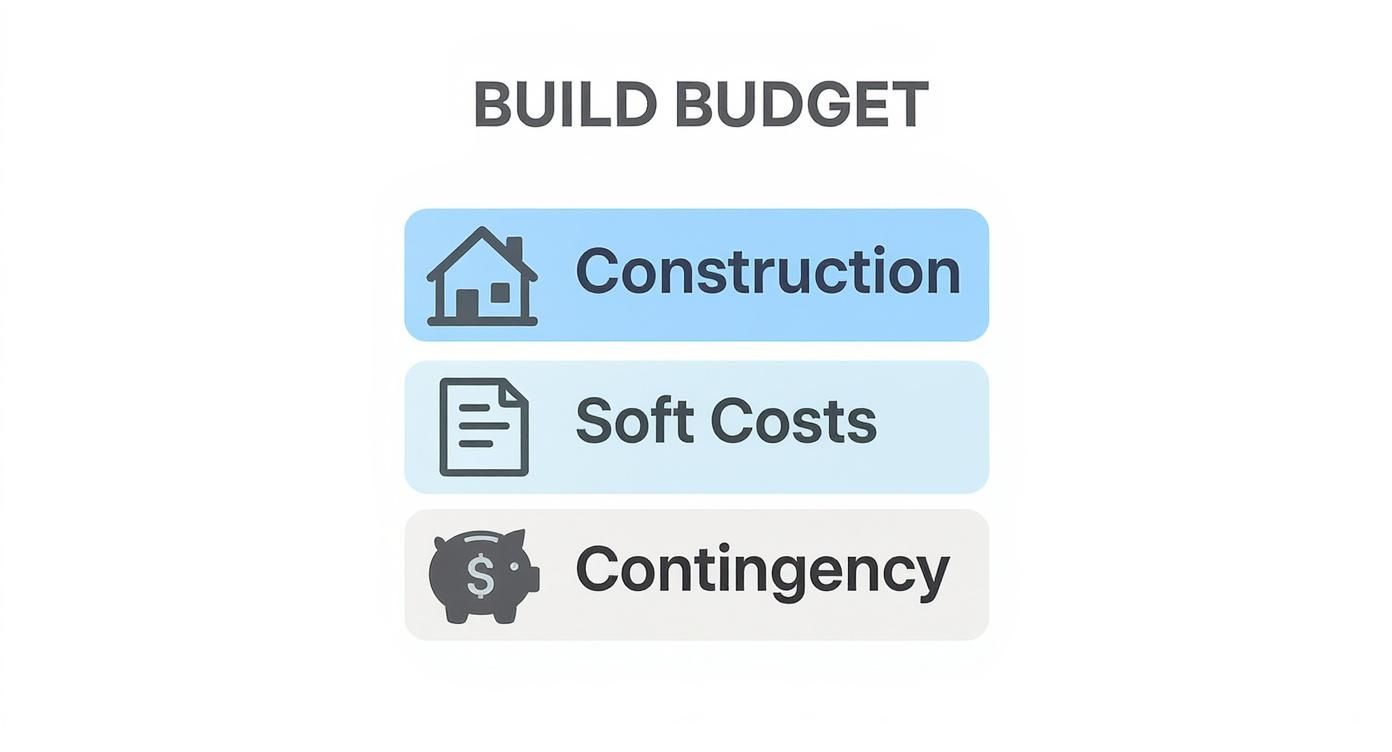
This really highlights that a builder's job goes far beyond just the bricks and mortar; they are also financial managers, juggling soft costs and steering the contingency fund with a steady hand.
Essential Questions for Every Potential Builder
Once your shortlist is ready, it’s time to interview each candidate. This isn't just about getting a price. It's about feeling them out and assessing their professionalism, their expertise, and whether they're the right fit for your specific project. Treat it like a job interview—because that's exactly what it is.
Go in prepared with a list of sharp questions designed to uncover how they really operate.
- Licensing and Insurance: "Can you show me a copy of your DB-U registration number and your current certificate for domestic building insurance?" This is completely non-negotiable. Make sure you verify their details with the Victorian Building Authority (VBA) yourself.
- Local Council Experience: "What's your experience building in our specific council area, like Boroondara, Stonnington, or the Mornington Peninsula?" A builder who knows the quirks of your local council can save you months of frustrating delays.
- Project Capacity: "How many other projects do you have on the go right now, and who will be our dedicated site manager?" This helps you gauge whether they have the bandwidth to give your project the focus it deserves.
- Communication Process: "What's your process for client communication? How often can we expect site meetings, and who will be our main point of contact?" A clear, open line of communication is the bedrock of a good builder-client relationship.
Remember, the Victorian building scene is a mix of big players and smaller, specialised firms. Industry data from IBISWorld shows that the largest companies account for about 36% of housing starts, but skilled independent builders are the true backbone of the custom home market. Your job is to find the right fit for your unique needs, not just the biggest name in the game. You can learn more about Australia's house construction industry trends on IBISWorld.
How to Check References Like a Pro
Any builder’s reference list is a curated collection of their happiest clients. To get the real story, you need to ask questions that dig deeper than, "So, were you happy with the result?"
Try asking these more insightful questions when you chat with their past clients:
- How did the builder handle unexpected problems on site? This is the most telling question you can ask. Every project hits a snag; what truly matters is how they solve it.
- How accurate was the initial budget, and how were variations handled? You're listening for words like "transparent," "fair," and "no surprises" when it comes to costs.
- Was the project completed on the agreed timeline? If not, what caused the delays? This gives you a clear insight into their project management and scheduling skills.
- What was the post-handover support like for fixing any minor defects? A great builder stands by their work long after they’ve handed over the keys.
This deep-dive vetting process might seem like a lot of work upfront, but it’s the best investment you can possibly make in your project's success. For a closer look at this crucial step, you can also check out our guide on how to select a builder, which offers even more practical tips.
By being methodical and asking the right questions, you move from hoping you've found a good builder to knowing you've found the right partner.
Getting Your Head Around Melbourne’s Planning and Permit Maze
If you’re new to building in Melbourne, trying to figure out the approvals process can feel like a full-time job. Every local council, from Bayside to Banyule, has its own unique set of rules and planning schemes. For many homeowners, this is easily the most stressful part of the journey, but getting a handle on the basics makes a world of difference.
The first thing to get straight is the difference between a planning permit and a building permit. They’re not the same thing, and it’s a common rookie mistake to mix them up. Depending on what you’re doing, you might need one, the other, or—more often than not—both.
A planning permit is about getting the green light from the council to use or develop your land in a particular way. It’s all about the bigger picture: how your new home or extension fits into the neighbourhood, what it looks like from the street, and how it affects your neighbours. This is where you’ll run into zoning rules, overlays, and ResCode.
A building permit, on the other hand, is purely about the technical side of the build. It’s a certificate confirming that your architectural and engineering plans are up to snuff with the Building Code of Australia (BCA) and other standards. It’s the final check to ensure your home will be safe, structurally sound, and compliant. You can get a better sense of this in our guide on how to get a building permit in Victoria.
The Unique Challenges of Melbourne Planning
Things get really interesting when you come up against one of Melbourne’s many specific planning controls. This is where an experienced local builder proves their worth, having navigated these hurdles dozens of times before. An out-of-area builder? They might be learning the ropes on your project, which can cost you time and money.
Here are a few classic Melbourne scenarios you could face:
- Heritage Overlays: If you're looking to renovate a beautiful period home in a suburb like Albert Park or Fitzroy, a Heritage Overlay will have a say in everything from the colour of your facade to the style of your window frames. The aim is to preserve the area's character, and that requires a builder who knows how to work with care and compliance.
- Small Lot Housing Codes: On a tight inner-city block in Richmond or South Yarra, you’ll be dealing with strict rules around setbacks, building height, and ensuring you don't cast a shadow over your neighbours' garden. These codes are all about making density liveable.
- ResCode Requirements: This is the statewide rulebook that covers most residential projects. It sets the standards for just about everything—how much of your land you can build on, how much private open space you need to have, and where your windows can go.
The official Victorian Government planning website has plenty of information, but the real challenge is figuring out how it all applies to your specific block of land.
This portal is a great starting point for the state-level rules, but your local council's planning scheme is where you’ll find the details that can make or break your application.
Why Your Builder’s Local Knowledge Is Your Secret Weapon
This is exactly why your choice of home builders in Melbourne VIC is so important. A builder with deep, on-the-ground experience in your specific council area is probably the most valuable asset you can have. They’ve already built relationships with the council planners and private building surveyors who’ll be looking at your application.
They know the unwritten rules. They know what a particular council officer tends to focus on, and what gets an application over the line quickly. That kind of insider knowledge can be the difference between a smooth approval and months of frustrating back-and-forth emails.
A builder who knows the local landscape can spot potential problems long before they become expensive ones. They might suggest a small design tweak that satisfies a tricky council requirement without you having to sacrifice your vision. They know which private surveyor is best for your type of project, ensuring your building permit is handled efficiently. This isn't just about convenience—it's a critical part of keeping your project on track and on budget.
Getting the Paperwork Right: Contracts, Timelines, and What to Expect On-Site
Once you've found the right builder, the project pivots from the 'what if' phase to the nitty-gritty of contracts, schedules, and the physical reality of construction. This is where your vision starts to become a tangible home, and getting your head around the process is the secret to a smooth, low-stress build.
First up is the building contract. This isn't just a formality; it's a hefty legal document that governs every aspect of the build. For any domestic building work in Victoria costing more than $10,000, a major domestic building contract is mandatory. It's designed to protect everyone involved, and a good builder will take the time to walk you through it, clause by clause, so you feel completely comfortable before putting pen to paper.
What to Look for in a Victorian Building Contract
Don’t let your eyes glaze over when you see the fine print. A few key areas have a massive impact on your budget and cash flow, so it pays to understand them inside and out.
- Progress Payments: Your contract will lay out a payment schedule tied to specific, verifiable construction milestones. Think of it as paying for work that’s actually been done. The standard stages are typically base, frame, lock-up, fixing, and completion.
- Variations: It’s almost a given that you'll want to make a tweak or two during the build. A 'variation' is any change to the original contract plans or specs. The contract must clearly state how these are handled—how costs are calculated, approved in writing, and added to the total.
- Provisional Sums (PS) and Prime Cost (PC) Items: These are essentially placeholders for costs that can't be locked in at the time of signing. A PC item is an allowance for a specific fixture, like that perfect Smeg oven or a particular tap. A PS item is a best-guess estimate for labour and materials where the final cost is unknown, like excavation on a tricky block.
A transparent contract is the bedrock of a good builder-client relationship. Your builder should be upfront about how they handle potential cost increases for materials and what protections are in place for both of you. This kind of proactive communication is what separates the great home builders in Melbourne from the rest.
Making Sense of the Project Timeline
Along with the contract, you should receive a detailed project timeline. This often comes in the form of a Gantt chart, which is more than just a rough guide—it's a roadmap for the entire build. It maps out every single task, how long it will take, and which tasks depend on others being finished first.
This timeline reveals the critical path: the sequence of non-negotiable tasks that dictates the project’s total length. If something on that path gets delayed, the whole project finish date gets pushed back. Having this visual tool helps you see what's coming, anticipate the next steps, and understand the real-world impact of any hold-ups, whether they’re due to a week of bad weather or a delay in your tile selection.
For anyone who wants to get deeper into the mechanics, there’s a lot to learn about project managing a build and what it takes to keep everything running smoothly.
From Dirt to Doorstep: The Build in Action
With the paperwork signed and permits in hand, it's time for the real fun to begin. The build follows a logical sequence, starting from the ground up and culminating in the moment you get the keys.
Key Construction Stages
Site Preparation & Base Stage: The site is cleared, the block is levelled in what’s called a "site cut," and all the under-slab plumbing and electrical conduits are laid before the concrete slab is poured. Your home now has its footprint.
Frame Stage: This is when the skeleton of your home goes up. It's a huge milestone because you can finally walk through the rooms and get a true feel for the layout and size of the spaces.
Lock-Up Stage: Just as it sounds, this is when the house becomes a secure, weatherproof shell. The roof goes on, external doors and windows are installed, and the exterior cladding or brickwork is completed.
Fixing Stage: Now the inside really starts to take shape. Plasterboard goes up, internal doors are hung, and all the fiddly bits like architraves, skirting boards, and cabinetry are fitted.
Completion & Handover: The final sprint to the finish line! This stage covers all the finishing touches: painting, tiling, plumbing fit-offs, and installing appliances. Once everything is done, a final inspection is carried out, a practical completion certificate is issued, and you finally get the keys to your beautiful new home.
Throughout this entire process, your relationship with the site manager is key. They're your go-to person on-site, coordinating the trades, checking quality, and keeping the schedule on track. Regular site meetings and clear, open communication will make all the difference, ensuring any little hiccups are sorted out quickly and paving the way for a fantastic building experience.
Your Top Questions About Building a Home in Melbourne, Answered
Thinking about building in Melbourne? You’ve probably got a long list of questions. It’s only natural. From how long it all takes to what the contract should look like, getting straight answers upfront can make the difference between a dream project and a stressful ordeal.
We get these questions every day from homeowners just like you. Let's walk through some of the big ones, so you can move forward with real confidence.
How Long Does It Really Take to Build a House Here?
This is the million-dollar question, and the answer isn't what it used to be. A few years ago, you might have heard six to nine months for a standard build, but the landscape has shifted significantly.
For a custom home in Melbourne today, a realistic timeline is anywhere from 12 to 18 months from the day construction starts to the moment we hand you the keys. Why the longer timeframe? It’s a mix of things – ongoing snags in the supply chain for materials, a real shortage of skilled trades, and councils taking longer to process approvals.
Any good builder will give you a detailed project schedule, often called a Gantt chart, before they even break ground. But what really matters is their communication. You want a team that’s proactive, letting you know about potential delays before they become big problems and explaining exactly how they’re managing them.
In this climate, a builder's project management skills are put to the test. Their ability to order materials months in advance and schedule trades like a game of Tetris is what keeps your build moving forward.
Fixed-Price vs. Cost-Plus Contracts: What's the Difference?
Getting your head around the building contract is non-negotiable for your financial peace of mind. In Melbourne, you’ll mainly come across two types: fixed-price and cost-plus. They’re very different beasts.
- Fixed-Price Contract: This is the go-to for most custom homes in Victoria. The builder agrees to complete the entire project for one fixed, total price. It gives you certainty, protecting you from unexpected cost blowouts. The trade-off? It’s less flexible if you decide you want to make major changes halfway through.
- Cost-Plus Contract: With this setup, you pay the actual cost of all the labour and materials, plus a pre-agreed margin for the builder's profit and overheads. It can feel more transparent because you see every invoice, but it comes with the risk of the final bill creeping up past your original budget.
For the vast majority of homeowners, a fixed-price contract offers the security and predictability you need for an investment of this size.
Getting to Grips with Prime Cost and Provisional Sum Items
Even inside a rock-solid fixed-price contract, there are always a few allowances for things that can't be locked in when you sign. These are called Prime Cost (PC) and Provisional Sum (PS) items.
A Prime Cost (PC) item is simply a budget allowance for a specific fitting you get to choose later. Think tapware, kitchen appliances, or tiles. The contract will have a set amount, say $800 for a kitchen tap. If you fall in love with one that costs $900, you just pay the $100 difference. Easy.
A Provisional Sum (PS) item is an educated estimate for a job where the final cost is still an unknown. The classic example is excavation. No one knows for sure what’s under the ground until the digging starts. If the crew hits a massive sheet of rock, they’ll need heavier machinery and more time, and that’s where this allowance comes in.
Do I Need to Hire a Designer and a Builder?
The traditional way of doing things was to hire an building designer, spend months perfecting a set of plans, and then shop those plans around to different builders for quotes. It can work, but it often creates a painful gap between the design dream and the construction budget.
There’s a much more streamlined way: the design-build model. This is where you work with one integrated team that has its own designers, and construction crew all under one roof.
Having a single point of contact changes everything. The design is created from day one with a sharp eye on your budget, communication is dead simple, and the whole process from concept to completion is usually much, much faster. It gets rid of the 'us vs. them' friction and ensures everyone is pulling in the same direction.
At Envy Abode, we provide a fully integrated design-build service that turns your vision into a stunning reality without the stress. We manage every detail, from concept design to final handover, ensuring a seamless and transparent process. Discover how our approach can create your perfect Melbourne home by visiting us at https://envyabode.com.au.