Malvern EastProject Repton , 2025
“The key thing we were looking for was the consistency in the pricing that we received, having the right team to be able to problem solve when an issue arose, they did it in a very calm and measured manner. They're a great team and we worked so well together, had we done the design with Envy it would have saved us 6 months minimum”
Luxury home builders Melbourne Australia: Elite Homes Guide

Building a custom home from the ground up is a massive undertaking, and it all starts with finding the right partner—one of the best luxury home builders Melbourne Australia has to offer. This isn't just about bricks and mortar; it's about translating your unique vision into a physical, architectural reality that genuinely reflects who you are and how you want to live. It’s a significant investment, both in your family’s future and in Melbourne’s dynamic property market.
Starting Your Melbourne Luxury Home Journey
Creating a bespoke home is a deeply personal process. It goes far beyond simple construction. We're talking about crafting a space that flows with your daily life, from the way the kitchen works during a busy morning to how the living areas are perfectly oriented to catch the afternoon sun. Think of this guide as your roadmap, designed to demystify every stage of the custom home journey here in Melbourne.
We’ll walk through the entire process together, from the very first concept sketches right through to the moment you’re handed the keys. Our goal is simple: to give you the knowledge you need to make smart, confident decisions every step of the way.
Why Build a Luxury Home in Melbourne?
Melbourne's prestige property market isn’t just holding steady—it’s thriving. This growth is fuelled by a real desire for high-quality, personalised living spaces that you just can't find in a standard off-the-plan home. The appeal is about more than a beautiful design; it’s about securing a prime location, integrating advanced technology, and demanding superior craftsmanship.
The numbers tell a compelling story. The market is projected to hit a staggering USD 25.19 billion in 2025 and keep climbing. In the last five years alone, the average value of new-build luxury homes has jumped by nearly 42%, far outpacing the growth of existing properties. This isn't just a fleeting trend; it’s a clear sign of strong investor confidence and the enduring value of creating something new and bespoke.
A custom-built home is a direct reflection of its owner. The true luxury lies in the freedom to design a space around your life, not the other way around. It’s about creating an environment that supports your ambitions, family, and wellbeing.
What This Guide Covers
The journey from an idea to a finished home demands meticulous planning. We’ll explore the critical steps involved, so you know exactly what to expect and how to prepare. If you want a head start, our pre-construction checklist for suburbs like Camberwell is a great resource for tackling those crucial early-stage decisions.
Here are the key areas we'll dive into to make sure your project is a resounding success:
- Site Selection and Builder Vetting: How to choose the perfect block of land and, just as importantly, the right building partner for your vision.
- Costs and Contracts: A transparent look at budgeting, understanding contracts, and steering clear of those dreaded hidden expenses.
- Design and Approvals: The art of collaborating with designers and navigating the specific regulations of your local council.
- Construction and Handover: Managing the build itself, from the day the ground is broken to the final inspection and handover.
Choosing Your Site and Building Partner
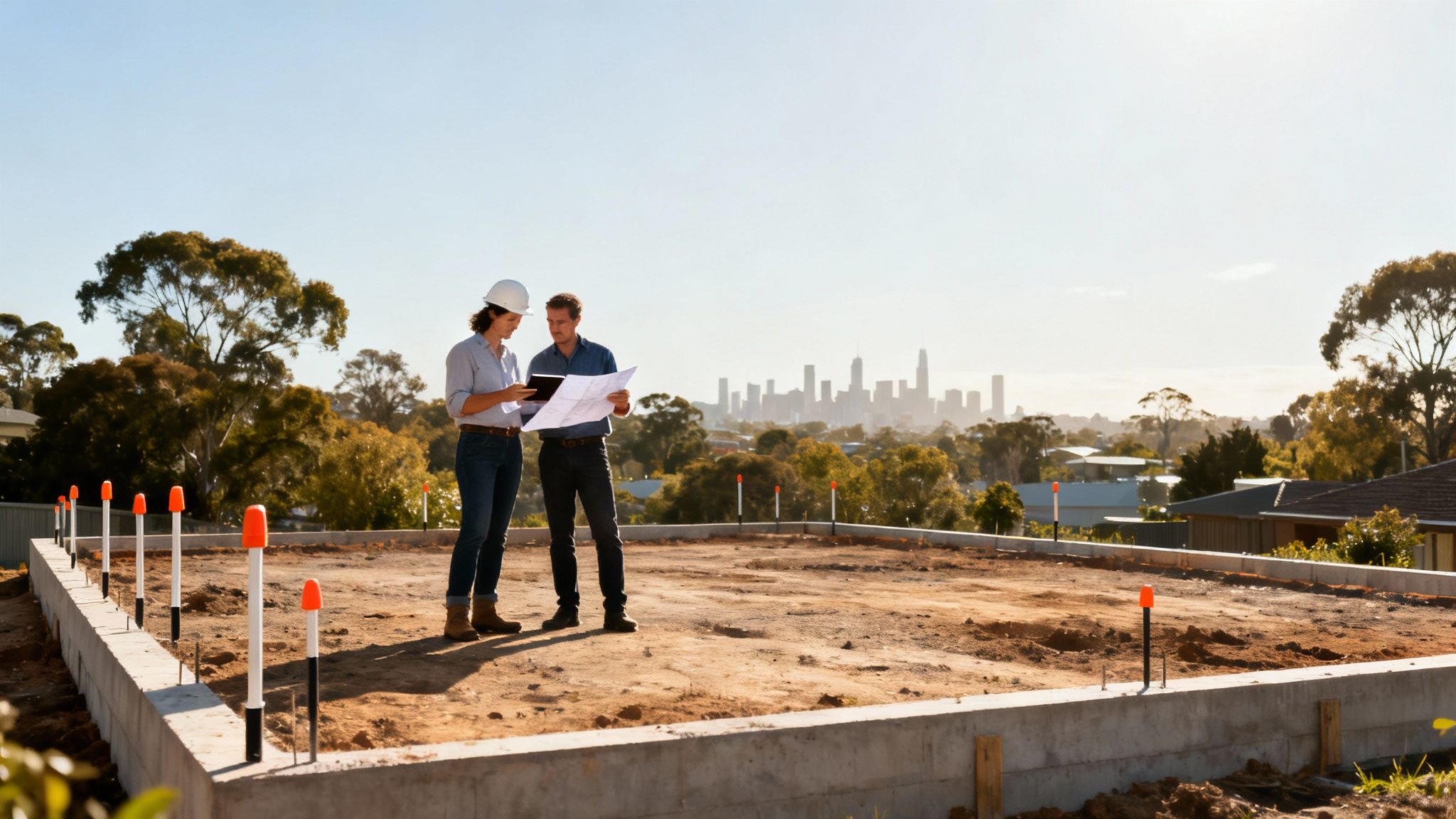
Before a single line is sketched, two foundational decisions will shape your entire project: the piece of land you choose and the team you trust to build on it.
These choices are completely intertwined. The right builder can see the hidden potential in a challenging site, while the perfect block can inspire a design you’d never even imagined. Getting these two elements right from the very beginning is the secret to preventing costly headaches and setting the stage for a smooth, rewarding build.
This is about more than just finding a block with a nice view or a builder with a glossy portfolio. The real work goes much deeper. For your site, it’s about understanding the unseen factors that dictate design and cost. For your builder, it means finding a true partner who shares your vision for quality.
Assessing Your Melbourne Site Potential
A block of land in Melbourne isn't just an address—it's a canvas with its own unique set of characteristics. A thorough site assessment is non-negotiable and should happen before you sign on the dotted line. I’ve seen clients overlook this step only to face significant budget blowouts or design compromises later.
Take a sloping block in a suburb like Balwyn North, for instance. It might offer incredible city views, but it also brings engineering challenges and potential excavation costs that a flat site in Brighton simply wouldn't have.
Here’s what you need to dig into:
- Council Overlays: Always check for planning scheme overlays like heritage, vegetation protection, or special building requirements. A heritage overlay in a suburb like Kew, for example, will heavily influence your home's external appearance and the materials you can use.
- Soil Conditions: A geotechnical report is absolutely essential. Reactive clay soil, which is common in many parts of Melbourne, demands far more complex and expensive footing systems than stable, sandy soil.
- Orientation and Sunlight: How does the sun move across the property throughout the day and across the seasons? Getting the orientation right can dramatically boost your home’s energy efficiency and liveability, flooding your living areas with beautiful natural light.
- Easements and Covenants: Are there any hidden restrictions on where you can build? Utility easements or old developer covenants can catch you by surprise.
A great site isn't just about what you can see. It's about understanding the land's hidden potential and its limitations. An experienced builder can offer invaluable insight here, spotting red flags that an untrained eye would easily miss.
Finding the Right Luxury Home Builder
With a booming construction industry, the search for a building partner can feel overwhelming. Victoria is leading the nation in new home construction—with 20,192 new starts in the last reporting period—and Melbourne is the heart of it all. This means there are plenty of luxury home builders in Melbourne, Australia, but they are not all created equal.
Your goal is to find a builder whose expertise, communication style, and entire project management approach aligns perfectly with your own.
The Vetting Process: A Checklist
You have to move beyond the slick websites and marketing brochures. Your vetting process needs to be methodical and thorough.
- Check Their Credentials: First things first, verify their registration with the Victorian Building Authority (VBA). This is a basic but critical check to ensure they are fully licensed and insured to operate in Victoria.
- Talk to Past Clients: Don't just rely on hand-picked testimonials. Ask for a list of recent clients and, if you can, one or two from several years back to see how the home has held up. Ask them about the communication, how issues were handled, and whether the project stayed on budget.
- Visit Their Work: Request a tour of a project currently under construction and a completed home. This gives you a firsthand look at their workmanship and the organisation of their sites. A clean site is often a sign of a well-run project.
- Evaluate Their Team: Who will you be dealing with day-to-day? Make sure you meet the project manager and site supervisor who would be assigned to your build. A strong, experienced team is just as important as the company’s director.
For a deeper dive into this crucial step, you can learn more about how to select a builder in our detailed guide.
By investing time in this dual-track investigation—assessing your site and rigorously vetting your builder—you create a foundation of confidence that will carry you through the entire project. This groundwork is the single most important investment you'll make.
Understanding Costs and Builder Contracts
Let’s get into the two things that can cause the most sleepless nights on any building project: the money and the paperwork. Getting crystal clear on both is absolutely essential before you sign on the dotted line. Any high-end builder in Melbourne worth their salt knows that total transparency on costs and a fair, easy-to-understand contract are the foundations of a great partnership.
The first step to building a realistic budget is to look beyond a simple square-metre rate. It’s a handy starting point for a rough idea, but it rarely paints the full picture. The true cost of your home is a much more complex equation, influenced by everything from the slope of your block to the specific brand of tapware you’ve fallen in love with.
Decoding the Real Cost of Your Build
Many of our clients are initially surprised by the expenses that fall outside the main construction quote. These aren't "hidden" fees; they are simply necessary costs that come with creating a bespoke, high-calibre home. A great builder will walk you through these from the very beginning to make sure there are no budget shocks down the track.
Some of these crucial budget items to plan for include:
- Significant Site Works: A challenging sloping block in a suburb like Templestowe or hitting unexpected rock during excavation can add tens, or even hundreds, of thousands to your budget before a single drop of concrete is poured.
- Council and Utility Fees: This is a big one. It covers everything from planning and building permit fees to council contributions and the costs of connecting brand new water, gas, and electricity services to your property.
- High-End Finishes and Fittings: The gap between standard and premium is enormous. Think imported Italian marble versus a locally sourced stone, or custom-designed joinery versus off-the-shelf options. Top-of-the-line European appliances alone can significantly shift the final figure.
- Consultant Costs: Your budget needs to have room for the experts who make it all happen—architects, engineers, surveyors, and potentially interior designers or landscape designers.
For luxury custom homes in Melbourne, the construction cost itself typically lands somewhere between $4,000 to $9,000 per square metre. For truly high-end luxury projects, it’s not uncommon to see this climb towards $6,500 per square metre.
So, for a 300-square-metre luxury home, you’re looking at a build cost between $1.2 million and $2.7 million. That's before factoring in land purchase, landscaping, and other premium inclusions.
To help you visualise where the money goes, here’s a typical breakdown.
Sample Budget Breakdown for a Luxury Melbourne Home
This table gives you a rough guide to how a budget is allocated across the different phases of a luxury build. It’s not just about the bricks and mortar; it’s about the professional expertise, compliance, and finishing touches that bring a high-end home to life.
Cost Category | Estimated Percentage of Total Budget | Key Considerations for Melbourne |
Site Works & Preliminaries | 10% - 15% | Soil conditions, slope (common in eastern suburbs), demolition of existing structures, council fees, and service connections. |
Structure (Slab, Frame, Roof) | 20% - 25% | Complexity of architectural design, choice of materials (e.g., steel vs. timber frame), and roofing materials. |
External Cladding & Windows | 15% - 20% | High-performance, double-glazed windows are crucial for Melbourne's climate. Cladding choices (brick, render, timber) greatly affect cost. |
Internal Finishes & Joinery | 20% - 25% | This is a major variable. Includes flooring, custom cabinetry, stone benchtops, tiling, and paint. |
Fixtures, Fittings & Appliances | 10% - 15% | Can escalate quickly depending on brand and quality. Includes tapware, lighting, and kitchen appliances. |
Prime Cost & Provisional Sums | 5% - 10% | A builder's allowance for items not yet selected (e.g., specific tiles or appliances) or for work that can't be quoted precisely upfront. |
Remember, this is a guide. Your builder should provide a detailed, itemised quote that reflects your specific plans and selections.
Fixed-Price vs Cost-Plus Contracts
When it comes to the contract itself, you’ll generally come across two main types. Neither is better than the other; the right one simply depends on your project’s complexity and your own appetite for financial risk.
A fixed-price contract offers security. You agree on one solid price for a very detailed scope of works. This is perfect when every single decision—from the doorknobs to the roof tiles—has been made before construction starts. It minimises surprises.
On the other hand, a cost-plus contract (sometimes called a cost-plus-margin contract) means you pay the actual cost of all labour and materials, plus an agreed-upon builder's margin. This model gives you incredible flexibility to make changes as you go but offers less certainty on the final budget. It's often used for highly architectural or complex renovations where not all costs can be predicted.
A fixed-price contract is all about protecting your budget, while a cost-plus contract is about maximising flexibility. The best approach is to have an open conversation with your builder about which structure makes the most sense for your home and your personality.
Your Building Contract Checklist
Your building contract is the most important document you’ll sign in this entire process. It needs to be a comprehensive, clear, and fair agreement that protects both you and your builder. Never, ever sign a contract you don’t 100% understand. It’s always a smart move to have it looked over by a solicitor who specialises in construction law.
Before you put pen to paper, make sure the contract includes these non-negotiables:
- A Detailed Scope of Works: It should list everything. We’re talking about the brand of tapware, the model of the oven, the type of insulation in the walls. Vague terms like “premium appliances” are a massive red flag.
- Complete Plans and Specifications: All the working drawings, engineering plans, and schedules of finishes should be attached and clearly referenced in the contract.
- A Clear Payment Schedule: The contract must outline the progress payment stages, which are typically tied to major construction milestones like ‘slab down’, ‘frame complete’, and ‘lock-up stage’.
- Defined Timelines: It must state a clear start date and a target completion date, along with how things like unavoidable weather delays will be handled.
- Process for Variations: There has to be a formal, written process for managing any changes you want to make, including how the extra costs will be calculated and approved by you.
- Dispute Resolution Clause: Just in case things go sideways, you need a clear, pre-agreed process for resolving any disagreements. It provides peace of mind for everyone.
Getting your head around the complete financial picture is one of the most empowering things you can do. For a deeper dive, check out our in-depth home building cost breakdown to see exactly where your investment goes.
Navigating Design and Council Approvals
With the finances sorted and contracts signed, we step into what is easily one of the most exciting parts of the journey: bringing your vision to life on paper. This is where your dream home starts to take real shape, born from a close collaboration between you, us, and our design team. It's a delicate dance, balancing your biggest aspirations with the practicalities of building, and pure aesthetics with everyday function.
To get this right, you really need to nail two things. First, there's the creative collaboration—making sure your ideas are heard, understood, and refined by experts. The second piece of the puzzle is the administrative side: steering your beautiful, finalised design through the maze of local council approvals. A top-tier builder is your guide through both, turning what could be major roadblocks into a smooth, clear path forward.
Crafting a Truly Collaborative Design
The initial design stage is all about conversation. Your job is to bring the vision, to share how you want to live, and to sprinkle in those personal touches that will transform a structure into a home. Our job is to bring the technical know-how, the creative problem-solving, and the critical understanding of what's actually buildable within your budget.
Your most powerful tool here is a detailed design brief. And I mean really detailed—go way beyond just listing how many bedrooms you want. Think about the rhythm of your daily life.
Do you love to entertain? Maybe you need a seamless flow from the kitchen straight out to a stunning alfresco area.
Is working from home your reality? You'll probably want a quiet, light-drenched office tucked away from the main family chaos.
Could you see multi-generational living in your future? A ground-floor master suite might be non-negotiable.
The more you can tell us about your lifestyle, the better our design team can craft a home that genuinely works for you. A great starting point is to explore different luxury home layouts and see what sparks your imagination.
Think of your design brief as the story of your future life in this home. It’s not about square metres; it’s about morning coffee routines, big family Christmases, and quiet Sunday afternoons. The best designs always come from an architect who truly gets that story.
The Melbourne Council Approval Maze
Once we’ve locked in a design you absolutely love, the focus shifts to getting the official green light. In Melbourne, this usually involves a two-step process with different authorities. This is where a builder's local experience becomes invaluable, because believe me, every single council has its own unique set of rules and priorities.
First up is the Town Planning Permit, which is handled by your local council. This permit basically checks how your proposed home fits into the neighbourhood. They'll look at its impact on the streetscape, your neighbours, and any local environmental policies.
This is where things can get very specific. A project in a suburb like Kew, for instance, might be subject to strict heritage overlays that dictate everything from the look of the facade to the types of materials you can use. Over in a leafy Bayside suburb like Brighton, you're often dealing with Vegetation Protection Overlays, which can limit tree removal and influence where the home sits on the block. An experienced luxury home builder in Melbourne, Australia, knows to look for these potential hurdles from day one and design with them in mind.
Securing Your Building Permit
With the planning permit in hand, we move on to the Building Permit. This is a different beast altogether. It's overseen by a registered building surveyor (either from the council or a private firm) and is all about the technical side, governed by the Victorian Building Authority (VBA).
This permit is purely focused on ensuring your home is safe, structurally sound, and meets modern standards. The surveyor will do a deep dive into all the construction documents, making sure everything complies with the National Construction Code and relevant Australian Standards. This includes a meticulous review of:
- Construction and Structural Engineering Drawings: The complete, detailed blueprints for your home.
- Soil Reports and Foundation Designs: This ensures the foundations are engineered perfectly for your specific site conditions.
- Energy Efficiency Reports: Proof that your home meets or exceeds today's energy standards.
While this process is less subjective than planning, it demands absolute precision in the paperwork. A builder who has strong relationships with trusted, reliable surveyors can help make sure this stage moves along swiftly, without any frustrating and unnecessary delays. By understanding both sides of this coin—the creative vision and the bureaucratic process—you can move confidently from an idea on paper to a fully approved plan, ready for the first shovel to hit the ground.
From Groundbreaking to Final Handover
This is it—the moment all that meticulous planning, design work, and paperwork has been building towards. There’s nothing quite like seeing the first soil turned and watching the bones of your home start to take shape. It’s an incredibly rewarding experience, transforming your vision from a blueprint into a tangible reality.
But this phase isn’t just about sitting back and watching. It’s a dynamic, collaborative process. The key to a smooth journey, from the first concrete pour to the day you’re handed the keys, is a rock-solid partnership with your project manager.
Clear and consistent communication is absolutely non-negotiable. Your builder should set a regular rhythm for site meetings. These are your chance to walk the grounds, see the progress with your own eyes, ask questions, and make those timely decisions that keep the project flowing. It’s this proactive teamwork that nips potential issues in the bud and keeps everyone on the same page.
Staying Engaged During Construction
While the builders are doing the heavy lifting, your input at key moments is what transforms a house into your home. Think of the build as a series of stages, each one laying the foundation for the next, and each requiring your specific attention at the right time.
Those scheduled site walks with your project manager are invaluable. This isn't about looking over the trades' shoulders; it's about getting a feel for the spaces as they come to life. It’s your opportunity to visualise the flow, see how your design choices are materialising, and confirm everything is tracking with the plans you so carefully created.
Navigating Finishes and Selections
Finalising your finishes and fittings is easily one of the most exciting parts of the build. This is where your home’s true personality emerges—from the warmth of the engineered timber floors to the exact style of tapware in the ensuite. It’s also the point where budgets can get a little wild if not managed with a firm hand.
Most custom home contracts include allowances for items that haven’t been locked in before construction starts. You’ll hear two main terms:
- Prime Cost (PC) Items: This is a budgeted allowance for a specific fitting where you haven't made a final choice yet. Think appliances, taps, or light fixtures. The contract includes an estimated cost, and you'll pay the actual price once your selection is made.
- Provisional Sum (PS) Items: This is an allowance for a scope of work that can’t be precisely costed upfront. Excavation is a classic example—it's impossible to know exactly what’s under the ground until the digging begins.
The secret to managing these is making decisions promptly and staying on top of how your choices affect the bottom line. If you fall in love with a Sub-Zero fridge that costs more than the PC allowance, that difference simply gets added to your next progress payment. The best luxury home builders in Melbourne, Australia, will give you clear deadlines for these selections to ensure the project never loses momentum.
The journey to this point, from the initial sketch to the building permit, is a critical sequence that has to happen before any site work can even begin.
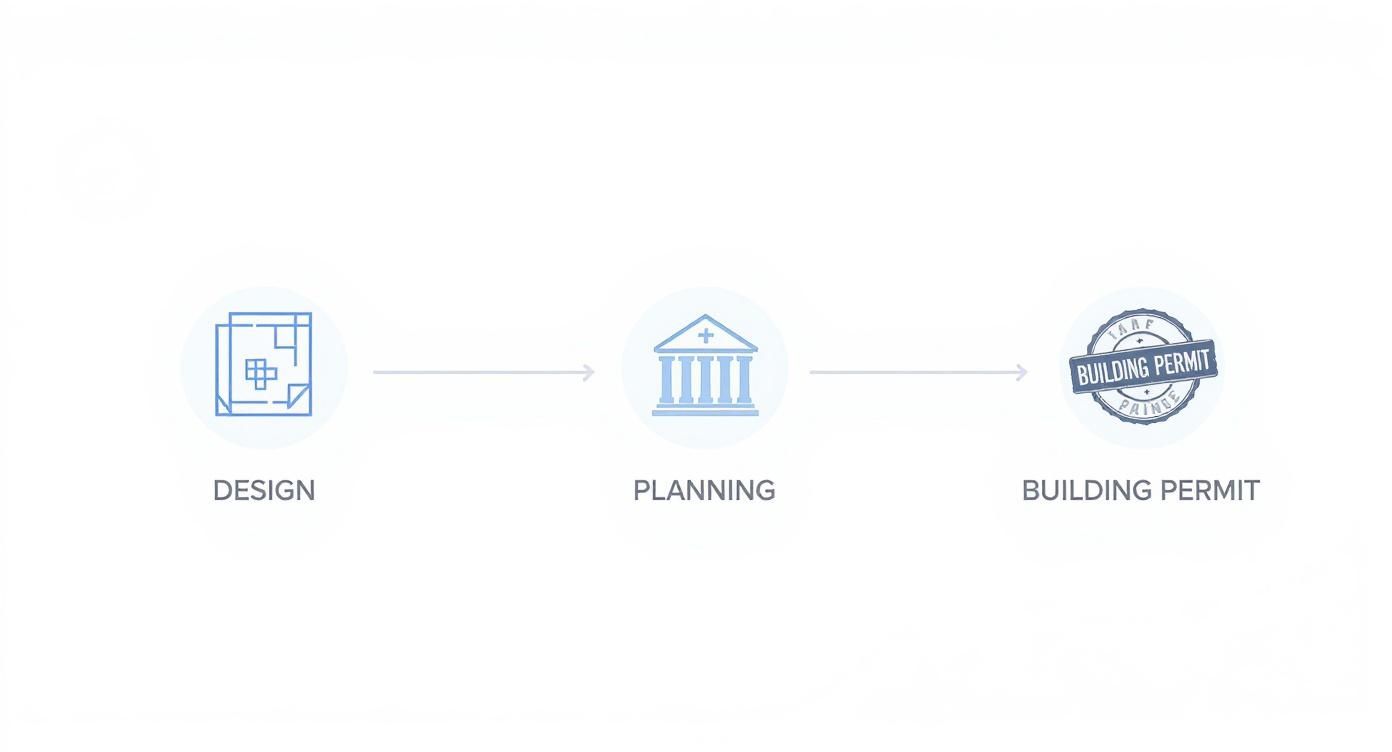
This process ensures that by the time construction starts, every detail has been accounted for, setting the stage for a successful build. To help you understand what's coming, here's a look at the key stages and where your input will be most vital.
Key Construction Milestones and Client Involvement
This table outlines the typical flow of the construction process, giving you an idea of timelines and highlighting the key points where your decisions are needed to keep things moving smoothly.
Construction Stage | Typical Duration | Client Action Items |
Site Preparation & Foundation | 2–4 weeks | Confirm final site placement; review excavation progress if PS items are involved. |
Framing & Lock-Up | 4–8 weeks | Walk-through to confirm room layouts, window/door placements, and overall flow. |
Rough-In (Plumbing, Electrical) | 2–4 weeks | On-site meeting to finalise exact placement of power points, switches, and lighting. |
Interior Linings & Finishes | 6–10 weeks | Finalise paint colours, flooring, cabinetry, tile selections, and PC item choices. |
Practical Completion & Handover | 2–3 weeks | Conduct detailed final inspection (PCI); sign off on defects list and final payment. |
Each stage builds upon the last, so timely decisions are crucial for maintaining the project's schedule and avoiding costly delays. Your project manager will guide you through each of these action items with plenty of notice.
Ensuring Uncompromising Quality
Throughout the entire build, quality checks are happening constantly. Your builder’s team, alongside independent building surveyors, will conduct inspections at every critical milestone. These aren’t optional; they’re mandated to ensure every part of your home meets Australia’s stringent National Construction Code.
They’ll check the steel reinforcement before the slab is poured, inspect the integrity of the timber frame, and verify the waterproofing is perfect before a single tile is laid.
A builder’s commitment to quality isn't just about the beautiful finishes you can see. It's about the hundreds of unseen details behind the walls—the precision of the framing, the integrity of the waterproofing, the quality of the insulation—that ensure your home is built to stand the test of time.
As the project winds down, you'll be invited to the Practical Completion Inspection (PCI), or what most of us call the final walkthrough. This is your chance to go over every inch of your new home with a fine-toothed comb alongside your project manager. Together, you’ll create a "defects list" of any minor items needing attention—a paint touch-up here, a stiff door handle there.
Take your time with this. Flick every light switch, open every drawer, and run your hand over every surface. A reputable builder welcomes this scrutiny. They’ll work diligently to tick off every single item on your list before the official handover.
Once you’re completely satisfied that the home is finished to the exceptional standard you expect, the final payment is made. And then comes the best part: you get the keys to your incredible new home.
Answering Your Big Questions About Building a Luxury Home
Embarking on a custom build journey is exciting, but it naturally comes with a lot of questions. Getting your head around timelines, locations, and who does what is the key to feeling confident and in control of your project.
Here are some of the most common queries we get from clients thinking about a bespoke home in Melbourne. Getting clear, straightforward answers early on helps set the right expectations and ensures you’re making smart decisions from day one.
How Long Does a Luxury Home Build in Melbourne Actually Take?
This is usually the first question on everyone's mind. While no two projects are ever the same, a realistic timeframe for a luxury build generally breaks down into two main phases.
First, there’s the pre-construction stage. This is where all the creative and administrative work happens—design development, engineering, and navigating the council approvals process. You should typically set aside 6 to 9 months for this part.
Once we have the green light and are ready to break ground, the build itself can take anywhere from 12 to 24 months. Things like intricate architectural details, adding a basement, or waiting on rare, imported materials can nudge the timeline towards the longer end of that scale. Your builder will provide a detailed project schedule in your contract, and that will be your most reliable guide.
What Are the Best Melbourne Suburbs for a New Luxury Home?
Melbourne has an incredible variety of suburbs, each with its own character and appeal. Honestly, the "best" one comes down to your personal lifestyle.
- Established Prestige: If you're after grand homes on large blocks with a blue-chip reputation, you can't go past suburbs like Toorak, Canterbury, and Hawthorn. They’re classics for a reason.
- Bayside Lifestyle: For those drawn to the water, suburbs like Brighton and Portsea offer a premium coastal lifestyle with stunning bay views and a sophisticated, relaxed community feel.
Ultimately, your choice will be a balance between things like proximity to the right schools, the kind of community atmosphere you're looking for, and the overall feel you want for your new home.
Choosing a suburb is about more than just an address; it's about investing in a lifestyle. Think about how you want to spend your weekends, what your commute will look like, and the community you want to be a part of. The land is the very first chapter of your home's story.
Should I Use a Custom Builder or a Volume Builder?
This question really gets to the heart of what kind of home you want to create.
Volume builders are great at what they do—offering a selection of pre-designed plans with a limited menu of customisation options. It’s an efficient model that keeps costs predictable, but it comes at the cost of genuine flexibility.
A luxury custom home builder, on the other hand, offers a completely bespoke service. We work directly with you and an building designer to design and construct a one-of-a-kind home that’s tailored specifically to your block of land, your family, and your unique way of life. This path guarantees a higher level of craftsmanship, access to better quality materials, and a result that is truly yours.
Do I Need to Hire My Own Building Designer?
The answer here often depends on how a particular builder operates. It’s a crucial question to ask when you first meet with potential luxury home builders in Melbourne, Australia.
Some firms, like ours, offer a fully integrated design and build service. This just means we have our own talented home designers in-house who work with you from the very first sketch. It can really streamline communication and the whole process.
Other excellent builders prefer to collaborate with an external designers you’ve hired separately. There are pros and cons to both approaches, so it's important to find out a builder’s preferred workflow to make sure it’s a good fit for you.
Ready to start the conversation about your own bespoke home? The team at Envy Abode is here to guide you through every stage, from initial design concepts to the final handover. Visit us online to explore our portfolio and book a consultation.