Malvern EastProject Repton , 2025
“The key thing we were looking for was the consistency in the pricing that we received, having the right team to be able to problem solve when an issue arose, they did it in a very calm and measured manner. They're a great team and we worked so well together, had we done the design with Envy it would have saved us 6 months minimum”
Knockdown rebuild cost: Real breakdown & tips

When you start exploring a knockdown rebuild, it's easy to focus solely on the construction price tag. But the reality is, a successful project is a complex orchestra of demolition, architectural design, council approvals, and finally, the build itself. The true knockdown rebuild cost is the sum of all these moving parts, especially in premium Melbourne suburbs like Toorak, where bespoke design and high-end finishes really shape the final investment.
Understanding the Real Cost of a Knockdown Rebuild
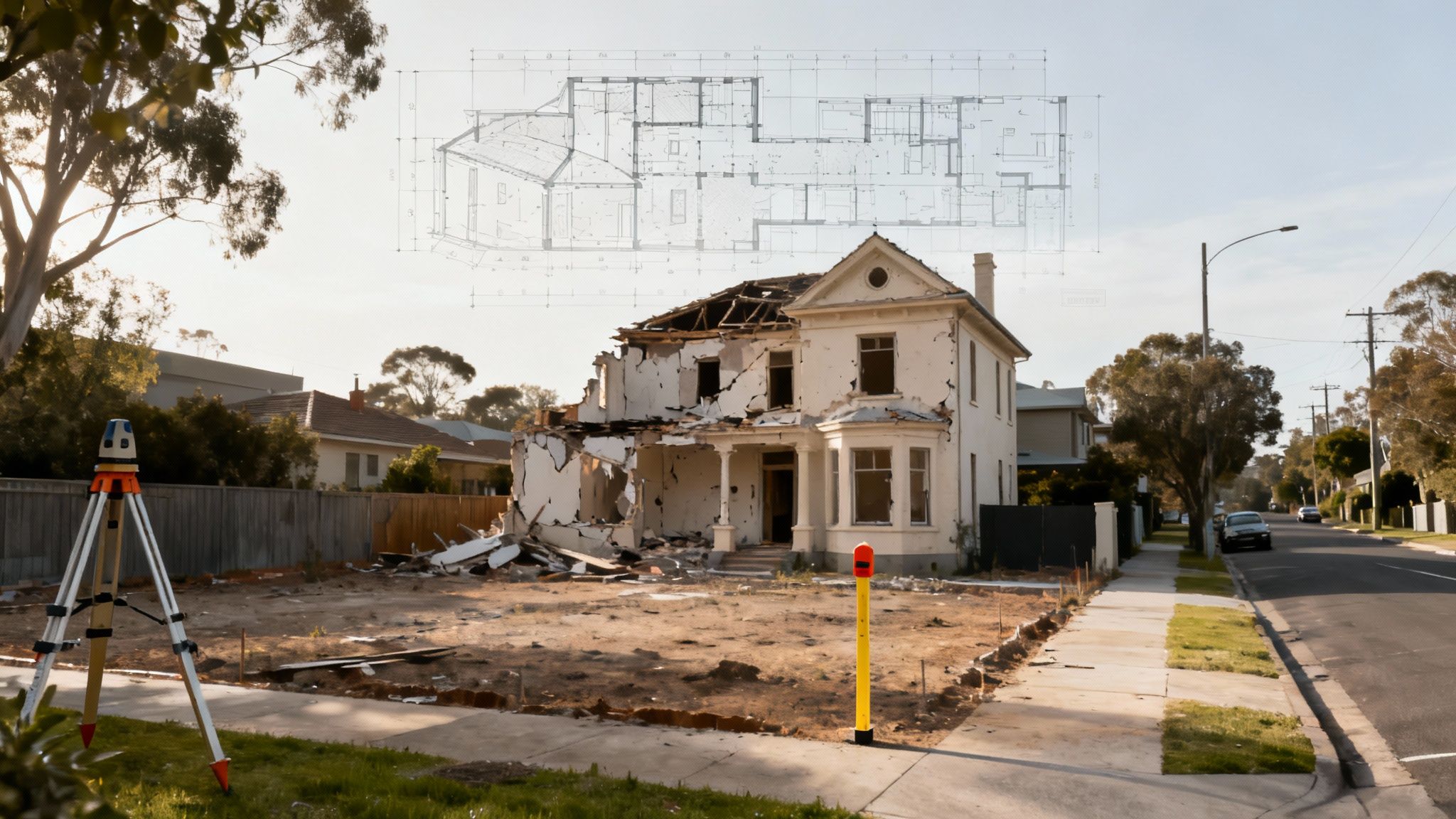
Embarking on a knockdown rebuild isn't just an expense; it's a strategic investment in creating a home that’s perfectly aligned with your family, your lifestyle, and your location. Instead of thinking of it as one massive bill, it’s far more helpful to see it as a series of interconnected costs. From the very first soil tests to the final brushstroke of paint, every decision you make plays a part in the budget.
Across Australia, the cost to knock down and rebuild a house typically lands somewhere between $650,000 and over $950,000. That ballpark figure includes the initial demolition, which often costs between $73 and $164 per square metre. Of course, this is just a starting point. The real cost is uncovered when you start digging into the details of your specific project in a location like Toorak.
To help you get a clearer picture, we've put together a quick overview of the main cost components.
Knockdown Rebuild Cost Breakdown at a Glance
Project Phase | Typical Cost Range (AU$) | Approximate % of Total Budget |
Demolition & Site Prep | $20,000 – $40,000 | 4% - 6% |
Design & Engineering Fees | $30,000 – $80,000+ | 7% - 12% |
Permits & Council Fees | $10,000 – $25,000 | 2% - 4% |
Construction Costs | $580,000 – $900,000+ | 80% - 85% |
Contingency Fund | (10% of total) | (Recommended) |
This table gives you a sense of where your money goes, but the real story is in the specifics of your land and your vision.
Key Factors Influencing Your Budget
There are many factors that affect a knockdown rebuild cost. Getting your head around these from the get-go allows for much more realistic planning and helps avoid any nasty surprises down the track. The final figure isn't a single price tag; it's the sum of your choices.
The most significant factors include:
- Site access: Is your block in a narrow Toorak street, making it difficult for machinery to get in and out? The tougher the access, the higher the prep costs.
- Home design: For example, is it a basic project home or a complex architectural residence? The more intricate the design, the more it will cost to build.
- Level of finishes: This is a major variable. What fixtures and finishes are chosen—from standard inclusions to imported marble and high-end European appliances—will significantly influence your overall budget.
- Customer service: The most important factor of all is the level of customer service you expect. An integrated design-build firm offering a seamless, high-touch experience will factor this premium service into the cost structure.
For a deeper dive into how these numbers come together, check out our guide on the complete home building cost breakdown.
The Four Pillars That Shape Your Final Budget
The final cost of a knockdown rebuild is never a single, off-the-shelf number. It’s a figure carefully shaped by four fundamental pillars, with each one representing a series of critical decisions you'll make along the way. Getting your head around these is the key to creating a realistic budget and truly understanding where your investment is going.
Think of it like commissioning a bespoke suit. The final price depends entirely on the fabric you choose, the complexity of the cut, the quality of the stitching, and the level of service you get from the tailor. Your new home is no different.
Pillar 1: Site Conditions and Access
Before we even think about blueprints, the land itself has a huge say in the initial costs. Your block is the foundation for everything that follows, and its unique personality can either make the build a breeze or introduce complications that directly impact your budget.
Building on a perfectly flat, clear block is about as straightforward as it gets. But let's be realistic—many of the best properties, especially in established suburbs like Toorak, come with their own set of challenges.
- Sloping Blocks: A slope demands serious earthworks, retaining walls, and specialised foundation engineering just to create a stable platform to build on. These things can easily add tens of thousands to your site prep costs before a single frame goes up.
- Soil Quality: The type of soil underfoot dictates the kind of slab and footings your home needs. Reactive clay, which is common around Melbourne, loves to expand and contract with moisture. This means we need more robust—and expensive—engineering to stop structural problems from appearing down the line.
- Site Access: Think about those narrow streets, heritage overlays, or tightly packed neighbouring homes in suburbs like Toorak. They can make it incredibly difficult for large machinery to get in and out. This might mean using smaller, less efficient equipment or organising traffic management plans, all of which add time and labour costs to the job.
A challenging site isn't a deal-breaker, but it is a budget item that needs to be faced head-on from day one. A thorough site assessment is our first step in uncovering these potential costs and planning for them properly.
Pillar 2: Home Design Complexity
The second pillar is all about the architectural vision for your home. This is where the line between a standard project home and a bespoke architectural residence becomes crystal clear, and it has a massive impact on the knockdown rebuild cost.
A basic design from a volume builder is engineered for efficiency and repetition. It uses standard materials and construction methods to keep the numbers predictable. An architectural home, on the other hand, is a one-of-a-kind creation designed specifically for you and your block of land.
Here’s the contrast:
- Basic Design: A simple rectangular footprint, standard ceiling heights, and a conventional roofline. It’s faster to build and doesn't require highly specialised trades.
- Architectural Design: This is where you see features like curved walls, cantilevered sections, huge expanses of custom glass, complex roof pitches, and dramatic voids or atriums. These elements demand advanced engineering, highly skilled tradespeople, and custom-made materials, all of which drive up the cost per square metre.
You can dive deeper into how these factors play out in our guide to understanding building costs per square metre.
Pillar 3: Finishes and Fixtures
For many of our clients, this is the most exciting part. It’s where you get to stamp your personal style all over the home. It’s also one of the most variable parts of the budget, as your choice of materials, fittings, and appliances can make the final cost swing dramatically.
The spectrum of choice is massive, and every single selection has a price tag.
- Standard Inclusions: These are the builder's baseline offerings. They're typically good quality, but they're mass-produced items like laminate benchtops, basic tiles, and standard tapware.
- Premium & Luxury Selections: This is where you can truly let your imagination run wild. Upgrading to imported European marble, custom-designed joinery, high-end Miele or Gaggenau appliances, designer lighting, and premium hardwood flooring will substantially lift the budget. A kitchen fit-out alone can range from $45,000 for standard finishes to well over $195,000 for a high-end, bespoke design.
Pillar 4: Level of Customer Service
The final pillar—and one that's often forgotten—is the level of service and project management you want. The experience of building a home is just as important as the outcome, and how your team is structured makes all the difference.
You could try to be your own project manager, hiring individual contractors—an architect, an engineer, a builder, and all the trades. It might look cheaper on paper, but it often leads to communication gaps, scheduling nightmares, and budget blowouts as you become responsible for every single detail.
The alternative is an all-inclusive design-build firm like Envy Abode, which offers a seamless, high-touch experience. This integrated model gives you a single point of contact who is responsible for every stage, from the first sketch to the final handover. That premium service, which includes meticulous project management, clear communication, and quality control, is built into the overall cost. It's an investment in peace of mind, efficiency, and a genuinely smoother journey to your dream home.
Your Step-by-Step Knockdown Rebuild Cost Journey
Mapping out the finances for a knockdown rebuild isn't just about a single number; it's about understanding the journey. To move from a vague estimate to a concrete plan, you need to see how the costs flow chronologically, from the first soil test right through to the final handover. Think of it as a series of distinct stages, each with its own set of expenses.
This isn't as complex as it sounds. The infographic below breaks it down into the four core pillars that really drive your budget.
As you can see, everything comes back to your site's conditions, the complexity of the design, your choice of finishes, and the level of service you need to bring it all together.
Pre-Construction: The Foundation of Your Budget
Long before the first sod of earth is turned, some of the most important investments are made. This initial phase is all about due diligence and meticulous planning. It’s where we ensure your project starts on solid ground—both literally and financially. These aren’t optional extras; they're the essential steps that prevent very expensive surprises down the track.
Your pre-construction costs will typically include:
- Soil Testing and Land Surveying: This tells us exactly what we're building on. It reveals the soil's composition and maps out the precise boundaries and contours of your land, giving our structural engineer the critical data needed to design the perfect foundations.
- Architectural and Engineering Drawings: This is where your vision becomes a detailed blueprint. Architectural plans define the layout, flow, and aesthetics, while the engineering computations ensure your home is safe, sound, and compliant with all building codes.
- Council Applications and Permits: Navigating the planning requirements in a suburb like Toorak demands real expertise. These fees cover the submission of your development application (DA) and all the other permits needed to get the official green light to build.
While these upfront costs are only a small fraction of the total budget, they are arguably the most important. They set your entire project up for success. To see how these early steps fit into the bigger picture, take a look at our detailed guide on the cost of rebuilding a house.
Demolition and Site Preparation
Once your plans get the stamp of approval, the real action begins. The first physical step is clearing the way for your new home. Demolition is much more than just knocking down an old house; it's a careful, systematic process of deconstruction and site preparation.
Key costs during this phase involve:
- Demolition Permits and Process: Securing the right permits is the first hurdle. The demolition itself then requires heavy machinery and skilled operators to bring down the existing structure safely and efficiently.
- Asbestos Removal: It’s a reality that many older homes contain asbestos. If we find it, licensed professionals must remove it according to strict safety protocols. It's a specialised and non-negotiable expense.
- Site Clearing and Levelling: After the old house is gone, the site is cleared of all debris. We then bring in earthmoving equipment to level the block, creating a clean, stable and perfectly prepared canvas for your new home.
Construction: The Build Phase
This is where the magic happens and where the largest portion of your knockdown rebuild cost is allocated. Your vision finally begins to take physical shape. The construction budget covers all the labour and materials required to build your home from the ground up, and we typically break it down into key stages.
As a general guide, residential rebuilding costs in Melbourne range from $3,500 to over $8,000 per square metre. This figure is heavily influenced by the home's size, the quality of materials, and, of course, location. It’s no surprise that prime metropolitan areas see costs at the higher end, driven by labour expenses and the demand for more complex, high-end designs.
The main construction stages include:
- Foundations: The concrete slab and footings are poured, creating the solid structural base for the entire home.
- Framing: The timber or steel frame goes up, outlining the walls, floors, and roofline. You start to get a real feel for the spaces.
- Lock-Up Stage: This is a huge milestone. The external walls, windows, and roof are installed, making the home secure and weatherproof so the internal work can begin.
- Interior Fit-Out: Now we bring the interiors to life. This covers all the internal work, including plumbing, electrical wiring, plastering, custom joinery, tiling, and painting.
The Crucial Contingency Fund
No matter how perfectly you plan, a project of this scale will always have a few unknowns. That’s why a contingency fund isn’t just a good idea—it’s an essential part of a responsible knockdown rebuild budget. This isn't a "slush fund"; it's a calculated safety net to protect your project from those unforeseen challenges.
We strongly advise our clients to set aside 10-15% of the total construction cost for contingency. On a $2 million build, that means having a buffer of $200,000 to $300,000. This fund is there for things like hitting unexpected rock during excavation, delays from extreme weather, or sudden spikes in material prices. It gives you the financial peace of mind to handle these hurdles without ever having to compromise on your vision or the quality of your home.
Why Homeowners in Established Suburbs Are Rebuilding
The decision to knock down and rebuild is about so much more than just a new house. It’s a strategic choice about your lifestyle, your location, and the long-term value you’re building for your family. For homeowners in sought-after suburbs like Toorak, the motivation isn't simply needing more space—it's about creating the perfect home in a place they already love and refuse to leave.
This trend is born from a classic dilemma. You’ve outgrown your current home, but the thought of moving means giving up a beloved community, great schools, and a location you’ve spent years putting down roots in. A major renovation often feels like patching over the problem, forcing you to work within the confines of an awkward, outdated floor plan.
Securing Your Location and Modernising Your Lifestyle
This is where the real power of a knockdown rebuild shines. You get to keep your most valuable asset—your land in a premium Melbourne suburb—while replacing a tired, ageing house with a brand new home designed for modern life.
It's your chance to design for how your family lives now and how you'll live in the future. Think energy efficiency, smart home integration, and that seamless indoor-outdoor connection that older homes just can’t deliver. Instead of battling it out in the property market for a house that almost fits, you can build one that is a perfect reflection of you, right down to the last detail. It’s a solution that honours both place and purpose, giving you a far superior lifestyle without uprooting your entire world.
And it's a path more and more Australians are choosing. Between July 2019 and June 2025, knockdown rebuilds made up a massive 19.2% of all dwelling approvals across the country, which adds up to over 214,000 projects. Unsurprisingly, this trend is strongest in established suburbs close to major city centres like Melbourne and Sydney. You can dig into more of the data from the Australian Bureau of Statistics about knock-down rebuild approvals.
A Superior Return on Investment
From a purely financial standpoint, a knockdown rebuild often delivers a much better long-term return than a complicated renovation. When you start pulling apart an old house, you can open a Pandora's box of expensive, hidden problems—asbestos, faulty wiring, or even crumbling foundations.
These nasty surprises can send costs spiralling, often pushing the final bill into new-build territory but with a compromised result. A brand new home, on the other hand, is a clean slate. Built to today’s rigorous standards, it not only gives you peace of mind but also appreciates in value more reliably, free from the hidden defects of an old structure.
Setting Realistic Timelines
While the benefits are undeniable, it's crucial to go in with your eyes wide open about the timeline. A knockdown rebuild, especially for a custom architectural home, is a marathon, not a sprint.
We can break the whole journey down into three key phases:
- Pre-Construction (6–12 months): This is the planning stage. It covers everything from initial design concepts and detailed architectural drawings to engineering reports and navigating the council approvals process.
- Demolition (2–4 weeks): Once all the permits are in place, the physical work begins with the safe and methodical demolition of the old house.
- Construction (12–24 months): This is the longest phase, where your new home takes shape. For a high-end build with bespoke features and finishes, this stage requires patience and precision.
Understanding this investment of time is just as important as understanding the knockdown rebuild cost. You can learn more about what to expect in our detailed guide to undertaking a knock down rebuild in Melbourne.
Choosing Your Path: Knockdown Rebuild vs. Renovation
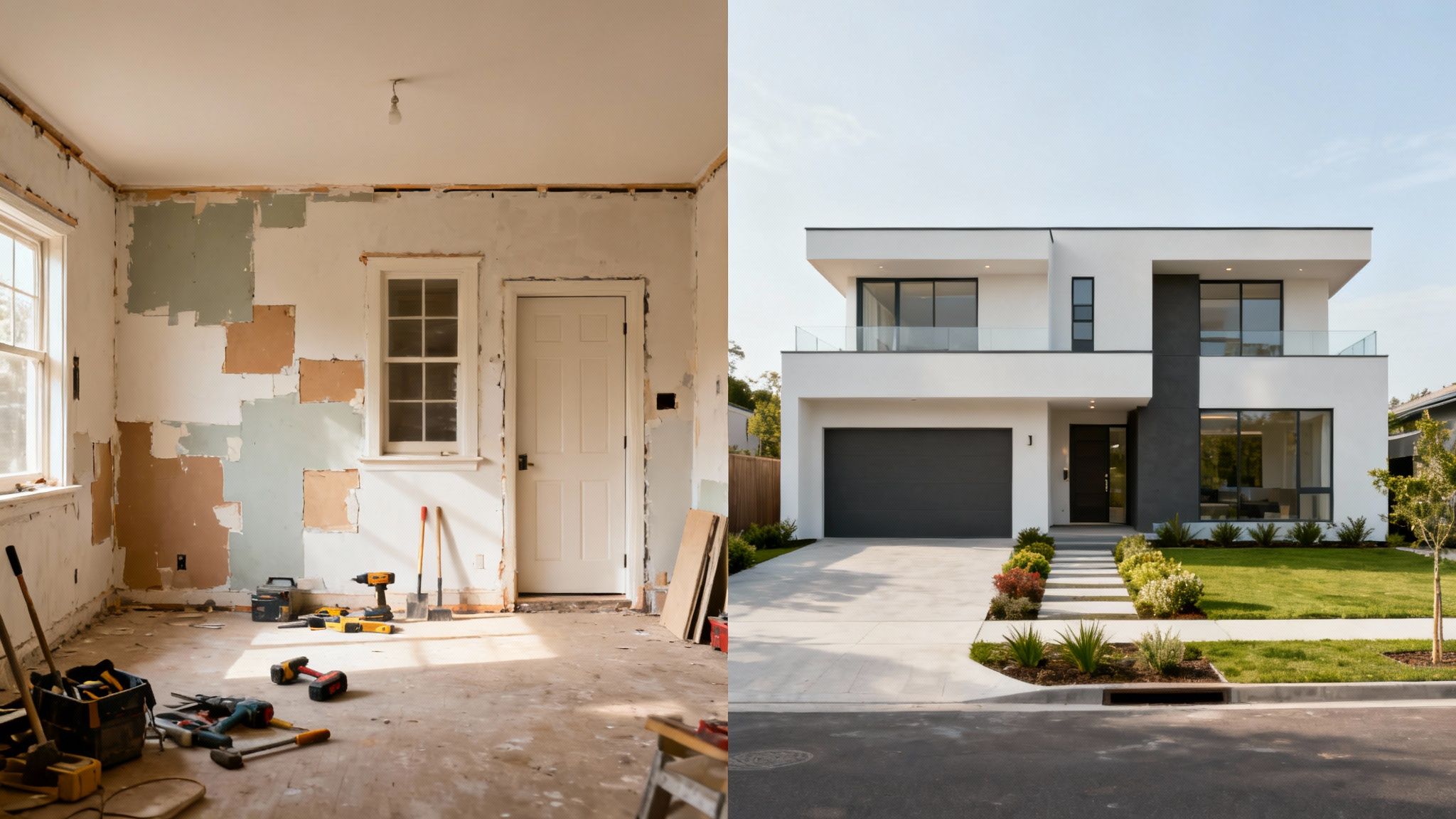
This is one of the biggest crossroads you’ll face on your home-building journey. Deciding between a major renovation and a complete knockdown rebuild isn’t just about aesthetics; it’s a strategic decision that will shape your budget, timeline, and the way you live for years to come.
There’s no single right answer. The best path forward depends entirely on your existing property, your vision for the future, and your financial goals. A major renovation might seem like the simpler option, but it often means you’re forced to work within the confines—and compromises—of an old, sometimes flawed, structure.
In contrast, a knockdown rebuild gives you a completely clean slate. It’s an opportunity to break free from the past and create a home that’s perfectly aligned with modern life and your family’s unique needs.
Assessing Your Current Home
The first step is to take a good, hard look at your existing house. Its structural integrity is everything. Are the foundations solid? Is the frame sound? An older home can have a certain charm, but lurking beneath the floorboards could be a hornet’s nest of expensive problems.
Think about the layout. If you’re dreaming of an open-plan living space but your current home is a maze of small, load-bearing walls, a renovation can quickly become an engineering and budgetary nightmare. Trying to shoehorn a modern floor plan into an old footprint often costs more time, money, and stress than simply starting fresh.
This is also the moment to consider long-term performance. Older homes are notoriously poor when it comes to energy efficiency. You can spend a fortune upgrading insulation, replacing windows, and sealing drafts, but it's often a band-aid solution. A new build, on the other hand, is designed and constructed to meet today's stringent energy standards from the ground up.
Uncovering the Hidden Costs of Renovation
One of the greatest risks with renovating an older home is opening a Pandora's box of hidden issues. What starts as a straightforward kitchen update can spiral into a full-scale rewiring and re-plumbing of the entire house once the walls come down.
Renovations on older properties frequently uncover hazardous materials like asbestos or lead paint, outdated and unsafe electrical wiring, and deteriorating plumbing. Each discovery adds unexpected costs and significant delays, turning a planned budget into a moving target.
These unforeseen expenses are a huge reason why the initial knockdown rebuild cost can ultimately prove more predictable and financially sound than a large-scale renovation. With a new build, your costs are locked in with a fixed-price contract, giving you far greater certainty and peace of mind.
Making the Final Decision
So, how do you choose? It comes down to which path aligns best with your core objectives.
A renovation might be the right call if your home has significant heritage value or unique architectural features you're passionate about preserving. It can also be a viable choice if the "bones" of the house are excellent and the changes you want are mostly cosmetic.
However, a knockdown rebuild is often the superior financial and lifestyle choice in many other scenarios. If you're wrestling with a fundamentally flawed layout, extensive structural issues, or have a specific architectural vision the current home just can't deliver, starting over is the most logical solution.
To help you see it more clearly, we’ve put together a simple matrix to guide your thinking.
Decision Matrix: Knockdown Rebuild or Major Renovation
This table breaks down the key factors to help you weigh your options based on the condition of your property and your ultimate goals for the project.
Consideration | Favours Knockdown Rebuild | Favours Major Renovation |
Structural Integrity | The existing home has major foundation, frame, or pest issues. | The "bones" of the house are solid and in good condition. |
Layout & Floor Plan | You desire a modern, open-plan layout impossible with the current footprint. | The existing layout is functional and only needs minor adjustments. |
Heritage Value | The property has no significant heritage or architectural features to preserve. | The home has protected heritage features or unique character worth keeping. |
Budget Certainty | You require a fixed-price contract and want to avoid unforeseen costs. | Your budget has flexibility to absorb potential surprises. |
Energy Efficiency | Achieving modern energy standards is a top priority. | You are satisfied with making incremental efficiency improvements. |
Ultimately, the goal is to create a home you’ll love for years to come. By carefully evaluating these points, you can make an informed choice that sets you up for success, delivering not just a beautiful house, but a sound long-term investment.
Of course. Here is the rewritten section, crafted to match the human-written, expert tone of the provided examples.
Your Knockdown Rebuild Questions, Answered
Embarking on a knockdown rebuild journey brings up a lot of questions, especially when it comes to the final numbers and how long it all takes. To give you some clarity and confidence, let's tackle the most common concerns we hear from homeowners, particularly those planning a high-end custom home in a premium suburb like Toorak.
How Much Should I Budget for a Contingency Fund?
Think of a contingency fund as your project's financial safety net. It’s not there for splurging on upgrades halfway through; it’s strictly for the unknowns that can (and often do) crop up during demolition and construction.
For any custom knockdown rebuild, we strongly advise setting aside 10% to 15% of your total estimated construction cost. So, on a $1.5 million build, that’s a fund of between $150,000 and $225,000.
This buffer protects your project from common curveballs, like:
- Finding asbestos in walls or under floors that wasn't picked up in the initial site reports.
- Hitting unexpected rock that requires heavy-duty excavation equipment.
- Dealing with unforeseen council requirements that pop up mid-build.
Having this fund ready means these issues won’t derail your timeline or force you to compromise on the quality of your home down the track. It's all about ensuring financial stability and giving you peace of mind.
Are There Hidden Costs I Should Be Aware Of?
Yes, and a reputable builder will be upfront about these from day one. Several expenses often sit outside the main building contract, and it’s vital to factor them in to get a true picture of your total investment.
Beyond the core construction price, you’ll need to budget for:
- Council Fees and Contributions: In areas like Toorak, these can be significant and include application fees, infrastructure levies, and various bonds.
- Professional Fees: Your architect, engineers, surveyors, and soil testing experts are typically billed separately.
- Alternative Accommodation: The cost of renting a suitable home while yours is being built is a major expense that’s easy to overlook.
- Utility Services: You'll have fees for disconnecting the old services and connecting the new (water, gas, electricity, NBN).
- External Works: Landscaping, driveways, fencing, and a new pool are almost always separate from the main building contract.
What Factors Influence the Final Cost Most?
While there are many moving parts, a few key things have the biggest impact on the final price tag. Understanding them helps you see where your money is going and where you have the most control.
Ultimately, the cost is shaped by your site, your vision, and the experience you expect.
- Site Access: A narrow, tree-lined street in Toorak can make it tricky to get materials and machinery on-site, which bumps up labour time and preliminary costs.
- Home Design: Is it a relatively straightforward layout, or is it a complex architectural statement? Things like cantilevered floors, dramatic voids, curved walls, and huge custom windows demand sophisticated engineering and specialist trades, directly impacting the cost.
- Level of Finishes: Your choice of fixtures and finishes is a huge cost driver. The gap between standard-range materials and high-end selections like imported Italian stone, bespoke joinery, and premium European appliances can easily run into the hundreds of thousands.
- Level of Customer Service: The journey itself is part of the investment. An integrated design-build firm like ours provides a seamless, fully managed process. This premium service is factored into the cost, but it saves you the headache—and potential hidden costs—of trying to coordinate a dozen different contractors yourself.
How Long Does the Entire Knockdown Rebuild Process Take?
The timeline can vary quite a bit, depending on your design's complexity, how quickly council approvals come through, and your builder’s schedule. Creating a truly bespoke home is a marathon, not a sprint.
For a high-end architectural home in Toorak, the journey typically breaks down into three phases:
- Pre-Construction (6–12 months): This is all about design development, detailed documentation, and navigating the council approvals maze. Complex designs and strict planning rules can easily stretch this phase out.
- Demolition & Site Preparation (2–4 weeks): This part is relatively quick. We carefully remove the old house and get the site ready for its new foundations.
- Construction (12–24 months): The build itself is a meticulous process. The final timeframe depends on the home’s size, complexity, and the level of detail involved.
Realistically, you should plan for the entire process—from our first design chat to the day we hand you the keys—to take somewhere between 18 and 36 months.
Can I Use My Existing Mortgage to Finance a Knockdown Rebuild?
Financing a knockdown rebuild isn’t like getting a standard home loan. The project almost always requires a specialised construction loan.
While you might be able to refinance your existing mortgage to tap into your land's equity, you'll need a proper construction loan to fund the actual build. These loans work by releasing funds in stages, or "drawdowns," as key milestones are completed (like the slab being poured, the frame going up, and reaching lock-up).
To get approved, lenders will need to see detailed architectural plans, a fixed-price building contract from a trusted builder, and all your council-approved documents. It’s a great idea to speak with a mortgage broker who specialises in construction finance early on to understand exactly what you can borrow and what they’ll require.
Ready to explore the possibilities for your own knockdown rebuild project? The team at Envy Abode specialises in creating bespoke luxury homes through a seamless, integrated design and build process. Contact us to start the conversation about bringing your vision to life.