Malvern EastProject Repton , 2025
“The key thing we were looking for was the consistency in the pricing that we received, having the right team to be able to problem solve when an issue arose, they did it in a very calm and measured manner. They're a great team and we worked so well together, had we done the design with Envy it would have saved us 6 months minimum”
Rebuilding a House Cost in Glen Iris Unpacked

So, what does it actually cost to rebuild a house these days? The honest answer is: it varies. A lot. The final figure is influenced by many factors, including the size and complexity of the design, the quality of fixtures and fittings you choose, and of course, the specific conditions of your site – is it flat, sloping, hard, or easy to access?
Across Australia, you’re generally looking at a range of $2,800 to over $7,500 per square metre. It’s a massive ballpark, and where your project lands depends on these variables. As you can imagine, rebuilding a house in sought-after suburbs like Glen Iris tends to push towards the higher end of that scale. Getting your head around these factors is the first real step to setting a realistic budget that won’t give you any nasty surprises down the track.
A Quick Guide to Glen Iris Rebuild Costs
When you're trying to figure out the cost of rebuilding a house, the most practical starting point is the price per square metre (m²). It’s the go-to metric in the building industry for a reason—it lets you quickly sketch out a high-level budget based on how big you want your new home to be.
But here’s the thing: not all square metres are created equal. The final number is a delicate dance between the complexity of your design, the quality of finishes you choose, and the unique quirks of your particular block of land.
A straightforward, single-storey home, for example, is a completely different beast to a custom-designed, multi-level masterpiece with heaps of architectural flair. Likewise, opting for standard project-home fittings versus premium, high-end fixtures will make a world of difference to your total investment.
Understanding the Key Cost Drivers
The journey from a bare block of land to a finished home has a lot of moving parts, and every single one has a price tag attached. Think of it like a mosaic – the final cost is made up of hundreds of individual financial tiles.
The big ones you need to watch are:
- House Size and Design: This is the obvious one. A bigger footprint costs more. But it's also about complexity. Tricky designs with lots of corners, split levels, or unique structural elements will bump up the labour and material costs.
- Quality of Finishes: This is where budgets can really blow out. Your choice of flooring, cabinetry, benchtops, tapware, and lighting will have a massive impact on the final cost to rebuild.
- Site Conditions: A perfectly flat, easily accessible block in Glen Iris is the dream. But let's be real—most aren't. A sloping site means more excavation and engineering work, while a block with tricky access can add time and machinery costs.
To put some numbers on it, the cost to rebuild a house in Australia can range from $2,800 to $7,500 per square metre. For a typical 200-square-metre home, you’re looking at a total build cost somewhere between $560,000 and $1,500,000.
Estimated Cost Per Square Metre for a Melbourne Rebuild
In Melbourne specifically, the numbers sit firmly in the upper tier compared to other cities. Here’s a table that breaks down what you can generally expect.
Build Tier | Average Cost (per m²) | Description & Inclusions |
Standard | $1,800 - $2,800 | A straightforward, budget-conscious build. Think project home level with standard inclusions, simple rooflines, and basic finishes like laminate benchtops and carpet flooring. |
Mid-Range | $2,800 - $5,500 | The most common tier. This includes a higher level of customisation, better quality finishes like stone benchtops, timber flooring, and upgraded fixtures. More architectural detail is common. |
Premium / High-End | $5,500 - $7,500+ | This is for a fully custom, architecturally designed home. Expect high-end European appliances, bespoke cabinetry, luxury materials, and complex structural elements. |
Keep in mind that recent inflation has pushed these figures up, so it's worth checking out the latest insights about Australian building costs to see how things have evolved. These numbers are a great starting point, but they aren't the whole story.
In the next sections, we'll dive deeper into each of these variables, giving you a clear breakdown of demolition, construction, and finishing costs so you can plan your Glen Iris rebuild with complete confidence.
Preparing Your Site for a New Beginning
Before the first slab is poured or a single frame goes up, the real work of rebuilding your house starts with the ground it sits on. This first stage—clearing away the old to make way for the new—is where some of the most overlooked costs hide, often lost in the excitement of picking out floor plans and finishes. Demolition and site preparation is the foundational chapter of your rebuilding story, and its budget can be surprisingly fluid.
The cost for this groundwork isn't a simple, fixed number. It's shaped entirely by the unique challenges your block of land presents. A flat site with easy access will be far more cost-effective to prepare than a sloping block or one with difficult access for machinery. Think of it like navigating Glen Iris's streets: getting a big excavator down a wide, open road is easy and efficient. But trying to squeeze that same machine down a narrow, heritage-listed laneway with tight access? That takes more time, smaller machinery, and specialised skills, which naturally pushes the costs up.
The Real Cost of a Clean Slate
Bringing down an old house is about more than just brute force and a wrecking ball. For many older homes in established suburbs like Glen Iris, it’s a methodical, careful process, especially when you factor in hazardous materials.
A standard demolition for a single-storey brick home usually falls somewhere between $15,000 to $25,000. If you're dealing with a more complex two-storey structure, that figure can easily climb closer to $40,000. But the real wild card is asbestos—a common ingredient in homes built before the 1990s.
Safe asbestos removal is completely non-negotiable. You have to bring in licensed professionals, and the cost can add anywhere from $3,000 to $10,000, or even more, to your demolition budget, depending on how much of it there is.
This isn't a corner you can afford to cut. The health risks are severe, and the legal and financial penalties for doing it wrong are massive.
Preparing the Groundwork for Success
Once the old house is gone, all eyes turn to the land itself. This is where the specific character of your block really starts to influence the rebuilding a house cost. What’s hidden under the surface and the natural slope of your land will dictate the next steps and the money you'll need to spend.
Here are a few of the key jobs involved:
- Soil Testing: A geotechnical engineer comes in to analyse your soil to figure out its stability and what it’s made of. This report is the bedrock of your foundation design and typically costs between $750 and $2,000.
- Excavation and Grading: If you’re lucky enough to have a perfectly flat block, you won't need much earthmoving. A sloping site, however, needs serious excavation to create a level building platform, which can add tens of thousands to your budget.
- Utility Connections: Getting services like water, sewerage, electricity, and gas to the right spots for your new home is another essential cost. If the old connections are in the wrong place or too old to use, you'll be paying for new trenching and connection fees, often ranging from $5,000 to $20,000.
If you want to get a better handle on everything involved, we break it all down in our guide on the fundamentals of site preparation for construction. These early steps might not be the most glamorous part of the build, but they are absolutely essential. Getting them right from the start ensures your new home is structurally sound and stable for decades to come, making it one of the smartest investments in your entire project.
Decoding Your Core Construction Budget
Once the ground is cleared and ready, we get to the main event: the build itself. This is where we move beyond those early, broad-strokes estimates and dive into the real nuts and bolts of your rebuilding a house cost. Think of it like popping the bonnet of a car—what looks simple on the outside is actually a complex network of interconnected parts, and every single one plays a role in the final price tag.
The first big decisions you make are right at ground level. Are you going for a classic concrete slab, or will your home be built on stumps? That choice alone sets a completely different financial starting line. The same goes for the home's skeleton—a traditional timber frame has different material and labour costs compared to a modern steel frame. Each decision sends ripples through the entire project, influencing every stage that follows.
Before you can even lay a foundation, there's a whole phase of site preparation that needs to be budgeted for first.
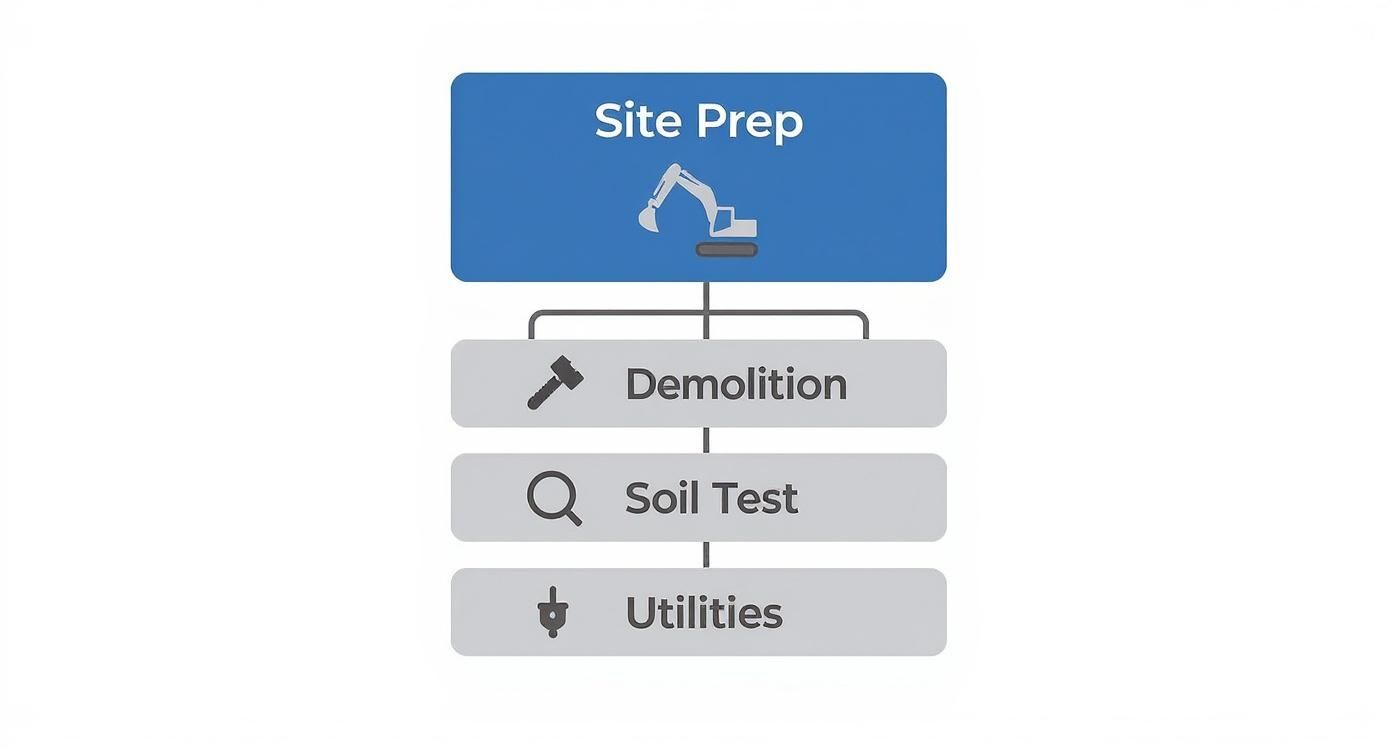
As you can see, demolition, soil testing, and getting your utilities sorted are all crucial, separate expenses. You need to have these costs nailed down before a single dollar of your main construction budget is even touched.
Framing and External Structures
With the foundation in place, it’s time to bring the structure out of the ground. The home's "skin" and "hat"—your external cladding and roofing—are not just major budget items; they define your home's entire look and how much maintenance you'll be doing down the track.
These aren't just aesthetic choices. They're practical decisions that directly impact insulation, durability, and cost.
- External Cladding: The options here are massive. You could go for a timeless brick veneer, which is incredibly durable but comes at a higher price than, say, a lightweight cladding with a rendered finish. Timber or composite weatherboards offer a completely different feel and can vary hugely in price depending on the quality you choose.
- Roofing Materials: Your roof has a massive say in the final look and cost. Colorbond steel is a hugely popular choice across Australia for good reason—it’s tough and relatively cost-effective. On the other hand, beautiful terracotta or slate tiles will give you a premium, classic look, but they'll also add a significant chunk to your budget.
- Windows and Glazing: Windows are another big-ticket item. Standard aluminium-framed windows are the go-to for keeping costs down. If you want better energy efficiency, you might look at thermally broken aluminium or timber frames, but the price will climb. Double-glazing is pretty much the standard for new builds in Victoria now, but if you want high-performance or specialised glass, that will add even more.
To give you a clearer picture, here’s a typical cost breakdown for the major construction phases of a home in Glen Iris. This should help you see where the money really goes.
Core Construction Cost Breakdown for a 250m² Glen Iris Home
Construction Phase | Typical Cost Range | Percentage of Total Budget |
Site Works & Foundations | $90,000 - $130,000 | 12% - 15% |
Framing (Timber/Steel) | $100,000 - $140,000 | 13% - 16% |
External Cladding & Roofing | $100,000 - $150,000 | 10% - 14% |
Windows & External Doors | $50,000 - $80,000 | 7% - 9% |
Internal Linings & Fix-out | $120,000 - $160,000 | 15% - 18% |
Kitchen & Bathrooms | $90,000 - $130,000 | 9% - 12% |
Services (Plumbing/Electrical) | $60,000 - $90,000 | 8% - 10% |
Finishes (Flooring/Painting) | $45,000 - $70,000 | 6% - 8% |
This table illustrates that the big-ticket items aren't always the flashy finishes; the structural essentials like framing and internal linings make up a huge portion of the budget.
The Impact of Architectural Design
Perhaps the single biggest driver of your core construction cost is the architectural design itself. The complexity of your home's shape has a much bigger impact on the final price than almost anything else.
Let's imagine two homes, both with a floor area of 250 square metres.
- Home A is a simple, single-storey rectangle with a standard roof pitch.
- Home B is a complex, multi-level design with cantilevered sections, multiple rooflines, split levels, and lots of corners.
Even though they have the exact same internal space, Home B will be monumentally more expensive to build. The complicated engineering, extra structural steel, tricky framing, and all the additional labour needed to execute a non-standard shape add up very, very quickly.
A simple design gives you the most bang for your buck, maximising internal space for the lowest cost. An architecturally ambitious design, on the other hand, prioritises a unique aesthetic, which naturally comes with a higher price tag. If you want to dig deeper into how all these elements fit together, our home building cost breakdown offers a comprehensive look at where your money goes.
Local Council Requirements in Glen Iris
Finally, it’s crucial to remember that you're not building in a bubble. Local councils, especially in an established suburb like Glen Iris, can add specific costs you might not have anticipated. The City of Stonnington has its own planning controls and building rules that will influence your design and, by extension, your budget.
This might include things like:
- Heritage Overlays: If your property is in a heritage area, there could be strict rules about the home's external look, forcing you to use certain materials or design features that add to the cost.
- Stormwater Management: Councils often insist on on-site stormwater detention systems. This usually means installing large underground tanks or other drainage solutions, which can be a hefty expense.
- Tree Protection: If there are significant trees on or near your block, they might be protected. This could require you to hire an arborist and install root barriers during construction, adding another layer of cost.
These local quirks are exactly why a generic, online cost calculator can only get you so far. Working with a builder who has direct experience in Glen Iris is invaluable. They’ll help you see these area-specific costs coming and build them into your budget right from the start, avoiding nasty surprises later on.
Why Materials and Labour Costs Are Always on the Move
Getting your head around the final figure on a builder's quote means looking past the floor plans for your new Glen Iris home. The total rebuilding a house cost is a moving target, heavily swayed by big-picture market forces that mess with two key things: the price of materials and the availability of skilled tradies. These two factors are constantly shifting, thanks to everything from global supply chains to local demand right here in Melbourne.
Think of it like this: your construction budget used to be a predictable shopping list. Today, it’s more like a stock market where the prices of essentials like timber, steel, and concrete can jump around without warning. This volatility makes it trickier than ever to nail down a truly realistic budget.
The Story Behind Material Prices
The price tags you see on building materials don’t just appear out of thin air. Big events on the other side of the world can disrupt the supply of timber and steel, causing prices to spike overnight. At the same time, local factors—like two concrete suppliers in a price war or a jump in diesel costs for delivery trucks—also have a massive impact on what you end up paying.
This constant flux was put under the microscope in a recent industry analysis.
In the June quarter, the cost of building materials for house construction shot up by 0.9%—that’s the steepest quarterly climb in nearly two years. Over the last twelve months, these input prices have risen by 2.1% overall. We’ve seen significant jumps in timber, plaster, paint, and insulation. You can dig deeper into these Australian construction material price trends to see the full picture.
What this really means is that a quote you got six months ago is likely out of date today. It’s why locking in prices with your builder is so critical once you’re ready to get started. It's also a great reason to look into alternatives, as a shift towards choosing sustainable building materials can sometimes offer more stable pricing and a greener footprint.
The Tradie Shortage and the Productivity Puzzle
Materials are only half the battle. The other half is finding the skilled hands to put it all together. In a high-demand city like Melbourne, getting great carpenters, electricians, and plumbers on-site can be a real mission. This shortage of skilled labour creates fierce competition, which naturally pushes up wages and adds to your overall build cost.
But there’s another piece to this puzzle that’s not so obvious: productivity.
Imagine you’re paying a team for a full day's work. If logistical hiccups or old-school methods mean they only get half as much done as a team would have 20 years ago, you’re essentially paying double for the same outcome.
Believe it or not, this is a real problem in the building industry, where productivity has reportedly halved since 1995. The industry is often working harder and costing more, but delivering less bang for your buck. This inefficiency gets baked directly into the quote you receive, which helps explain why rebuilding a house costs more today than the raw material prices alone would suggest.
Choosing Your Finishes and Fittings
If the structure is the skeleton of your new home, then the finishes and fittings are its personality. This is the fun part, where your vision and style really come to life. It's also where your budget can either be masterfully managed or completely blown out of the water. Every choice you make here—from the kitchen benchtops to the bathroom tiles—has a massive impact on the final rebuilding a house cost.
Think of it like buying a new car. The base model does the job perfectly well, but every upgrade you add—the leather seats, the sunroof, the premium sound system—adds a chunk to the final price tag. Your home works in exactly the same way. The gap between standard, builder-grade finishes and high-end selections is enormous, and knowing where to save and where to splurge is the secret to getting the look you want without the financial headache.
A standard project home might have an internal finishes budget of around $90,000. But for a high-end custom build in a suburb like Glen Iris, it’s not unusual to see that figure climb past $250,000 for the very same floor area. That huge difference is the result of thousands of individual choices that add up surprisingly fast.
The Kitchen: Where Budgets Are Made or Broken
The kitchen truly is the heart of the home, and it’s also the heart of your finishes budget. It is almost always the most expensive room to fit out, with the main costs coming from cabinetry, benchtops, and appliances.
Here’s a quick look at how fast the numbers can climb:
- Benchtops: A quality laminate benchtop is a solid, budget-friendly starting point. If you upgrade to an engineered stone like Caesarstone, you'll instantly add thousands to the bill. And if your heart is set on natural stone like marble or granite, the price can soar even higher, especially for premium slabs with waterfall edges.
- Cabinetry: Standard melamine or laminate cabinets are the most cost-effective option. Moving up to 2-pac painted joinery gives you that seamless, premium finish, but it comes at a significant price jump. At the top end, you have custom timber veneers or solid wood cabinetry.
- Appliances: You can easily fit out a kitchen with a full suite of reliable, good-looking appliances for under $8,000. However, if you opt for high-end European brands like Miele or Gaggenau, that cost can quickly jump to $25,000 or more.
Bathroom Selections: From Practical to Palatial
Bathrooms are another key area where your selections make a huge financial difference. The line between a functional, stylish bathroom and a luxurious, spa-like retreat is drawn by your choice of tiles and fixtures.
The real cost multiplier in a bathroom isn't just the price of the materials, but the labour involved in installing them. A large-format porcelain tile, for instance, costs more per square metre than a basic ceramic one, and it also requires a more skilled (and expensive) tiler to lay perfectly.
Think about the tiling alone. Tiling a shower recess and a vanity splashback is pretty standard. But if you decide you want floor-to-ceiling tiles on all four walls, you’ve just quadrupled your material and labour costs in an instant. Likewise, a standard back-to-wall toilet might cost $500, while a sleek, wall-hung model with an in-wall cistern can be over $1,500 before you even account for the more complex installation.
Flooring: The Foundation of Your Style
The flooring you choose really sets the tone for your entire home. It’s a big-ticket item that’s tied directly to the square meterage of your house, so even small differences in the per-metre price can add up to a lot.
- Carpet: Good quality synthetic carpet is often the most affordable choice for bedrooms, bringing warmth and comfort underfoot.
- Laminate/Hybrid: These popular floating floors give you the look of real timber for a fraction of the cost. They’re also incredibly durable, making them a fantastic mid-range option.
- Engineered Oak: This is where you step into the premium category. Engineered timber offers the authentic look and feel of solid wood but with better stability. The cost is a big step up from laminates.
- Solid Timber: For that timeless, classic look, nothing beats solid timber. It’s the ultimate choice, but it also carries the highest price tag for both the materials and the specialist installation required.
Ultimately, your selections in these key areas will decide whether your finishes budget stays on track or goes off the rails. By sitting down and prioritising what’s most important to you, you can make smart, strategic decisions that deliver that high-end feel without blowing out the total rebuilding a house cost.
Should You Rebuild or Renovate in Glen Iris
For homeowners in established suburbs like Glen Iris, it’s the ultimate property dilemma: do you work with the bones of your existing home, or is it better to start with a completely clean slate? The choice between renovating and rebuilding is one of the biggest financial decisions you'll make, and the right answer really hinges on your home's condition, your long-term goals, and your appetite for budget uncertainty.
At first glance, renovation often seems like the more sensible, cost-effective path. However, what starts as a simple kitchen or bathroom update can quickly spiral. The moment walls are opened up in an older home, you can uncover a Pandora's box of hidden issues—outdated wiring, crumbling plumbing, or even serious structural problems you never knew existed.
Comparing the Costs: Renovation vs Rebuild
To make a smart decision, you have to look at the numbers. Recent data shows that Australian homeowners are heavily invested in improving their current properties. One in three households undertook a renovation project, with the average spend on a kitchen remodel hitting $57,500 and a full bathroom renovation costing around $35,000.
When you scale that up, a full home renovation can average $465,000, while a major extension typically costs about $445,000. The catch is that these figures often don't tell the whole story. A staggering 60% of renovators end up spending 20–30% more than they initially planned due to unexpected costs. Victoria sits near the top for renovation spending, with an average project cost of $274,800.
This is where the financial argument for rebuilding starts to become much clearer. While the upfront rebuilding a house cost is higher, it offers a level of budget certainty that renovations simply can't match. With a knockdown rebuild, every wire, pipe, and beam is brand new, eliminating the risk of costly surprises hidden within old walls.
When Renovating Makes Sense
Despite the risks, there are definitely situations where renovating is the superior choice, especially in a suburb with the character of Glen Iris.
- Preserving Heritage Features: If your home has beautiful period details—like intricate ceiling roses, original timber floors, or a classic facade—that you want to protect, a careful renovation is the only way to go.
- Minor Layout Changes: If you generally like your home's layout and just need to modernise a few key areas or make small structural changes, a renovation will be far more efficient than a full rebuild.
- Smaller-Scale Projects: If your goal is simply a new kitchen or an updated ensuite, a targeted renovation is clearly the more logical and affordable path.
The Case for a Knockdown Rebuild
On the other hand, a knockdown rebuild becomes the smarter financial move when the scope of your desired changes becomes extensive. If your renovation plans involve moving multiple structural walls, re-plumbing and re-wiring the entire house, and underpinning failing foundations, you're essentially rebuilding the house from the inside out anyway.
At this point, you're paying a premium for the immense labour involved in working around an existing, and often problematic, structure. A full rebuild allows you to get the exact layout, energy efficiency, and modern amenities you want, often for a more predictable final cost.
A rebuild allows you to design a home perfectly suited to your family’s needs without the compromises of an old floor plan. You can orient rooms to capture natural light, create open-plan living spaces, and incorporate modern insulation and technology from the ground up. To better understand this process, check out our detailed guide on the knockdown and rebuild process in Melbourne.
Ultimately, when a renovation starts to look like a series of expensive patches on a fundamentally flawed structure, a rebuild offers a far more secure and valuable long-term investment.
Your Rebuilding Cost Questions, Answered
Let's be honest, figuring out the finances for a rebuild can feel like you're trying to hit a moving target. There are so many moving parts that influence the final cost. To help clear things up, here are some straight answers to the questions we hear most from homeowners in Glen Iris as they start budgeting for their rebuilding a house cost.
How Much Should I Set Aside for a Contingency Fund?
Think of a contingency fund as your project's financial safety net—it's absolutely essential. We always tell our clients to set aside 10-15% of the total estimated build cost.
So, if your project in Glen Iris is budgeted at $900,000, that means having an extra $90,000 to $135,000 in the bank. This isn't just for 'what ifs'; it's for the real-world things that can pop up, like discovering unexpected rock during excavation, a sudden jump in timber prices, or even those last-minute design changes you fall in love with.
Are Architect Fees Included in the Build Cost?
This is a big one, and the short answer is: usually, no. When a builder gives you a cost per square metre, it almost always refers to the physical construction work itself.
All the professional fees needed to get to that point—like architects, engineers, soil reports, and council permits—are separate. You should plan for these to add another 8-15% to your total project budget. Always get a crystal-clear breakdown from your builder on what their quote includes and, just as importantly, what it doesn't.
Does Landscaping Really Add That Much to the Cost?
Yes, it does, and it's one of the most commonly overlooked expenses. It’s easy to focus on the house itself and forget about the outside.
A basic landscaping job with some turf, simple garden beds, and a driveway might set you back between $25,000 and $40,000. But if you want a finish that truly complements your beautiful new home—we’re talking retaining walls for a sloping block, beautiful paving, a proper deck, and an irrigation system—your costs can easily climb past $75,000 to $150,000. Factoring this in from the very beginning means the outside of your home will look just as stunning as the inside.
Planning a rebuild requires a deep understanding of design, construction, and the ins and outs of local council rules. At Envy Abode, our fully integrated design-build service means we handle every single detail for you. See how we bring our clients' visions to life by exploring our work.