Malvern EastProject Repton , 2025
“The key thing we were looking for was the consistency in the pricing that we received, having the right team to be able to problem solve when an issue arose, they did it in a very calm and measured manner. They're a great team and we worked so well together, had we done the design with Envy it would have saved us 6 months minimum”
10 Things to Consider When Building a House in Caulfield

Building a custom home is one of life’s most rewarding experiences, offering the unique opportunity to create a space that perfectly aligns with your lifestyle, tastes, and future aspirations. However, the path from a vacant block in a sought-after suburb like Caulfield to a finished architectural masterpiece is paved with critical decisions. Overlooking key details during this complex process can lead to budget overruns, frustrating delays, and a final product that falls short of your vision.
This comprehensive guide is designed to be your definitive checklist, outlining the essential things to consider when building a house to ensure your project is a seamless, successful, and satisfying endeavour. We will explore the critical stages that define a well-executed build, from initial site selection and navigating local council regulations in areas like Caulfield, to selecting the right design-build partner who can transform your dream into a tangible reality. This is not just a list; it is a strategic framework for managing the intricacies of construction.
By breaking down the journey into actionable steps, you can avoid common pitfalls and make informed choices with confidence. We will cover crucial topics including budget and financial planning, design and architecture, contractor selection, energy efficiency, and project scheduling. Understanding these elements from the outset is the most effective way to protect your investment and ensure the final structure is not just a house, but a bespoke home tailored precisely to you. This roadmap provides the clarity needed to confidently embark on your custom home journey in Caulfield.
1. Location and Site Selection
The adage "location, location, location" is paramount when building a house. It is the single most significant decision you'll make, influencing everything from your daily lifestyle and long-term financial return to the architectural possibilities of your design. Choosing the right spot goes far beyond liking the neighbourhood; it involves a detailed analysis of the land itself and its surrounding environment.

This foundational choice is one of the most critical things to consider when building a house. A premium block in a sought-after suburb like Caulfield offers proximity to top-tier schools and amenities but may come with specific heritage overlays or compact footprints. Conversely, a coastal plot requires specialised engineering to withstand saline air and potential storm surges. Your block's topography, soil composition, and orientation will directly dictate design constraints, building costs, and your home’s energy efficiency.
Key Site Evaluation Factors
Before committing to a block of land, a thorough due diligence process is essential. Overlooking a critical detail at this stage can lead to unforeseen expenses and compromises later on.
Zoning and Overlays: Investigate local council zoning regulations, easements, and any heritage or environmental overlays. In areas like Caulfield, these rules can restrict the size, height, and style of your home.
Geotechnical Reports: A soil test is non-negotiable. It reveals the ground's stability, reactivity, and load-bearing capacity, which impacts foundation design and cost. Unforeseen rock or unstable soil can significantly inflate your site work budget.
Topography and Orientation: A sloping block can offer stunning views but will incur higher costs for excavation and retaining walls. The block’s orientation determines access to natural light, a key factor in passive solar design and energy savings.
For a deeper dive into the specifics of land acquisition, our guide on buying a block of land in Australia provides an essential checklist.
Ultimately, the right location harmonises your lifestyle aspirations with the practical realities of construction, ensuring your custom home is a sanctuary that stands the test of time.
2. Budget and Financial Planning
Establishing a realistic and comprehensive budget is the financial bedrock of your home-building journey. It governs every decision, from the size and complexity of the architectural design to the quality of the final finishes. A meticulously planned budget is one of the most crucial things to consider when building a house, as it prevents scope creep, financial stress, and the risk of an unfinished project.
This process involves more than just the raw construction cost. A robust financial plan accounts for land acquisition, council permits, consultant fees (architects, engineers), site works, landscaping, and a significant contingency fund. For a luxury build in a suburb like Caulfield, where high-end finishes and custom joinery are standard, underestimating these associated costs can quickly derail the project. A detailed budget ensures your vision aligns perfectly with your financial capacity from the outset.
Key Budgeting Components
A successful build is managed on paper long before it is managed on-site. Breaking down your budget into clear categories provides clarity and control throughout the entire process.
- Hard vs. Soft Costs: Differentiate between hard costs (labour, materials, physical construction) and soft costs (design fees, permits, legal expenses, insurance). This distinction helps in tracking and allocating funds accurately.
- Contingency Fund: This is non-negotiable. Allocate a contingency of at least 15-20% of the total construction cost to cover unforeseen issues like unexpected site challenges, material price increases, or design changes.
- Detailed Cost Estimates: Work with your builder to create a line-item budget. This detailed breakdown should cover every stage, from excavation and foundation to fixtures and final paint, ensuring no expense is overlooked.
To understand where your money goes, our guide to the typical home building cost breakdown in Australia offers an in-depth analysis.
Ultimately, a well-managed budget acts as your project’s roadmap, empowering you to make informed decisions and ensuring your dream home is delivered without financial compromise.
3. Design and Architecture Planning
Thoughtful design is the soul of a custom home, translating your vision into a functional, beautiful, and enduring living space. This critical planning stage establishes the home's entire character, from its aesthetic appeal and spatial flow to its long-term livability and energy performance. It's about creating a blueprint that not only looks impressive but also intuitively supports your family's daily rituals and future evolution.
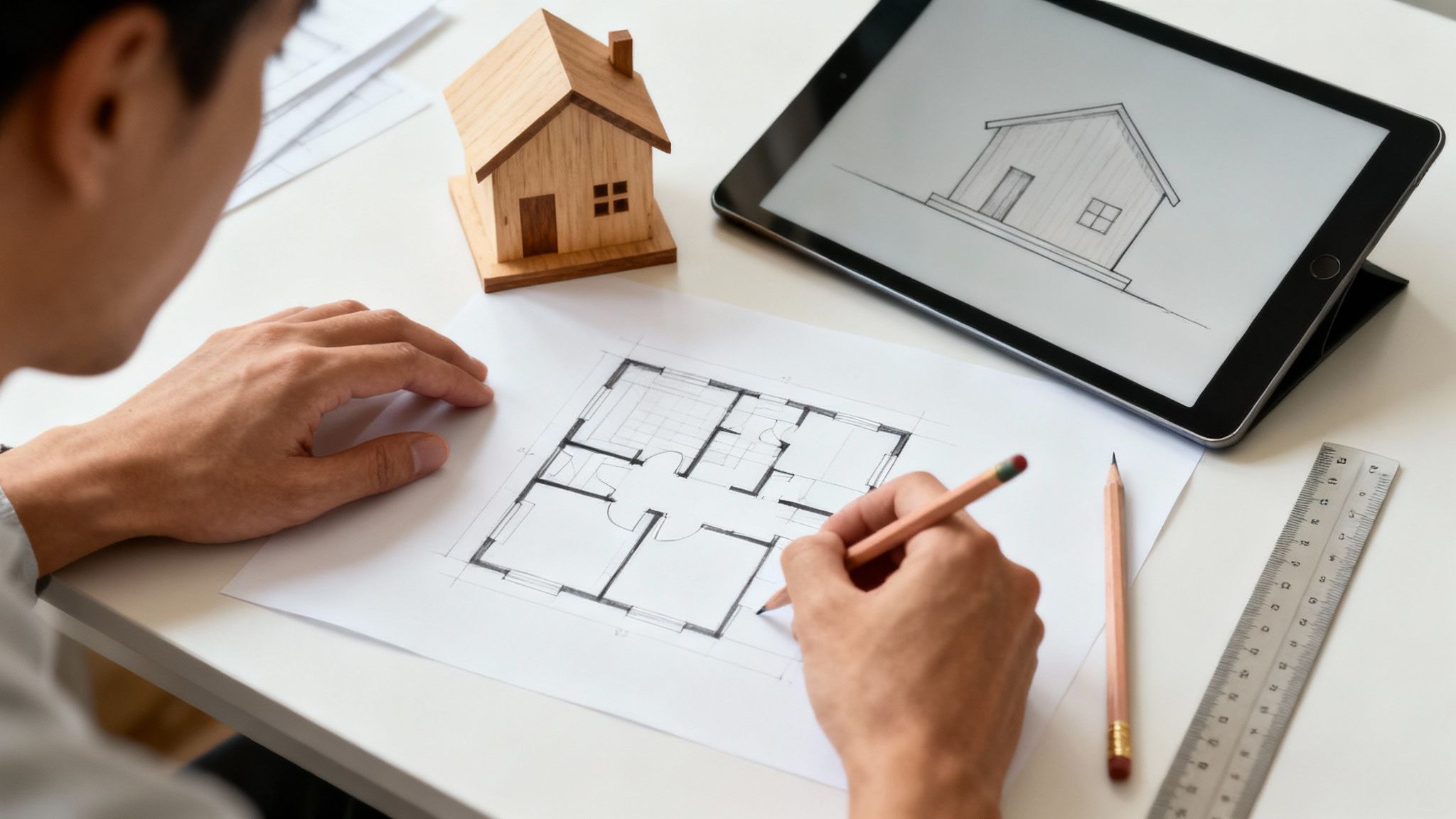
This process is one of the most personal things to consider when building a house. A well-conceived architectural plan maximises the potential of your site, whether it's a compact block in Caulfield or a sprawling regional property. It considers how an open-plan living area can enhance family connection or how strategically placed windows can frame a garden view. From the grand statement of a contemporary facade to the subtle efficiencies of passive solar design, every decision made here directly impacts your daily satisfaction and the home's eventual resale value.
Key Design and Planning Considerations
A successful design is a collaborative effort that balances aspirations with practicality. Rushing this stage often leads to regrets, so investing time upfront is paramount to achieving a home that truly fits your lifestyle.
- Lifestyle Analysis: Before drawing a single line, consider your family's current and future needs. Think about how you entertain, work from home, and relax. Designing flexible spaces, like a study that can become a guest room, ensures the home adapts as your life changes over the next 10 to 20 years.
- Spatial Flow and Layout: The floor plan must be efficient and logical. Pay close attention to the relationship between rooms, minimising wasted corridor space and creating a natural flow. Optimise room sizes based on their actual use; a grand but rarely used formal dining room may be less practical than a more generous family living area.
- Architectural Style and Aesthetics: Define the overall look and feel you want to achieve. Gather inspiration but ensure the style is cohesive and complements the surrounding Caulfield neighbourhood and landscape. This includes exterior materials, rooflines, window styles, and interior finishes.
A great design isn’t just about aesthetics; it’s about creating a home that functions perfectly for the people who live in it. It’s a direct reflection of your priorities and values.
Ultimately, meticulous design and architecture planning ensures your new build is not just a structure, but a sanctuary crafted specifically for you, enhancing your quality of life for years to come.
4. Building Permits and Regulations Compliance
Navigating the web of building permits and regulatory compliance is an unavoidable and critical step in the home-building journey. This process ensures your new home is constructed legally, meets stringent safety standards, and will hold its value for future marketability. Building codes define everything from structural integrity and fire safety systems to energy efficiency and plumbing standards, with requirements that vary significantly between councils.
Failing to secure the correct approvals is one of the most serious missteps when considering things to build a house. Non-compliance can lead to hefty fines, orders to halt construction, and even the demolition of unapproved work. In a suburb like Caulfield, you might face not only the standard building code requirements but also specific heritage or neighbourhood character overlays that dictate design aesthetics. This administrative phase is non-negotiable and protects your investment by ensuring your home is safe, compliant, and insurable.
Key Compliance and Permitting Steps
A proactive and organised approach to permits is essential to avoid costly delays. Your design-build team should lead this process, but understanding the key components will empower you as the homeowner.
- Understanding the National Construction Code (NCC): This is Australia's primary set of technical design and construction provisions. Your architect and builder must ensure every aspect of your design, from foundation depth to window glazing, complies with these national standards.
- Local Council Approvals: Beyond the NCC, local councils have their own planning schemes. These can govern setbacks from boundaries, site coverage allowances, and specific design elements required to maintain the character of a Caulfield neighbourhood.
- Mandatory Inspections: Construction is a staged process, with mandatory inspections required at critical milestones. These typically include the foundation, framing, waterproofing, and a final inspection upon completion. Each stage must be passed before work can proceed.
For a detailed walkthrough of the application and approval stages, our guide on how to get a building permit in Australia offers crucial insights.
Ultimately, a diligent approach to permits and regulations ensures a smooth construction timeline and delivers a home that is not only beautiful but also certifiably safe and legally sound.
5. Utilities and Infrastructure Planning
Connecting your new home to essential services is a non-negotiable step that can significantly impact both your budget and construction timeline. Utilities and infrastructure planning involves coordinating with providers for water, sewerage, electricity, gas, and telecommunications. This process is far more complex than a simple phone call; it requires early investigation and strategic integration into your architectural plans.
This is one of the most practical things to consider when building a house, as overlooking it can lead to major delays and unforeseen expenses. A block in an established suburb like Caulfield likely has straightforward connections to municipal grids, but older infrastructure may require costly upgrades. In contrast, a rural or coastal property might necessitate entirely self-sufficient systems like septic tanks, water bores, or solar power with battery storage, adding tens of thousands of dollars to site costs. Planning these connections during the design phase is crucial for efficiency and safety.
Key Utility Planning Factors
Engaging with utility providers early in the process is essential to avoid surprises. Each service will have its own application process, lead times, and associated costs that must be factored into your project schedule and finances.
- Service Availability and Costs: Confirm which services are available at your property boundary. Contact local providers to get accurate quotes for connection fees, which can vary wildly depending on the distance from the main lines and any required infrastructure upgrades.
- Site-Specific Requirements: Rural or remote sites often require specialised solutions. This can include geotechnical assessments for septic systems (costing anywhere from $4,000 to $25,000+) or hydrogeological reports for drilling a water bore.
- Future-Proofing: Plan for future needs. Consider the electrical capacity required for EV charging stations, extensive home automation, or a pool. Ensure your telecommunications plan includes high-speed fibre internet, which is increasingly vital for modern living and property value.
A critical first step is to "Dial Before You Dig" to locate all existing underground services. Accidentally striking a utility line is a dangerous and expensive mistake that can bring your entire project to a halt.
Proactive utility planning ensures that from the day you move in, your home is fully functional, safe, and equipped to support your lifestyle now and into the future.
6. Contractor Selection and Management
Selecting the right builder is as crucial as choosing the right block of land. This partner will transform your architectural plans from a two-dimensional drawing into a three-dimensional reality. The general contractor or builder manages the entire construction process, from coordinating specialised tradespeople and sourcing materials to maintaining the schedule and ensuring every detail meets the highest quality standards.
This decision is one of the most impactful things to consider when building a house. A poor choice can lead to significant delays, budget overruns, substandard workmanship, and stressful disputes. In contrast, a strong partnership with a reputable builder ensures a smooth, transparent, and enjoyable journey. A builder with experience in complex projects, like a bespoke new build in Caulfield, will have established relationships with reliable suppliers and subcontractors, safeguarding your project’s integrity.
Key Contractor Vetting Factors
A rigorous vetting process is essential to protect your investment and ensure a high-quality outcome. Before signing any contract, conduct thorough due diligence to find a builder who aligns with your project's complexity and your expectations for communication and quality.
- Credentials and Reputation: Verify the builder's licence, insurance (such as public liability and builder’s warranty insurance), and any industry accreditations. Look for builders who are members of respected bodies like the Master Builders Association, as this signals a commitment to professional standards.
- References and Portfolio: Request and contact references from recent projects of a similar scale and style to your own. Ask about their experience with communication, budget management, and the final quality of the home. Review the builder’s portfolio to assess their workmanship in the Caulfield area.
- Contracts and Communication: Ensure you receive a detailed, fixed-price contract that clearly outlines the scope of work, timeline, payment schedule, and a process for handling variations. Establish a clear communication protocol from the outset, including who your primary contact will be and the frequency of progress meetings.
Entrusting your vision to a proven expert is paramount. At Envy Abode, we manage the entire design-build process, ensuring seamless coordination and accountability from concept to completion.
Ultimately, selecting a builder is about forging a professional relationship built on trust, transparency, and shared commitment to quality. This choice will define your entire construction experience and the final success of your home.
7. Energy Efficiency and Sustainability
Integrating energy efficiency and sustainability from the outset is no longer a niche consideration but a fundamental aspect of modern luxury home construction. It is a strategic investment that significantly reduces long-term operating costs, minimises your environmental footprint, and enhances daily comfort and indoor air quality. This forward-thinking approach is one of the most impactful things to consider when building a house, directly influencing its future value and liveability.
A sustainable home design prioritises a "whole-of-house" system where elements like insulation, high-performance windows, and efficient HVAC systems work in harmony. For instance, a new build in Caulfield can leverage passive solar design to capture winter sun while using strategic shading to repel summer heat, drastically cutting reliance on artificial heating and cooling. Homes built to standards like Passive House can use up to 90% less energy for heating and cooling, while a net-zero home generates as much renewable energy as it consumes, offering true energy independence.
Key Sustainability and Efficiency Factors
Building sustainably involves making smart choices at every stage, from structural design to appliance selection. These decisions lock in savings and comfort for decades to come.
- Building Envelope: The foundation of an efficient home is a superior building envelope. This means prioritising high-grade insulation in walls, ceilings, and under floors, coupled with meticulous air sealing to prevent drafts and energy loss.
- Glazing and Orientation: Double or triple-glazed windows with thermally broken frames are essential. Their placement should be optimised to maximise natural light and passive solar gain in winter while avoiding overheating in summer.
- Renewable Energy and Systems: Integrating a solar panel system with battery storage, like a Tesla Powerwall, allows you to generate and store your own clean energy. This is complemented by installing Energy Star rated appliances and high-efficiency heat pump systems for hot water and climate control.
A well-designed, sustainable home is a high-performance asset. For a comprehensive overview of techniques and materials, explore our guide to building an energy-efficient home.
By focusing on sustainability, you are not just building for today; you are creating a resilient, cost-effective, and exceptionally comfortable home for the future.
8. Timeline and Project Scheduling
Understanding and respecting the project timeline is fundamental to a successful and low-stress build. A realistic schedule acts as the project's roadmap, managing everything from cash flow and contractor coordination to your own expectations. Far from a simple start-and-finish date, a well-crafted schedule is one of the most important things to consider when building a house, as it dictates the entire logistical flow of the construction process.
A typical custom home build in a suburb like Caulfield can range from 12 to 18 months, or even longer for highly complex designs. This timeframe accounts for everything from initial site works to the final coat of paint. Overlooking the schedule or failing to plan for contingencies can lead to budget blowouts from extended financing, contractor standby fees, and the stress of a project that feels like it will never end.
Key Scheduling Considerations
A detailed project schedule is a dynamic document, not a static one. It requires proactive management and communication between you, your builder, and all involved trades.
- Critical Path and Milestones: Your builder should develop a detailed schedule outlining the "critical path"- the sequence of tasks that determines the project's total duration. This includes major milestones like foundation pour, frame completion, lock-up, and practical completion.
- Contingency Buffers: Experienced builders always incorporate a buffer into the schedule, typically 10-20%. This accounts for unavoidable delays such as inclement weather, unforeseen site issues, or hold-ups in council approvals and inspections.
- Long-Lead-Time Items: Many high-end or custom materials have significant lead times. Special-order windows, custom joinery, imported tiles, or specific European appliances should be identified and ordered months in advance to prevent them from halting progress on-site.
A common pitfall for homeowners is delaying decisions on finishes and fixtures. Your builder will provide a schedule for when selections are needed. Meeting these deadlines is crucial to keeping the project moving smoothly and avoiding costly delays.
Ultimately, a transparent and realistic schedule, reviewed regularly, provides peace of mind. It ensures all stakeholders are aligned, resources are used efficiently, and your architectural vision is realised without unnecessary friction or financial strain.
9. Structural Integrity and Foundation Design
The unseen framework of your home, its foundation and structural system, is arguably the most critical component ensuring its longevity, safety, and performance. This is not an area for compromise; it is the skeleton upon which every other design element rests. The correct approach to structural engineering guarantees your home can withstand environmental stresses and the test of time, preventing costly and dangerous failures down the track.
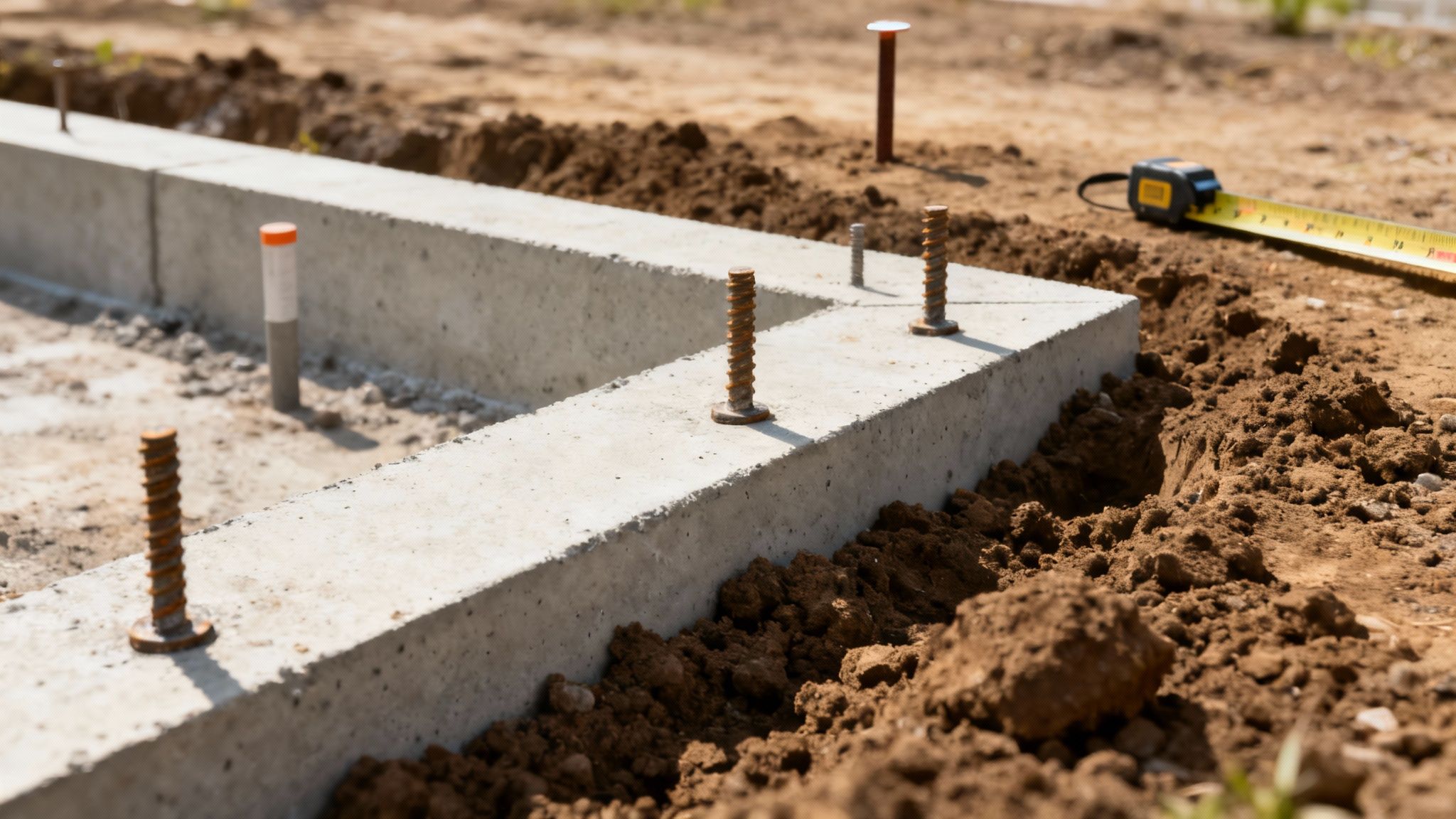
This vital aspect is one of the most important things to consider when building a house. The design of your foundation is directly tied to your site's specific conditions. For instance, the reactive clay soils common in suburbs like Caulfield necessitate robust solutions like post-tensioned slabs or engineered raft slabs to mitigate seasonal ground movement. Getting this wrong can lead to severe issues, from cosmetic cracking to catastrophic structural failure and water ingress. A qualified structural engineer is essential to analyse loads and specify the correct materials and methods.
Key Structural & Foundation Considerations
Ensuring a sound structure requires a proactive and detailed approach from the very beginning of the design process. Diligence at this stage protects your investment for decades to come.
- Soil Testing is Non-Negotiable: Before finalising any design, a geotechnical report must be completed. This analysis dictates the most suitable and cost-effective foundation type for your specific block.
- Engineer-Verified Design: Always engage a licensed structural engineer to design and verify all structural elements, from the footings to the roof frame. Their calculations are crucial for safety and compliance.
- Site-Specific Solutions: The foundation must be appropriate for your soil and climate. This could mean deep pilings for a sloping block, specialised moisture barriers in damp areas, or reinforced connections in high-wind zones.
- Waterproofing and Drainage: A high-quality waterproofing membrane and a comprehensive drainage system are vital to protect the foundation and substructure from moisture damage, a common and costly problem.
A correctly engineered foundation does more than just hold your house up; it protects your entire investment from the ground up, ensuring the integrity of every finish and fixture within.
Ultimately, investing in expert structural design and quality construction is fundamental. It provides the peace of mind that your home is not only beautiful but also safe, durable, and built to last.
10. Health, Safety, and Indoor Air Quality
A truly luxurious home nurtures the well-being of its occupants. Beyond aesthetics and function, considering the health and safety of your indoor environment is a critical, yet often overlooked, aspect of custom home design. Modern construction methods create highly-sealed, energy-efficient building envelopes, but this can inadvertently trap indoor air pollutants, leading to poor air quality.
This focus on a healthy living space is one of the most important things to consider when building a house today. New building materials, furnishings, and finishes can release volatile organic compounds (VOCs) into the air, a process known as off-gassing. Without proper ventilation, these contaminants, along with dust, allergens, and moisture, can concentrate indoors. A health-first approach involves a holistic strategy, integrating specialised ventilation systems, non-toxic material selection, and robust moisture control to create a sanctuary that actively supports your family’s health.
Key Factors for a Healthy Home Environment
Prioritising indoor air quality from the initial design phase ensures these systems and materials are seamlessly integrated, rather than retrofitted as an afterthought. This proactive approach is fundamental to long-term occupant health.
- Material Selection: Deliberately choose materials with low or zero VOCs. This includes paints, adhesives, sealants, flooring, and cabinetry. Opting for formaldehyde-free insulation and joinery, for instance, significantly reduces the off-gassing of common carcinogens.
- Advanced Ventilation: Incorporate a mechanical ventilation system, such as a Heat Recovery Ventilator (HRV) or Energy Recovery Ventilator (ERV). These systems continuously supply fresh, filtered air while expelling stale, polluted air, all while minimising energy loss.
- Moisture and Mould Control: A comprehensive moisture management plan is essential. This includes proper site grading, effective guttering, and internal humidity control (ideally between 30-60%) to prevent the growth of mould and dust mites, which are major triggers for allergies and respiratory issues.
Building a healthy home is about creating a controlled ecosystem. By carefully selecting what comes into your home and how air circulates within it, you ensure the environment supports well-being, not detracts from it.
Ultimately, designing for health transforms your house from a simple structure into a restorative space, safeguarding your family from invisible environmental threats and enhancing your quality of life.
10-Point Comparison: Homebuilding Considerations
Item | Complexity 🔄 | Resources ⚡ | Expected Outcomes 📊 | Ideal Use Cases 💡 | Key Advantages ⭐ |
Location and Site Selection | Moderate 🔄 — site analysis, zoning checks | High ⚡— land cost, surveys, travel | High 📊 — long‑term value & lifestyle fit | New builds in areas like Caulfield | Increases appreciation; access to amenities |
Budget and Financial Planning | Moderate‑High 🔄 — detailed cost planning | High ⚡— capital, contingency, financing | High 📊 — cost control; fewer overruns | All projects; pre‑construction phase | Prevents overruns; prioritizes scope |
Design and Architecture Planning | High 🔄 — custom design, iterations | Moderate‑High ⚡— architects, extended time | High 📊 — usability, aesthetics, resale | Custom homes; long‑term livability focus | Optimizes space, function, energy use |
Building Permits and Regulations Compliance | High 🔄 — jurisdictional complexity | Moderate ⚡— fees, documentation, time | High 📊 — legal approval; marketability | Any regulated jurisdiction; complex sites | Ensures safety, avoids fines and rework |
Utilities and Infrastructure Planning | Moderate 🔄 — coordination with providers | High ⚡— connection costs, installations | High 📊 — operational readiness, fewer delays | Rural sites or new subdivisions | Secures service availability; avoids costly delays |
Contractor Selection and Management | High 🔄 — vetting, contracts, supervision | Moderate‑High ⚡— contractor fees, management time | High 📊 — quality execution; schedule adherence | Complex builds; multi‑trade projects | Improves quality, reduces disputes and delays |
Energy Efficiency and Sustainability | Moderate‑High 🔄 — systems integration | Moderate‑High ⚡— upgrades, tech, skilled labor | High 📊 — lower operating costs; higher value | Owners targeting long‑term savings/eco goals | Lower bills, incentives, improved comfort |
Timeline and Project Scheduling | Moderate 🔄 — critical path & buffers | Low‑Moderate ⚡— coordination tools, monitoring | High 📊 — predictability; less schedule risk | Time‑sensitive builds; phased projects | Controls delays; aligns stakeholders |
Structural Integrity and Foundation Design | High 🔄 — geotech and engineering work | High ⚡— testing, specialized materials | Very High 📊 — safety, durability, resale | Poor soil (e.g., in Caulfield), slopes, seismic sites | Prevents failures; reduces future repair costs |
Health, Safety, and Indoor Air Quality | Moderate 🔄 — systems and material choices | Moderate ⚡— ventilation, low‑VOC materials | High 📊 — occupant health; market appeal | Families, allergy/asthma concerns, wellness builds | Improves air quality, reduces health risks |
Partnering for Success on Your Caulfield Build
Building a custom home or undertaking a significant extension in a suburb like Caulfield is more than a construction project; it’s the realisation of a deeply personal vision. The journey from an empty plot of land or an existing structure to a finished luxury residence is complex, layered with critical decisions at every turn. As we’ve explored, the process involves a meticulous blend of financial planning, creative design, regulatory navigation, and technical execution. The sheer number of things to consider when building a house can feel overwhelming, but they are not isolated challenges. Instead, they are interconnected elements of a single, holistic process.
Successfully navigating this journey isn't about becoming an expert in every field overnight. It's about recognising the importance of each stage and assembling a professional team that can manage these complexities on your behalf. From securing the right block of land in Caulfield and understanding its unique geotechnical properties to designing for optimal solar orientation and integrating smart, sustainable technologies, every decision builds upon the last. The quality of your foundation dictates the integrity of the structure, just as the foresight in your utility planning influences your home's future efficiency and running costs.
Your Blueprint for a Successful Build
The most critical takeaway from this comprehensive guide is the power of integrated planning. A fragmented approach, where architects, engineers, and builders work in silos, often leads to budget overruns, timeline delays, and compromised design intent. The key to a seamless, rewarding experience lies in a unified strategy that considers all ten pillars-from initial site selection to final indoor air quality-from the very beginning.
This proactive, integrated model ensures that:
- Financial and Design Goals Align: Your architectural plans are developed with a clear, realistic understanding of your budget, preventing costly redesigns or disappointing compromises down the track.
- Regulatory Hurdles are Anticipated: Navigating council approvals in areas like Glen Eira Council is a specialised skill. An experienced team can anticipate requirements for a Caulfield build, prepare documentation correctly, and manage the process efficiently.
- Sustainability is Built-In, Not Bolted-On: Energy efficiency isn't just about solar panels. It's about strategic window placement, high-performance insulation, and system design that are woven into the architectural fabric of your home from day one.
- Quality is Consistent: When a single team oversees the project from concept to completion, accountability is clear. There is a continuous thread of quality control that runs through every material choice, every trade, and every finish.
Turning Vision into a Tangible Reality
Ultimately, building your dream home is a significant investment of your time, resources, and emotion. Mastering these considerations empowers you to ask the right questions, make informed decisions, and choose a building partner with confidence. It transforms you from a passive observer into an active, knowledgeable participant in the creation of your own space. The reward is a home that not only looks stunning but also performs exceptionally-a healthy, efficient, and inspiring environment tailored precisely to your lifestyle. Your Caulfield dream home awaits, and with this knowledge as your foundation, you are perfectly positioned to build it with precision and passion.
Ready to take the next step and transform your ideas into a bespoke Caulfield residence? At Envy Abode, we specialise in a seamless, end-to-end design-build process that expertly manages every consideration discussed in this guide. Contact our team to begin a conversation about your vision and discover how our integrated approach can deliver your dream home with clarity and confidence.