Malvern EastProject Repton , 2025
“The key thing we were looking for was the consistency in the pricing that we received, having the right team to be able to problem solve when an issue arose, they did it in a very calm and measured manner. They're a great team and we worked so well together, had we done the design with Envy it would have saved us 6 months minimum”
Energy Efficient House Construction Guide

Building a new home is one of the biggest investments you’ll ever make, but choosing to build an energy efficient house is easily one of the smartest. This isn’t about adding a few costly features on top; it’s a fundamental shift in thinking. We see it as a core component of a modern luxury home, one that’s designed to slash your running costs, boost your property’s long-term value, and create an unbelievably comfortable living space.
The Foundation of a Smarter Home
When we talk about building an energy-efficient home, especially in a premium area like Camberwell, we’re talking about creating a high-performance system. Every single component has to work together in harmony.
Forget thinking about isolated features like solar panels or good windows. True, lasting efficiency comes from a holistic approach where meticulous attention to detail during design and construction pays you back for decades. It’s a process that turns a house from a simple structure into a dynamic environment that actively manages its own energy use. And it all starts long before the first shovel hits the dirt.
A Roadmap to High-Performance Living
There’s a growing urgency for this in Australia. With energy prices soaring by 27% over the last three years alone, the financial sting for homeowners is very real. A well-designed, energy-efficient home can cut those energy bills by up to 80%. That’s a staggering saving that also delivers unparalleled year-round comfort.
This infographic breaks down the core process of building a truly efficient home, from the initial concept right through to handing you the keys.
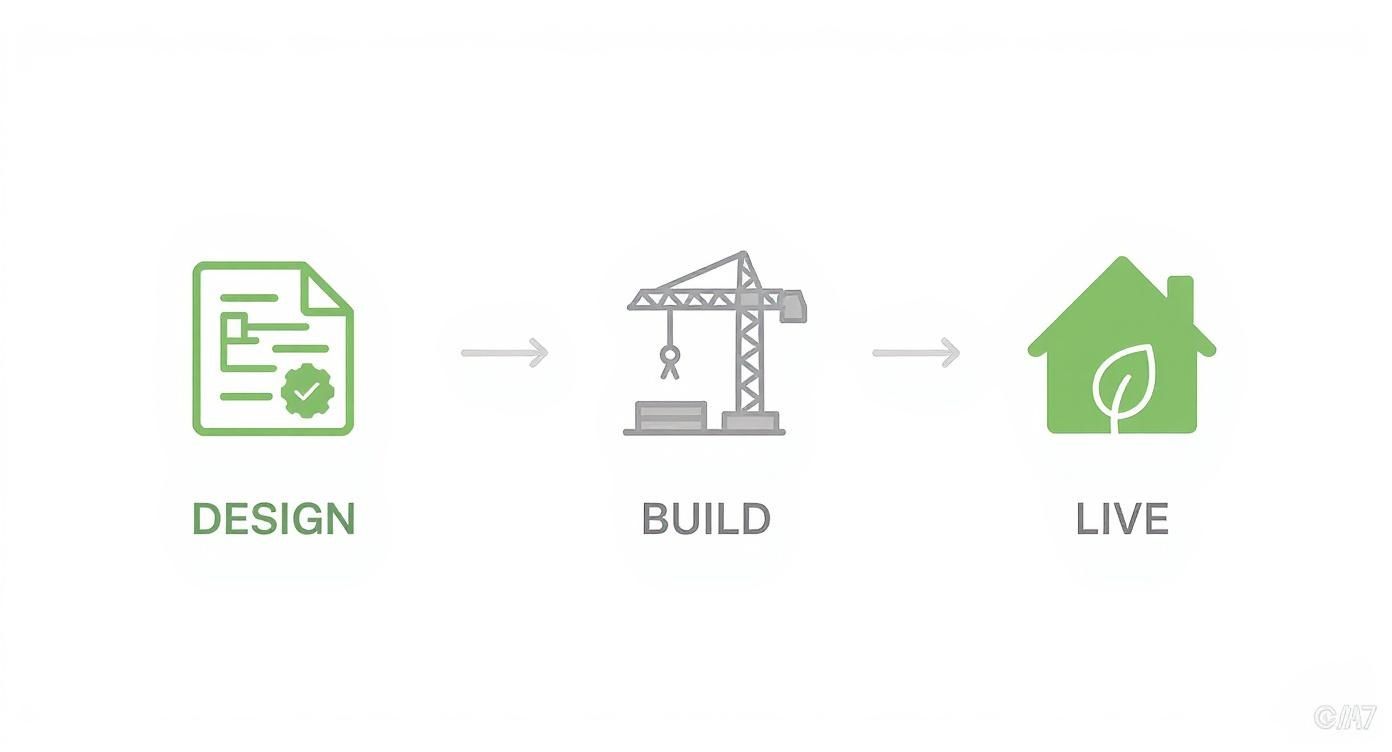
As you can see, success isn’t just about the final build. It’s about weaving efficiency into every single stage, from the earliest blueprints to the final coat of paint.
The Core Pillars of Energy Efficient Construction
At its heart, a high-performance home is built on a few key pillars that all work in concert. These aren't just buzzwords; they are the practical, non-negotiable strategies that form the backbone of a truly efficient build.
The table below summarises these fundamental components.
Pillar | Objective | Key Strategies |
Passive Design | To work with the climate, not against it, using natural elements to heat and cool the home. | Strategic orientation, window placement, shading, and natural ventilation. |
Airtight Envelope | To create a sealed thermal shell that prevents energy loss and maintains stable indoor temperatures. | High-performance insulation, air sealing, and energy-efficient windows and doors. |
Efficient Systems | To actively power the home with minimal energy consumption, supplementing its passive strengths. | High-efficiency HVAC, smart home tech, solar panels, and battery storage. |
Each of these pillars is essential for creating a home that’s not just beautiful, but also incredibly smart, comfortable, and cheap to run.
By focusing on these core areas, you create a home that is more than just a place to live. It becomes a testament to smart design, forward-thinking investment, and a commitment to sustainable living that pays you back every day.
Each of these elements builds upon the last, and the process truly starts from the ground up—by understanding your specific block of land. You can check out our guide on site preparation for construction to see just how much these early steps influence the entire project.
Leveraging Passive Design for Your Property
Some of the biggest wins in your energy efficient house construction happen long before we even think about breaking ground. Better yet, they often cost absolutely nothing to implement.
This is the beauty of passive design—a thoughtful, common-sense approach that uses your home's orientation, layout, and the site's natural features to work with the environment, not against it. It's easily the most cost-effective strategy for creating a home that feels comfortable all year round, without constantly running expensive heating and cooling.
This isn’t just theory; it's a practical, site-specific process. For a property in a temperate climate like Camberwell, a detailed site analysis is our first port of call. We don't just look at the block of land; we analyse the sun's path across it throughout the year, map prevailing wind directions, and account for any existing trees or neighbouring structures that might cast shadows.
This initial analysis dictates the entire layout of your home. It’s all about creating a space that feels naturally warm in winter and refreshingly cool in summer, just by being smart about where everything goes.
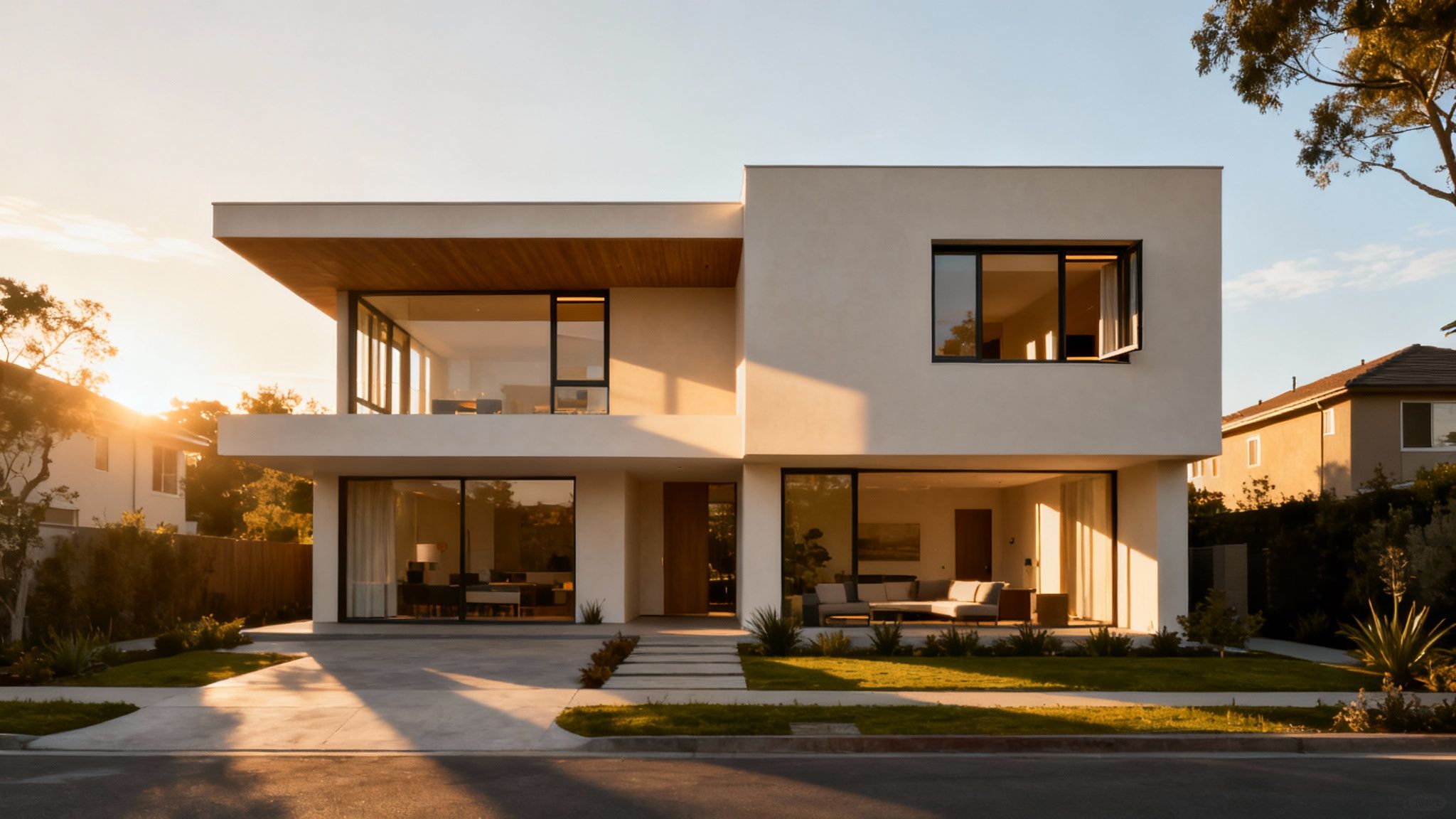
Orienting for Success in Melbourne’s Climate
Here in the southern hemisphere, the sun travels across the northern sky. It sits low on the horizon during winter and high overhead in summer. This simple fact is the cornerstone of effective passive design in Melbourne.
Our main goal is to orient your primary living spaces—the kitchen, living room, and dining area where you spend most of your time—to face north. This allows the low winter sun to stream in through large, strategically placed windows, giving you free, natural heat all day long.
At the same time, we'd typically place less-frequented rooms like bathrooms, laundries, and garages on the southern or western side of the house. These areas can act as a thermal buffer, shielding your main living zones from cold southerly winds or the intense, low-angled afternoon sun that beats down from the west in summer.
The Impact of Strategic Window Placement
Windows are much more than just a view; they are thermal gateways. Their size, placement, and glazing specifications are absolutely critical to a home's passive performance.
- North-Facing Windows: These should be large and plentiful to maximise solar gain in winter. They capture the sun's warmth and light, which means less need for artificial heating and lighting.
- South-Facing Windows: We keep these smaller, as they receive very little direct sunlight and can be a major source of heat loss during the colder months.
- East and West-Facing Windows: These require careful planning. While morning sun from the east can be lovely, the harsh afternoon sun from the west can cause serious overheating in summer. It’s best to minimise windows on the western facade or protect them with effective external shading.
By carefully planning window placement based on orientation, you can create a home that essentially heats and cools itself. It’s a design choice that has zero ongoing cost but delivers massive energy savings for the lifetime of the home.
Shading and Ventilation: Your Natural Thermostat
Once your home is correctly oriented, shading becomes your next go-to tool. Properly sized eaves and awnings aren't just an aesthetic choice; they are a passive thermostat.
They are designed to be just long enough to block the high summer sun from hitting your north-facing windows, preventing the house from overheating. Yet, they're short enough to allow the low winter sun to pass right underneath and warm your home. This simple, fixed architectural feature works automatically, year after year.
Cross-ventilation is the final piece of the puzzle. By placing windows and doors on opposite sides of a room or the house, you can capture prevailing breezes. This creates a natural airflow that can cool the home on a warm evening, purging the heat built up during the day and cutting down your reliance on the air conditioner.
It’s a simple but profoundly effective cooling strategy. To dig deeper into how these elements work together, you can learn more about what passive solar design is in our detailed article.
Building a High-Performance Airtight Envelope
If passive design is the brains of the operation, then the building envelope is the brawn. It’s the hardworking physical shell of your home—the foundation, walls, roof, and windows—all working in perfect unison. For a genuinely energy efficient house construction, getting this shell perfectly sealed and insulated isn't just a nice-to-have; it's non-negotiable.
This is where the real craftsmanship comes into play, separating a standard build from a high-performance one. A well-built envelope is like a premium thermos, keeping your home beautifully warm in winter and refreshingly cool in summer with very little effort from your heating and cooling systems. Constructing an energy-efficient house requires a lot of attention to detail in how each building component is installed and or sealed correctly to give the maximum energy efficiency output. Its success all comes down to a trio of excellence: superior insulation, uncompromising air sealing, and high-quality windows.
Beyond Basic Insulation: A Deeper Look
We all know about insulation, but its true effectiveness goes far beyond just how thick it is. We measure its thermal resistance in R-values—the higher the number, the better it is at stopping heat from moving where you don't want it to. For a climate like Camberwell’s, locking in high R-values for your ceiling, walls, and underfloor is the essential first step.
But here’s the thing: the type of insulation and, even more critically, how it’s installed, changes everything. You can have the best insulation money can buy, but if it’s full of gaps, compressed, or sloppily fitted, it's practically useless. These little imperfections create "thermal bridges," which are like open highways for your expensive conditioned air to escape.
Common Insulation Options Compared:
- Glasswool or Rockwool Batts: This is the cost-effective, go-to choice for many. The batts are designed to fit snugly between wall studs and ceiling joists. The key word here is snugly. A meticulous installer is needed to ensure every piece is cut precisely to fit, leaving no gaps or compressed spots.
- Spray Foam Insulation (SPF): A fantastic product that expands to fill every single crack and crevice. It creates a seamless thermal barrier and an air seal all in one go, making it an excellent choice for tricky rooflines or hard-to-reach spots.
- Structural Insulated Panels (SIPs): These are clever, prefabricated panels made of a rigid foam core sandwiched between two structural boards. Using SIPs allows us to build an incredibly strong, airtight, and well-insulated structure with impressive speed.
The key takeaway isn't just about picking a high R-value off a chart. It’s about ensuring your builder has a rock-solid process for flawless installation. A detail-oriented team will painstakingly cut and fit every piece, guaranteeing a continuous, unbroken thermal blanket around your entire home.
The Critical Role of Air Sealing
Picture your home as a balloon. Even a tiny pinprick will eventually let all the air out. The exact same thing happens with your home's envelope. Uncontrolled air leakage—what we commonly call draughts—can be responsible for up to 25% of a home’s heat loss in winter. That's a huge waste.
This is why a dedicated air sealing strategy is so crucial. It’s a methodical process of using specialised tapes, membranes, and sealants to close every unintentional gap in the building's structure. It all happens during construction and is mostly invisible once the plaster goes on, but the impact it has on your comfort and energy bills is massive.
Key Areas for Meticulous Air Sealing:
- Junctions: Where walls connect to the floor, ceiling, and each other.
- Penetrations: Around every pipe, vent, and electrical wire that goes through a wall or ceiling.
- Window and Door Frames: Properly sealing the gap between the frame and the structural opening.
- Attic Hatches and Recessed Lighting: These are notorious culprits for major, often-overlooked air leaks.
Getting this level of detail right ensures the air you’ve paid to heat or cool stays inside where it belongs. The result is a home with a much more stable indoor temperature and dramatically lower energy bills.
High-Performance Windows: The Final Piece
Windows are easily the most complex part of the building envelope. They need to let in light, provide views, and offer ventilation, all while stopping heat transfer. Old-school, single-pane windows are a massive energy sink in any home, but today’s high-performance windows are genuine marvels of engineering.
The glass is just one part of the story. A truly energy-efficient window is a complete system that combines three critical elements:
- Glazing: Double-glazing (two panes of glass) is the absolute minimum standard for an efficient home, while triple-glazing takes performance to an even higher level. The space between the panes is filled with an inert gas like argon, which is a very poor conductor of heat.
- Low-E Coatings: This is a microscopically thin, transparent layer of metal applied to the glass. A low-emissivity (Low-E) coating is clever—it reflects infrared heat, keeping warmth inside during winter and outside during summer, all without affecting the natural light coming in.
- Thermally Broken Frames: The frame material is just as vital as the glass. Standard aluminium frames conduct heat beautifully, which is exactly what you don't want. Thermally broken aluminium or high-quality uPVC frames have a built-in insulator that creates a barrier, stopping this heat transfer in its tracks and preventing condensation.
Investing in the right windows is one of the single most effective upgrades you can make to your home’s performance. You can dive deeper into selecting the best options in our detailed guide to energy-efficient windows.
Choosing Smart Materials and Renewable Tech
Once you’ve nailed the passive design and have a beautifully sealed building envelope, your home is already primed for incredible performance. The next move in your energy efficient house construction is to choose the materials and active systems that will build on that solid foundation. This is where smart material selections lock in thermal stability and renewable technologies get to work powering your home.
This isn’t about just adding flashy gadgets. It’s about making deliberate choices that seriously improve the comfort, health, and running costs of your home for years to come. From wall systems that naturally regulate temperature to ventilation that brings in fresh air without energy loss, every single element plays a crucial role.
Thermally Efficient Building Materials
The materials forming your home’s structure have a massive impact on its ability to hold a stable indoor temperature. While standard timber framing gets the job done, more advanced systems offer far superior thermal mass and insulation, essentially acting like a climate-control battery for your home.
Two fantastic options we often recommend for a high-performance build are:
- Insulated Concrete Forms (ICFs): Think of these as hollow foam blocks that are stacked, reinforced with steel, and then filled with concrete. What you get is a solid concrete core sandwiched between two continuous layers of high-grade insulation. The result is an incredibly strong, airtight, and exceptionally well-insulated wall system.
- Reverse Brick Veneer: This is a clever twist on traditional construction. The brickwork is placed on the inside of the timber frame, with insulation and lightweight cladding on the outside. This exposes the thermal mass of the bricks to the interior, letting them soak up and slowly release heat. It’s a simple change that keeps indoor temperatures remarkably stable, day and night.
For a deeper dive into your options, check out our guide on sustainable building materials which explores more choices that benefit both your home and the environment.
High-Efficiency Systems for Modern Homes
Even with a brilliant building envelope reducing your reliance on heating and cooling, you’ll still need systems to manage the climate and ensure healthy air. Thankfully, modern tech offers incredibly efficient solutions that use just a fraction of the energy of their older cousins.
An Energy Recovery Ventilation (ERV) system, for instance, is an absolute game-changer for airtight homes. It works quietly in the background, pulling stale air out while bringing fresh, filtered air in. But here's the clever part: before it exhausts the old air, it transfers the heat and moisture to the incoming fresh air. This means you get constant ventilation without throwing away the energy you’ve already used to warm or cool your home.
An ERV system is truly the lungs of a high-performance home. It guarantees superb indoor air quality by reducing allergens and pollutants, all while recovering up to 80% of the energy from the outgoing air.
Tapping into Renewable Energy
The final piece of the puzzle is to generate your own clean power on-site. The push for sustainability in Australia’s residential construction sector is stronger than ever, with builders increasingly incorporating solar to meet both client demand and government incentives. States like Victoria are actively encouraging this shift through policies focused on energy efficiency.
Sizing a solar panel system correctly is vital. For a family in a suburb like Camberwell, we’d start by analysing your expected electricity use, looking at everything from your appliances to your daily habits. The goal is to design a system that not only covers your daily needs but also generates a surplus. That surplus can either be fed back to the grid or, even better, stored for when you need it most.
Adding a battery storage system is what really completes the circle of energy independence. It allows you to store all that excess solar power your panels generate during the day and use it at night or on cloudy days. This one addition drastically cuts your reliance on the grid, protects you from power outages, and maximises the financial return on your solar investment. It effectively turns your home into its own self-sufficient power station.
Understanding the Financial Return on Your Build
Let’s talk money. Does building an energy-efficient home cost more upfront? In most cases, yes. That initial investment typically goes into superior gear like high-performance insulation, triple-glazed windows, and an absolutely meticulous approach to air sealing.
But the real question is: does it pay you back? Absolutely. And faster than you might think.
Thinking of these early expenses as a "cost" is the wrong way to look at it. This is a direct investment in the long-term financial health and performance of your property. We're not just talking about shaving a few dollars off your power bills. This is about creating a higher-quality asset that holds its value, costs far less to run and maintain, and is genuinely more desirable on the property market.
Framing your energy efficient house construction as a smart, wealth-building strategy is the right way to approach it. Let's break down exactly where that return on investment comes from.
Mapping Out Your Long-Term Savings
The most immediate and obvious payback comes from radically lower energy bills. A high-performance home, properly designed for a climate like Camberwell’s, can slash heating and cooling costs by 80% or even more compared to a standard new build.
That translates into thousands of dollars in real savings, year after year, which adds up significantly over the life of your home loan.
But it goes beyond just energy. A well-sealed building envelope protects the home’s structure from moisture and extreme temperatures, meaning far less wear and tear over time. High-quality systems and durable materials simply last longer, which reduces the frequency (and cost) of repairs and replacements down the track.
The Resale Value Premium
This is where the financial argument gets really compelling. Today’s homebuyers are savvier than ever. They’re actively looking for properties that promise lower running costs, better comfort, and a smaller environmental footprint.
This demand has a direct and measurable impact on resale values. The market data is clear: homes with proven green credentials command a significant price premium. Features that are fundamental to an energy-efficient build are now major selling points that buyers are willing to pay more for.
In fact, Australian homes with key energy-efficient attributes command a national average price premium of $118,000, representing a 14.5% higher sale price. For a major city like Melbourne, that premium escalates to 23.8%, or an average of $197,000. You can dig into these findings from the Green Building Council of Australia.
This proves the upfront investment isn't just money spent—it’s equity built. It's retained in the value of your home and often multiplied when it comes time to sell.
Having Confident Financial Conversations
Understanding these numbers means you can walk into conversations with your builder and your lender with confidence. When you can clearly articulate the long-term financial upside, the discussion shifts from being about initial expenses to planning a strategic, high-performance investment.
Key financial benefits to highlight:
- Drastically Lower Bills: Put a number on the potential annual savings on electricity and gas.
- Reduced Maintenance Costs: Talk about the longevity and durability of high-quality components.
- Proven Resale Value: Use the market data to show the significant price premium these homes attract.
- Future-Proofing: An efficient home is your best defence against future energy price hikes and evolving building regulations.
By presenting a clear financial case, you frame the decision not as an indulgence, but as the smartest way to build a valuable, comfortable, and high-performing asset for your future.
Common Questions About Energy-Efficient Homes
Building a high-performance, energy-efficient home is an exciting journey, but it naturally comes with a lot of questions. From costs and timelines to which features really make a difference, clients often want to get into the practical details. It's a process where every choice matters, from how components are installed to the way every single joint is sealed.
Let's dive into some of the most common questions we hear from homeowners we work with in areas like Camberwell.
How Much More Does an Energy-Efficient Build Really Cost?
This is usually the first question on everyone's mind, and it's a fair one. Generally, you can expect an upfront investment of 5% to 10% more than a standard build.
That extra investment goes into higher-quality materials and systems—think superior insulation, high-performance windows, meticulous air-sealing, and sometimes renewable energy setups. But it's crucial to see this as an investment, not just a cost. The long-term savings on your energy bills often provide a full return within 5 to 10 years. On top of that, Australian property data consistently shows these homes fetch a significant price premium when it's time to sell, meaning you can recoup that initial investment and then some.
What Is the Most Important Factor for Efficiency in a Climate like Camberwell?
While it’s true that every element has to work together, the single most powerful factor is passive solar design—specifically, your home's orientation.
This is a decision made right at the design stage. It costs nothing extra, yet it has a massive impact on your home's comfort and running costs for its entire life. In a temperate climate like Camberwell's, orienting living areas to the north is key. This lets you capture free warmth from the low winter sun while using well-designed eaves to block out the harsh, high summer sun. It's a simple, elegant strategy that drastically cuts your need for mechanical heating and cooling, which are by far the biggest energy hogs in any home.
The real magic of an energy-efficient home isn't in one single feature. It's in the synergy of a smart, well-oriented design, a perfectly sealed building envelope, and efficient systems all working together in harmony.
Can I Make My Existing Home More Energy-Efficient?
Absolutely. While nothing beats a blank slate for maximising efficiency, retrofitting an older home can deliver huge improvements in comfort and energy savings. The best place to start is with a professional energy audit to pinpoint exactly where you're losing the most energy. This helps you prioritise upgrades for the best bang for your buck.
Some high-impact retrofits to think about include:
- Upgrading Insulation: This is often the most cost-effective first step. Topping up or replacing ceiling and wall insulation makes a world of difference.
- Professional Draught-Proofing: You'd be amazed how many tiny gaps and cracks add up. A specialist can find and seal these air leaks, which quietly undermine your home's performance.
- Replacing Windows: Swapping out old, single-glazed windows for modern double-glazed units offers an immediate and very noticeable improvement to comfort, quietness, and your energy bills.
- Adding Solar Panels: A solar PV system is a fantastic way to slash your electricity costs and shrink your carbon footprint.
Why Is a NatHERS Rating So Important?
The Nationwide House Energy Rating Scheme (NatHERS) is your home’s energy report card. It gives you a clear, standardised benchmark of its thermal efficiency, scored on a scale from 0 to 10 stars.
A higher star rating means better performance and lower bills for heating and cooling. The National Construction Code (NCC) now requires a minimum of 7 stars in many areas, but we always encourage clients to aim higher. An 8, 9, or even 10-star home is what we consider a true high-performance build.
By making the NatHERS rating a central part of the conversation with your designer and builder from day one, you ensure efficiency is baked into the project's DNA, not just tacked on as an afterthought. It gives everyone a clear goal to work towards and a way to measure the design's success before a single sod is turned.
Ready to build a home that's as smart and high-performing as it is beautiful? The team at Envy Abode specialises in creating bespoke, energy-efficient luxury homes that deliver lasting value and unparalleled comfort. Start the conversation about your project today.